
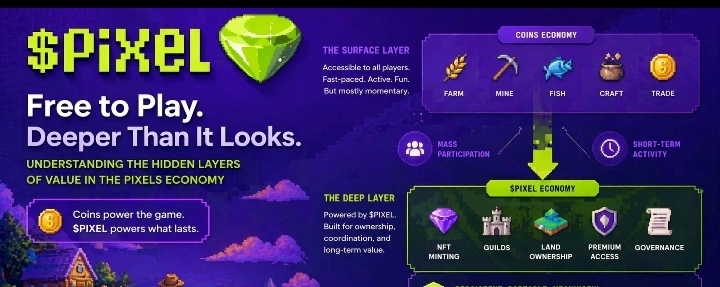
You can spend hours inside the game and never touch $PIXEL. Farming loops work, Coins keep circulating, and nothing forces you out of that rhythm. It feels self-contained. Comfortable, even. But after watching it for a bit, I started getting this slight disconnect. The effort players put in doesn’t always line up with what actually sticks.
And that’s where it gets a bit strange.
Coins handle most of the visible economy. You earn them, spend them, repeat. It’s simple enough. But they don’t really travel. They don’t carry much weight outside the moment they’re used. It’s activity, not memory. I kept thinking about that while looking at where $PIXEL shows up. It’s not everywhere. In fact, it’s surprisingly absent from the parts most players spend their time in.
Then it appears in very specific places. Minting assets. Certain upgrades. Guild-related things. Areas where something persists a bit longer, or connects to something else. It’s not louder, just… positioned differently.
I remember thinking, this isn’t about paying to move faster. It’s closer to choosing where your time actually lands.
That sounds subtle, but it changes how the system behaves. Two players can spend the same number of hours. One stays fully inside the Coin loop, stacking small gains, staying active. The other steps into $PIXEL occasionally, not constantly, just enough to anchor what they’re doing into something that doesn’t reset as easily.
You don’t notice the difference right away. That’s probably the point.
It reminds me a little of how some blockchain systems separate execution from settlement, although that comparison only goes so far. You can have a lot of activity happening, but only some of it gets finalized in a way that matters later. Pixels seems to echo that idea, just in a softer form. Most of the game is execution. The parts tied to Pixel feel closer to settlement.
I didn’t see that at first. Honestly, it just looked like another dual-currency setup. But the more I looked, the less it felt like a typical premium token. It’s not aggressively pushed. You can ignore it for quite a while. Which is unusual, because most systems want you to feel that gap early.
Here, the gap shows up slowly. Almost as a drift.
The tricky part is whether players actually respond to that. Most people don’t think in layers when they’re playing. They react to what’s in front of them. If the difference between Coins and Pixel stays too abstract, then a large portion of the player base might never cross that boundary in a meaningful way.
And if that happens, the token starts floating a bit. It exists, it has utility, but it’s not tightly connected to the majority of behavior inside the game.
There’s also the supply side, which doesn’t really care how elegant the design is. Unlocks happen. Distribution continues. If the parts of the system that use Pixel don’t grow at the same pace, then pressure builds in a different direction. I’ve seen that play out in other ecosystems where the structure made sense, but timing didn’t.
Still, I can’t ignore what’s interesting here.
If Pixels keeps expanding, especially beyond a single game loop, this separation could start to matter more. Coins stay local. They serve the moment. $PIXEL, on the other hand, could start acting like a thread between different parts of the ecosystem. Not just as a currency, but as a way to carry certain outcomes forward.
That’s where it shifts from game economy into something closer to infrastructure, even if it doesn’t look like it yet.
But there’s an uncomfortable edge to that idea too. If most players stay in the visible loop while value quietly accumulates elsewhere, then the system isn’t exactly neutral. It’s selective. Not in an obvious way, not in a paywall sense, but in how it decides what actually lasts.
I’m not sure if that’s intentional or just an emergent effect of the design.
What I do know is that Pixels doesn’t push you to notice this. You can play for a long time without thinking about it at all. And maybe that’s why it works. The system doesn’t interrupt you. It just routes things differently underneath.
From the outside, it still looks like a free economy.
But after sitting with it for a while, it doesn’t feel entirely free. It feels layered. And depending on where you operate inside those layers, the same amount of effort might not mean the same thing at all.
I didn’t really question free-to-play systems for a long time. They usually follow the same script. You come in, things feel open, progress is steady… and somewhere later, a wall appears. Either time slows down or rewards thin out, and then the paid layer starts making sense. It’s not even hidden anymore. Everyone knows the pattern.
Pixels doesn’t feel like that, at least not immediately. That’s what made me pause.#pixel $PIXEL L @Pixels