

I didn’t notice it at first.
The game just felt… balanced. Not perfectly, but enough to keep pulling me back. I’d finish a few tasks, step away, and still feel like something was left unfinished. Not in a frustrating way—more like the system had quietly shifted while I wasn’t looking.
At a glance, @Pixels looks familiar. Farming loops, resource gathering, task boards, and a central token—$PIXEL . Nothing unusual on the surface.
But the longer you stay, the harder it becomes to isolate any single part of it.
Because nothing operates alone.
You start by earning. Time goes in, rewards come out. Simple. But those rewards don’t just sit there—they push you into other systems. Crafting. Upgrades. New layers that weren’t visible at the start.
And that’s when the question forms:
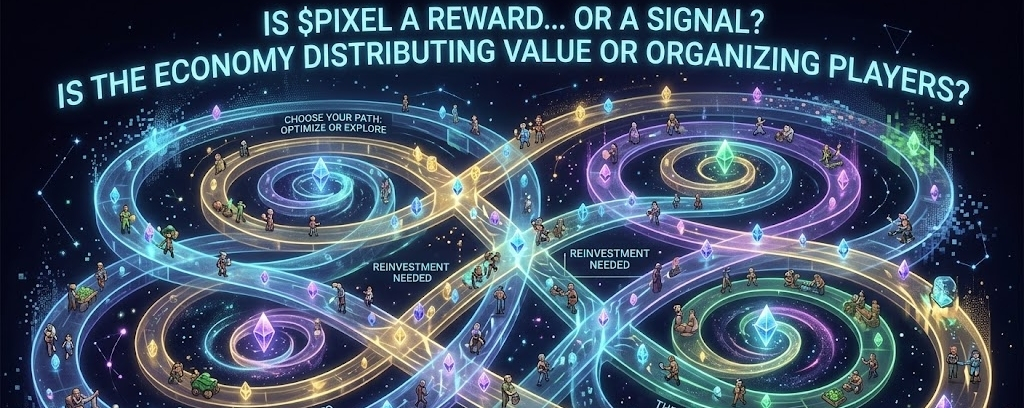
Is $PIXEL really a reward, or is it a signal?
Because the token doesn’t just represent value—it represents movement. It’s constantly being earned, spent, and redirected. And each movement subtly reshapes player behavior.
The economy starts to feel less like a structure and more like a circulation system.
Supply enters through player activity. Demand is created through friction—upgrades, time gates, competition. And sinks are everywhere, though rarely obvious. Small costs. Repeated actions. Incremental spending that feels optional—until it isn’t.
Nothing forces you.
But everything guides you.
And that’s where it becomes interesting.
The system isn’t just managing resources—it’s managing decisions.
Every action carries a trade-off. Spend now or wait. Optimize or explore. Play efficiently or casually. Over time, these decisions compound into patterns—not just economic ones, but behavioral ones.
You begin optimizing without realizing it.
You begin thinking in loops.
And slowly, the game shifts from something you play to something you participate in.
That’s the first real shift.
What looks like a reward loop is also a filtering system.
Players don’t progress equally. Some accumulate. Some circulate. Some exit. The system continuously sorts participants—not through strict rules, but through economic pressure.
Which raises a deeper question:
Is the economy distributing value, or organizing players?
Because those are very different goals.
On one side, this design creates strength. The system doesn’t rely only on new players—it depends on existing players making ongoing decisions. Spending, optimizing, reinvesting. The economy stays alive because players keep engaging with it.
But that same complexity also creates fragility.
If players begin to clearly see the loops, does the illusion break?
If optimization replaces enjoyment, does participation become mechanical?
And if the flow of $PIXEL slows—if circulation weakens—what happens to everything built on top of it?
Because the system depends on motion.
Not just activity, but belief in continued value.
And that belief isn’t enforced. It’s maintained—carefully and quietly.
There’s also a constant tension between short-term extraction and long-term sustainability. Players are always deciding whether to take value out or reinvest it. The system doesn’t stop either choice—it simply adapts.
Which leads to another question:
Is the economy stable because it’s well-designed, or because it hasn’t been fully tested?
Maybe both.
What Pixels has built with PIXEL isn’t just a token economy. It’s a layered interaction between time, incentives, and human behavior. Every mechanic feeds into another, and the real design lies not in what players do—but in why they keep doing it.
And the deeper you look, the harder it becomes to separate intention from emergence.
Is the system guiding players, or are players shaping the system?
Maybe it’s both.
Because in the end, the economy isn’t fixed. It’s a relationship—between players, choices, time, and value.
And like any relationship, it only works as long as both sides continue to engage.
So the real question isn’t whether the PIXEL economy works.
It’s how long it can keep people believing that it does.#pixel