
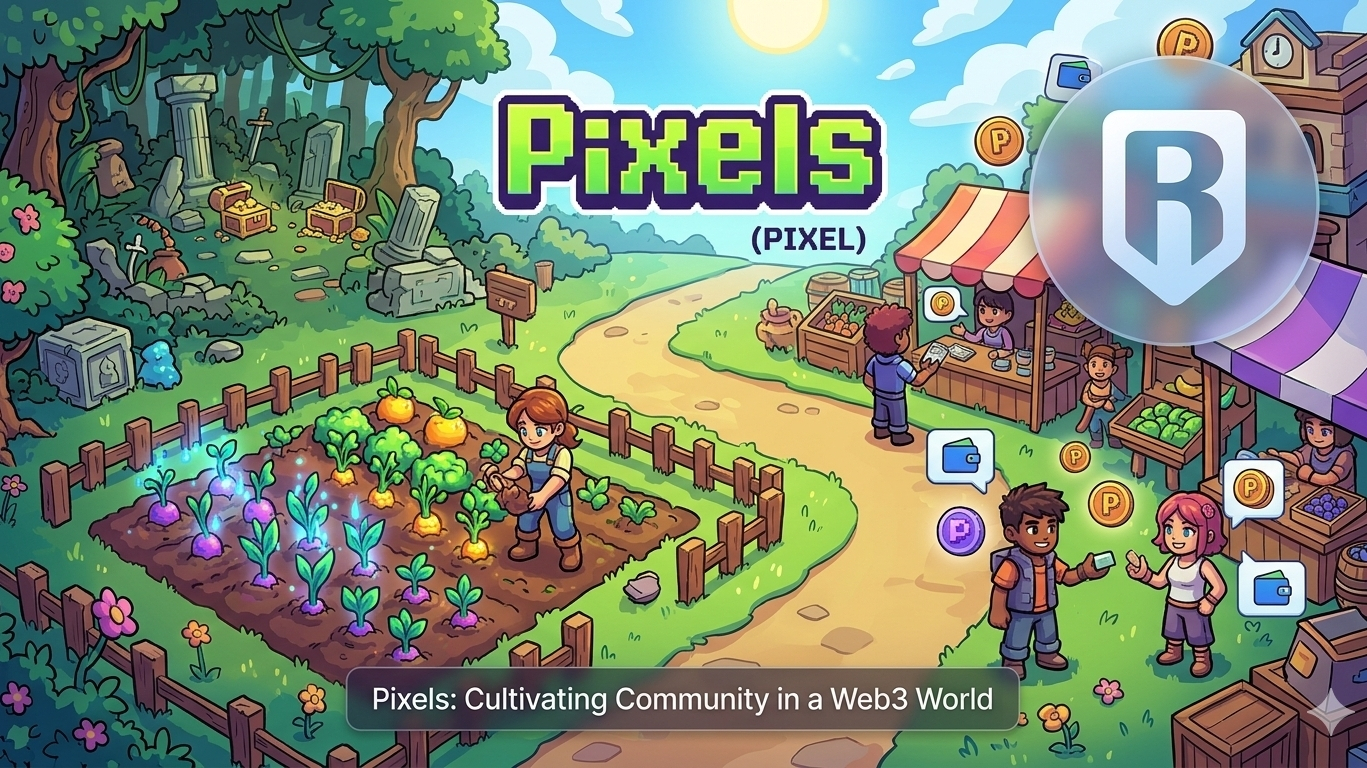
At first glance, @Pixels feels like one of those rare ecosystems where everything just flows. You log in, you play, you earn, you interact—without the heavy friction that usually defines crypto-based environments. It gives off the illusion of openness, almost like value is being created out in the open, accessible to anyone willing to participate. But when I look at it through the lens of Fogo’s philosophy and design thinking, I start to see something deeper—something quieter.
Because in systems like this, what feels free is often being carefully structured beneath the surface.
Fogo, as I understand and interpret it, isn’t about obvious extraction or aggressive token pressure. It’s about subtle architecture—where value doesn’t disappear, it shifts. It flows through layers that aren’t immediately visible to the average participant. And that’s exactly where the interesting conversation around $PIXEL begins.
Pixels gives users the sense that they are operating in a low-cost, almost “free-to-play” economic loop. Actions are simple. Rewards seem frequent. Barriers are minimal. But in Fogo-style thinking, simplicity on the surface often means complexity underneath. The question isn’t whether value exists—it’s where it’s being routed.
In traditional crypto economies, we often talk about sinks and faucets. Faucets distribute value; sinks absorb it. In a healthy system, they balance each other. But Fogo introduces a more nuanced layer to this concept. Instead of obvious sinks, it suggests the possibility of hidden sinks—mechanisms that don’t feel like costs but still redirect value.In the case of $PIXEL, this could mean that while users feel like they are earning freely, the real economic movement is happening in layers they don’t directly perceive. Whether it’s through asset upgrades, time investment, or ecosystem dependencies, value might not be leaving the system—it might just be moving upward, inward,or into more controlled channels.And that’s not necessarily a bad thing.In fact, from a Fogo perspective, this kind of design can be incredibly powerful. It creates sustainability without triggering resistance. Users don’t feel drained, so they stay engaged. They continue to participate, to build, to invest their time and attention. Meanwhile, the system quietly organizes and redistributes value in a way that maintains long-term balance.But there’s a trade-off.When value flows through hidden layers, transparency becomes limited. Users may not fully understand how their actions contribute to the broader economy. They see their rewards, but they don’t always see the counterbalance. And in crypto—where trust is often tied to visibility—that can create a subtle tension.Fogo doesn’t reject this tension. It leans into it.From my point of view, Fogo is less about making everything visible and more about making everything coherent. It’s okay if users don’t see every mechanism, as long as the system behaves in a way that feels fair over time. The challenge is ensuring that this coherence holds, especially as the ecosystem grows and evolves.With $PIXEL, the risk isn’t that value is being extracted—it’s that users might not recognize where it’s going. And when people can’t trace value, they start to question it. Not immediately, but gradually. It shows up as uncertainty, as hesitation, as a shift in behavior.That’s why the idea of “hidden layers” is so important.These layers aren’t just technical—they’re psychological. They shape how users perceive the system, how they interact with it, and how long they choose to stay. If designed well, they create a sense of effortless participation. If not, they can lead to disconnect.From a Fogo standpoint, the goal isn’t to eliminate these layers but to refine them. To make them efficient, balanced, and aligned with user incentives—even if they’re not fully visible. It’s about creating an ecosystem where value movement feels natural, not forced.And this is where Pixels becomes a fascinating case study.Because it sits at the intersection of play and economics, simplicity and structure, openness and control. It invites users in with a sense of freedom, but it sustains itself through deeper mechanisms that aren’t immediately obvious.In my view, that’s not a contradiction—it’s a strategy.The real question is whether this strategy can hold over time. Can $PIXEL continue to move value through hidden layers without breaking user trust? Can it maintain the feeling of “free” while ensuring the system remains economically sound?Fogo suggests that it’s possible—but only if the balance is constantly maintained.Because in the end, no system is truly free. Value always moves. The only difference is whether we can see it.And right now, with Pixels, it feels like we’re only seeing the surface.
