
Most games take your time and give you nothing back.
That’s not a hot take. That’s the business model.
You grind for hours, stack digital items, maybe feel a sense of progress—and then you move on. New game. New grind. Old progress? Gone. Locked in someone else’s system.
I’ve watched this loop repeat for over a decade. Studios tweak the formula, dress it up with better graphics or battle passes, but the underlying deal never changes: you don’t own what you earn.
Then something like Pixels shows up, running on the Ronin Network, and suddenly the pitch flips.
Own your assets. Trade them. Build something that lasts.
Sounds familiar, right?
Yeah. Because we’ve heard it before—and it usually ends badly.
Pixels doesn’t scream for attention. That’s the first thing you notice.
No aggressive promises. No “financial freedom” nonsense plastered everywhere. It looks like a soft, pixelated farming game. Calm. Almost boring at a glance.
That’s intentional.
Because underneath that cozy surface is a system doing something far more ambitious—and far more fragile.
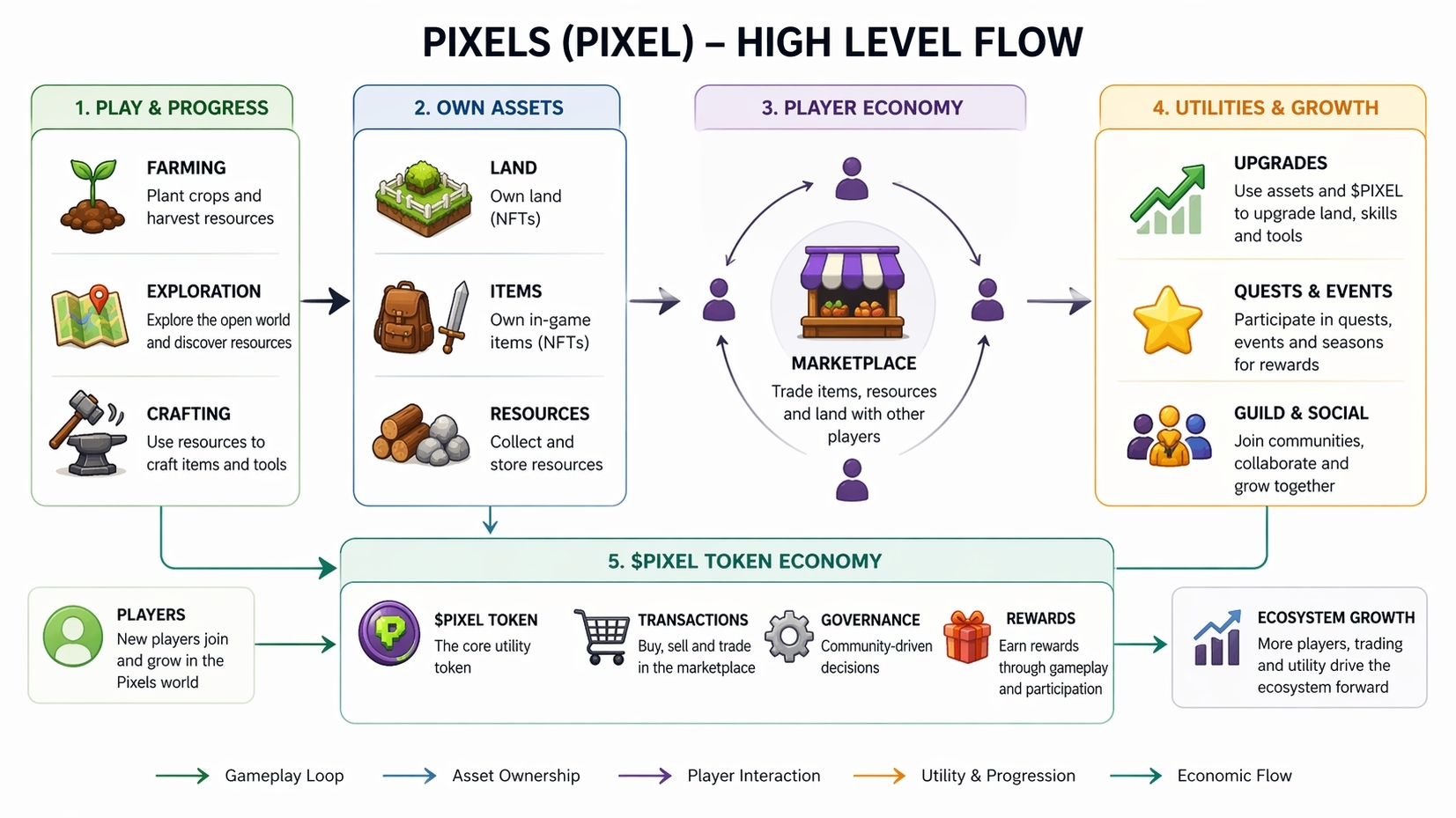
You plant crops. You harvest them. You craft items or sell them. Simple loop.
Almost too simple.
But here’s the catch.
Those resources don’t disappear into a game engine. They move. Between players. Through a marketplace that isn’t entirely controlled by the developers.
And suddenly, you’re not just playing.
You’re participating.
I’ve seen this pattern before. Early Web3 games tried to brute-force economies into existence. Tokens everywhere. Rewards for everything. It worked—until it didn’t.
Inflation kicked in. Prices collapsed. Players bailed.
What was left? Empty worlds and worthless assets.
Pixels takes a different route. Slower. More controlled. Less hype.
The real kicker is this: it tries to make the game fun before it makes it profitable.
That shouldn’t be groundbreaking. But in this space, it is.
Spend a few hours in Pixels and something odd happens.
You stop thinking like a player.
You start thinking like a participant in a system.
You notice which crops sell faster. Which items are scarce. Which players are consistently buying. It’s subtle, but it pulls you in.
I’ve watched players turn into specialists without being told to.
One focuses purely on farming high-yield crops. Another becomes a trader, flipping goods between markets. Someone else builds a reputation crafting tools others rely on.
No assigned roles. No rigid classes.
Just behavior emerging from incentives.
Messy. Human. Real.
Now, let’s talk about the part nobody likes to dig into: the token.
$PIXEL isn’t just a side feature. It’s embedded deep into the system—transactions, upgrades, rewards. Everything flows through it.
That’s power.
It’s also a risk.
Token economies have a bad habit of collapsing under their own weight. Too many rewards, and you get inflation. Too little, and players lose interest. It’s a balancing act that’s closer to economics than game design.
And if you’ve followed this space, you know how often that balance breaks.
Pixels hasn’t cracked the code. Not yet.
But it hasn’t blown up either. Which, frankly, already puts it ahead of most.
Ownership is the headline feature everyone talks about.
You own your land. Your items. Your resources.
That’s true—technically.
But that’s only half the story.
Ownership doesn’t guarantee value. It just means the risk is yours now. If demand drops, your assets lose relevance. If the player base shrinks, liquidity dries up. If developers tweak the system—and they will—the entire economy shifts.
I’ve seen players learn this the hard way.
Ownership isn’t safety.
It’s exposure.
Where Pixels actually earns its respect is in the details.
It’s accessible. You don’t need to wrestle with wallets and jargon for hours before you can play. That alone removes a huge barrier that killed earlier projects.
The social layer isn’t fake either. You rely on other players. You trade, negotiate, sometimes compete in ways that feel organic rather than scripted.
And the infrastructure—being on Ronin—matters more than people think. Faster transactions. Lower friction. Fewer moments where the tech gets in the way of the experience.
Sounds boring.
It’s not.
That’s the stuff that keeps systems alive.
But let’s not pretend it’s all smooth.
Time commitment creeps up on you. Miss a few cycles, and suddenly you’re behind. The game doesn’t punish you directly—it just lets the economy move on without you.
Early players have a head start. They always do. They’ve already positioned themselves in the market, built networks, accumulated assets.
Then there’s the external noise.
Regulatory pressure. Market swings. Developer decisions behind closed doors. Corporate ego. Funding constraints. All the usual suspects that quietly shape outcomes while players focus on gameplay.
None of this is unique to Pixels.
But it’s always there.
The mistakes? Same ones, over and over.
Players jump in expecting easy money. They ignore supply and demand. They overextend too quickly. And when the system corrects itself—as it always does—they’re caught off guard.
Here’s what most people miss.
The players who do well aren’t grinding the hardest.
They’re paying attention.
They watch patterns. They adapt. They treat the game less like a slot machine and more like a living system.
If I were starting today, I wouldn’t rush.
I’d start small. Observe. Figure out what actually moves in the market. Build relationships early—because the social layer is where a lot of the leverage sits.
And I’d keep one rule in mind the entire time:
Don’t get attached to the token.
That’s where people lose perspective.
So, is Pixels worth your time?
Depends what you’re expecting.
If you want a relaxing farming game with a social twist—you’ll find it.
If you’re curious about digital ownership and player-driven economies—this is one of the cleaner experiments out there.
If you’re chasing guaranteed returns?
You’re going to be disappointed.
The bottom line?
Pixels works because it doesn’t try to oversell itself.
It builds quietly. Lets players shape the experience. Keeps the system just stable enough to function without pretending it’s bulletproof.
I’ve seen louder projects with bigger promises collapse in months.
Pixels is still here.
Not because it’s perfect.
Because, so far, it’s been careful.
And in this space, careful might be the only real advantage that lasts.
