
There’s a familiar kind of frustration in the real world: you work harder, put in more hours, do everything “right”—and still, someone else captures most of the upside. Not because they worked more, but because they understood the system better. Or worse, because they helped design it.
That’s the lens you need to look through when you open Pixels.
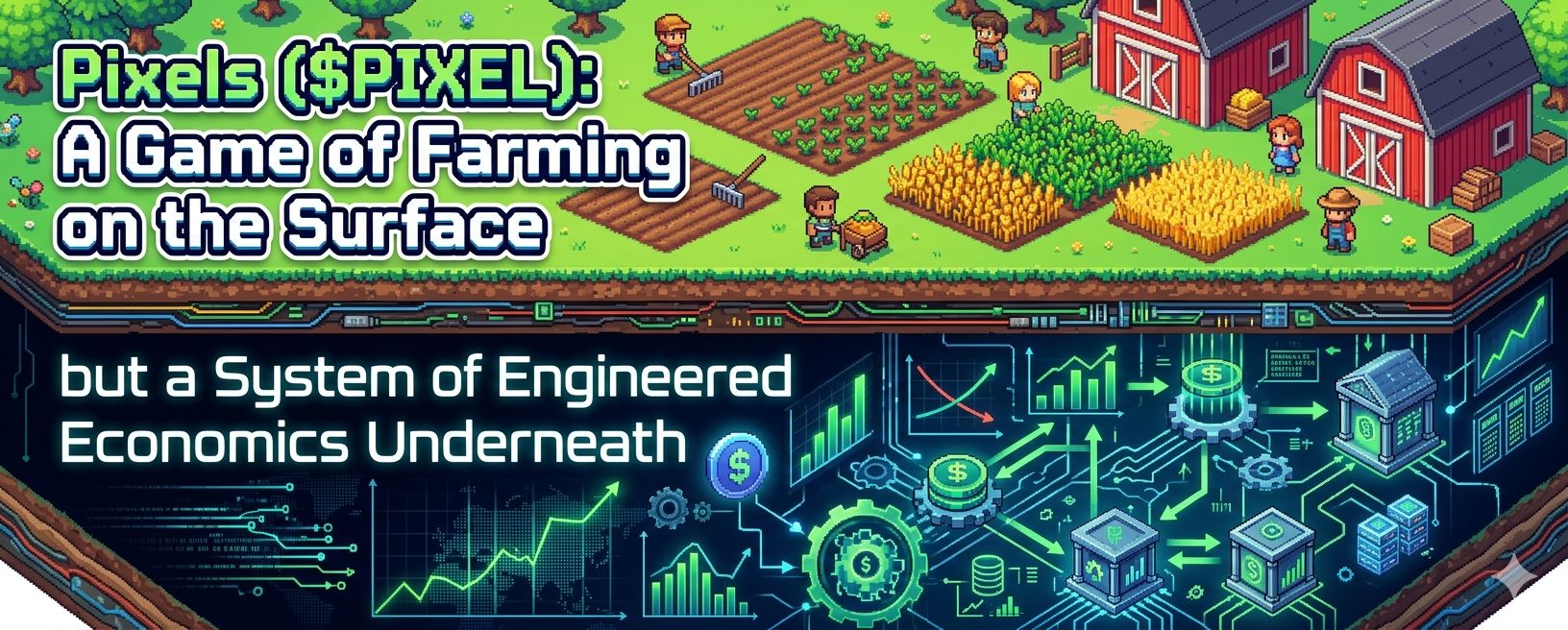
On the surface, it’s a farming and crafting game. Underneath, it’s a controlled economic environment where effort, capital, and design collide—and not on equal terms.
The System Beneath the Game
Pixels isn’t just a game loop—it’s a labor market wrapped in nostalgia.
Players contribute time, attention, and repetition. That’s labor. In return, they earn PIXEL or assets tied to it. That’s compensation.
But unlike a free market, the rules here are not emergent—they are designed.
Developers act as central planners. They decide:
How much PIXEL enters the system
What actions generate rewards
Where tokens must be spent
When balance changes occur
So what you’re interacting with isn’t a decentralized economy—it’s a semi-controlled economy with player participation.
The key relationship is simple: Players produce → System distributes → Developers regulate
And regulation is everything.
Tokenomics: Where the Real Game Happens
At its core, PIXEL follows a familiar Web3 gaming structure—but the nuance is in the balance.
Emission (Supply Inflow)
New PIXEL enters primarily through gameplay rewards. Farming, crafting, quests—these are essentially emission channels. The more active the player base, the higher the token output.
But here’s the catch: emissions scale with engagement. If player growth spikes, supply pressure increases immediately.
Burn Mechanisms (Supply Outflow)
PIXEL exits the system through:
Upgrades (tools, efficiency boosts)
Land-related activities
Crafting sinks
Competitive or gated features
These are not optional—they’re designed friction points.
Net Supply Dynamics
The system constantly walks a tightrope:
Too much emission → inflation → token price pressure
Too much burn → player fatigue → reduced activity
In most current Web3 gaming environments, including Pixels, the bias leans slightly toward inflation during growth phases—because onboarding new players matters more than preserving token scarcity early on.
Demand: Real or Engineered?
Demand for PIXEL doesn’t come from speculation alone—it’s embedded into gameplay.
You need the token to:
Progress faster
Unlock efficiency
Compete at higher levels
Extract more value long-term
But this demand is not purely organic. It’s designed.
The game creates problems—and then sells you the solution in PIXEL.
That doesn’t make it fake. It makes it controlled.
The real question is:
Does demand persist when incentives slow down?
If players stop needing to spend to stay competitive, demand weakens fast. That’s the pressure point every Web3 game faces.
The Rules You See—and the Ones You Don’t
Every system has visible rules. Pixels also has invisible ones.
What the system rewards:
Consistency over bursts
Asset ownership (land, upgraded tools)
Early positioning
What it ignores:
Late effort without capital
Players who don’t reinvest
Passive participants
This creates a structural imbalance.
Early players compound faster because:
They accumulate assets cheaper
They face less competition
They benefit from early emission phases
Late players enter a saturated environment where:
Rewards are diluted
Costs are higher
Efficiency gaps are already established
It’s not unfair—it’s just how designed economies behave.
From a Trader’s Lens
If you strip away the game layer, Pixels becomes easier to read.
Bullish Signals:
Rising daily active users (DAU) without proportional emission spikes
Increasing burn-to-emission ratio
Strong retention (players staying beyond initial rewards phase)
Expansion of sinks (new reasons to spend PIXEL)
Bearish Signals:
Rapid token inflation during user growth
Declining engagement after reward adjustments
Over-reliance on new player inflow
Weak secondary demand outside core gameplay
Key Metrics That Actually Matter:
DAU vs token emission per user
Burn rate consistency
Retention curves (Day 7, Day 30)
Asset concentration (who owns land/resources)
Price alone tells you nothing without these.
The Economic Cycle (It Repeats)
Pixels, like most Web3 games, moves in cycles:
Hype → Extraction → Stabilization → Decline/Reset
Hype brings players and capital
Early participants extract value
System stabilizes as emissions and burns balance
Interest fades → rewards shrink → reset begins
The mistake traders make is thinking the first cycle is the final one.
It never is.
Reflexivity: The Loop That Feeds Itself
Pixels operates on a reflexive loop:
Rising token price → attracts players → increases activity → boosts demand → supports price
But the reverse is also true:
Falling price → reduces incentive → lowers activity → weakens demand → accelerates decline
This loop is fragile.
Sustainability depends on whether the system can maintain engagement without relying on price appreciation.
Most can’t.
The Uncomfortable Reality
Pixels is not a fair system. It’s an optimized one.
Rewards are not distributed based on effort alone—they’re shaped by:
Entry timing
Asset ownership
Understanding of system mechanics
Developers don’t remove control—they manage it carefully.
Decentralization here is gradual, selective, and often cosmetic in early phases.
Where Pixels Stands Now (Realistic Current View)
Based on current Web3 gaming behavior:
Players are more extraction-focused than ever
Loyalty is low unless progression feels meaningful
Token economies are under constant sell pressure
Pixels appears to be evolving toward deeper sinks and slower emissions—an attempt to extend lifecycle rather than maximize short-term hype.
That’s a positive sign.
But the core challenge remains unchanged: Can the system create value faster than players extract it?
Final Thought
Pixels isn’t a game you play—it’s a system you either understand… or slowly get outperformed by.
