
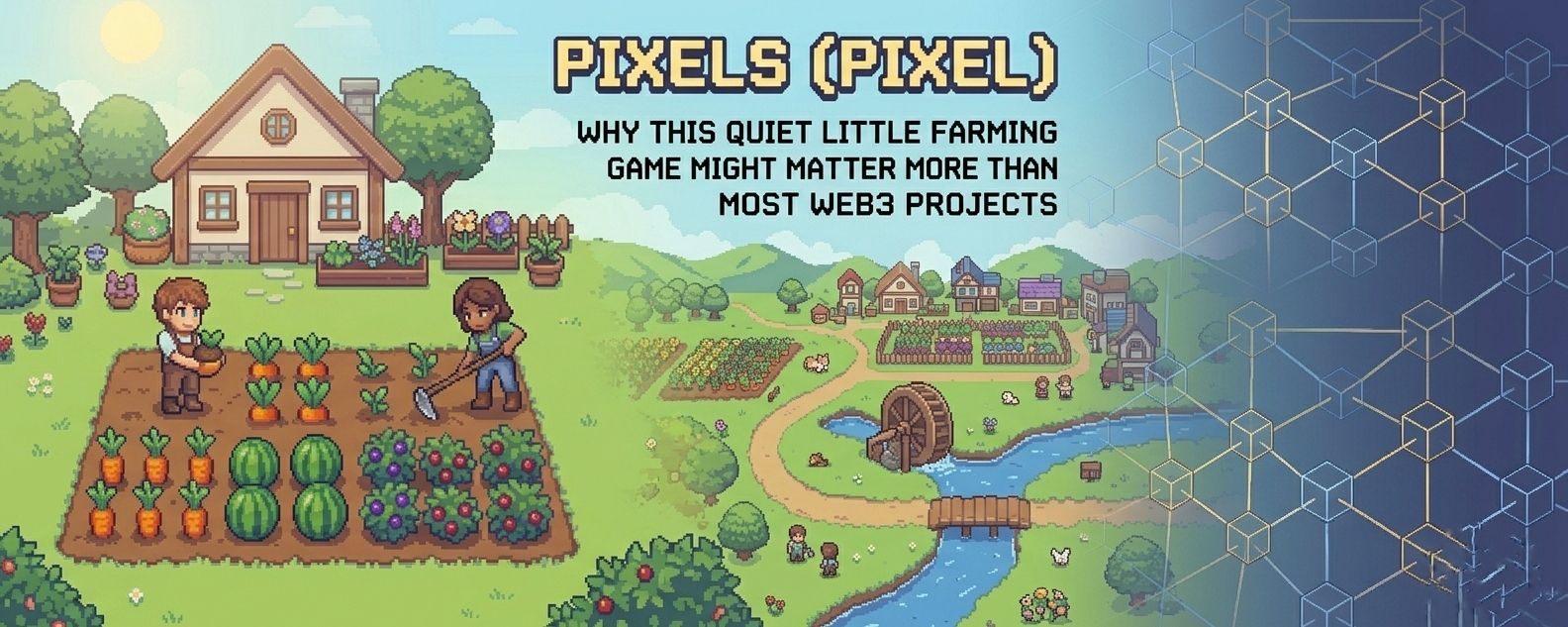

(PIXEL) isn’t the loudest project in Web3 gaming—and that might be exactly why it deserves attention. While many blockchain games lean heavily on hype, complex tokenomics, or unsustainable reward systems, Pixels takes a noticeably different path. It focuses on simplicity, accessibility, and long-term player engagement rather than short-term speculation.
At its core, Pixels is a social farming MMO built on the , the same ecosystem that helped scale Web3 gaming through titles like . This foundation gives Pixels a technical advantage, offering low transaction costs and smoother gameplay compared to many other blockchain-based games. But technology alone isn’t what makes Pixels stand out—it’s the design philosophy behind it.
Unlike many Web3 games that prioritize earning over gameplay, Pixels leans into familiar mechanics. Farming, resource gathering, crafting, and social interaction form the backbone of the experience. These are not revolutionary features, but they are proven ones. Players don’t need to learn complicated systems or understand blockchain mechanics to get started. Instead, they can simply play, progress, and gradually discover the deeper layers of the game.
The introduction of the PIXEL token adds an economic layer, but it doesn’t dominate the experience. This is a critical distinction. In many play-to-earn models, gameplay becomes secondary to farming rewards, leading to inflation, botting, and eventual collapse. Pixels attempts to avoid this by tying rewards more closely to meaningful in-game activity and progression. The result is a system that feels more like “play-and-earn” rather than “play-only-to-earn.”
Another factor that makes Pixels noteworthy is its approach to sustainability. The team has been actively refining its economy, introducing mechanisms like energy systems, crafting requirements, and resource sinks to balance supply and demand. These changes may slow down short-term earnings, but they help create a healthier long-term environment. In a space where many projects fail due to poor economic design, this kind of iterative improvement is a positive sign.
Land ownership and NFTs also play a role, but again, Pixels keeps things grounded. Owning land provides advantages such as better resource generation or customization options, but it doesn’t completely lock free players out of the experience. This balance is important because it allows new users to join without a large upfront investment, while still giving value to those who choose to invest more deeply.
Community is another area where Pixels quietly excels. Because the gameplay is social and cooperative, players naturally interact, trade, and build connections. This organic engagement is far more valuable than artificial incentives because it creates retention. People don’t just stay for rewards—they stay because they enjoy the experience and the community around it.
Of course, Pixels is not without its limitations. The graphics are simple, the gameplay loop can feel repetitive, and it lacks the high production value of traditional AAA games. But expecting a Web3 farming MMO to compete directly with major studio titles misses the point. Pixels isn’t trying to be the next blockbuster—it’s trying to be consistent, scalable, and sustainable.
And that’s where its real potential lies. In Web3, survival is often more important than rapid growth. Many projects launch with massive attention only to fade within months. Pixels, on the other hand, is building steadily, improving incrementally, and focusing on fundamentals. It may not dominate headlines, but it continues to grow its user base and refine its systems.
In the bigger picture, Pixels represents a shift in how Web3 games can succeed. Instead of chasing innovation for its own sake, it proves that execution matters more. A simple game with a functional economy and an engaged community can outperform more ambitious projects that fail to deliver on their promises.
So while Pixels may look like just another farming game on the surface, it could end up being something more important—a proof that Web3 gaming doesn’t need to be revolutionary to be viable. It just needs to be real enough, balanced enough, and engaging enough to keep players coming back.
