
I’ve been spending quite some time exploring PIXEL and honestly, the more I dig into it, the more I realize this project is not just another farming game. What started as a simple and addictive Web3 farming experience is now evolving into something much bigger — a full ecosystem built around data, incentives, and sustainable growth.
At first glance, Pixels looks like a “fun-first” game — and that’s important. Most GameFi projects fail because they forget that if the game isn’t enjoyable, no reward system can save it. Pixels clearly understands this. The gameplay loop, progression system, and social elements are designed to keep players engaged naturally, not just through rewards.
But where things get really interesting is behind the scenes.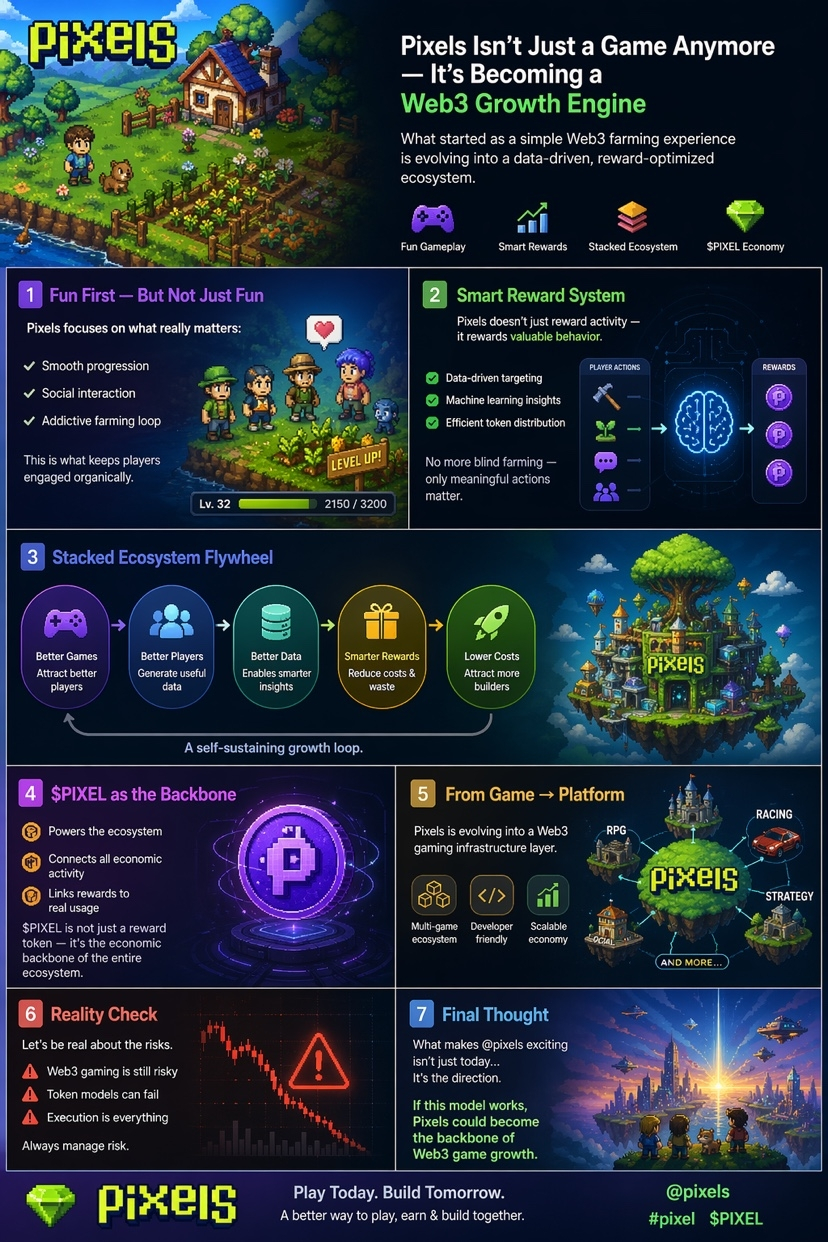
🎯 Smart Rewards > Blind Farming
Unlike traditional play-to-earn models where users farm tokens and dump them, Pixels is taking a more calculated approach. Their system uses data and behavioral tracking to reward meaningful player activity, not just repetitive grinding.
This changes everything.
Instead of rewarding everyone equally, the ecosystem:
Identifies valuable player actions
Targets rewards more efficiently
Reduces unnecessary token emissions
In simple terms: not all players are treated the same — and that’s actually a good thing for sustainability.
🔁 The “Stacked” Ecosystem Flywheel
What really caught my attention is how Pixels is building what I’d call a Stacked ecosystem — where each layer strengthens the next.
Here’s how I see it:
More engaging games → bring in better players
Better players → generate high-quality data
Better data → improves reward targeting
Efficient rewards → lower user acquisition costs
Lower costs → attract more developers
And the cycle continues.
This isn’t just game design — this is platform thinking.
💡 From Game to Infrastructure
In my opinion, Pixels is slowly transitioning from:
“a Web3 farming game”
to
“a growth infrastructure layer for Web3 games”
With:
$PIXEL as the economic backbone
Data-driven reward systems
Developer-friendly integrations
It feels like they’re trying to solve one of the biggest problems in Web3 gaming: retention + sustainability
⚖️ My Honest Take
I like the direction. It’s practical, data-driven, and doesn’t rely purely on hype. The idea of aligning incentives using real player behavior instead of just emissions is something GameFi has needed for a long time.
That said, risks are still there — like any Web3 project. Execution will matter more than vision.
👀 Final Thought
Projects like @Pixels are interesting not because of what they are today — but because of what they’re trying to become.
If they successfully build this feedback loop between players, data, and rewards, Pixels could end up being more than just a game — it could become a core layer for the next generation of #Web3 gaming.