
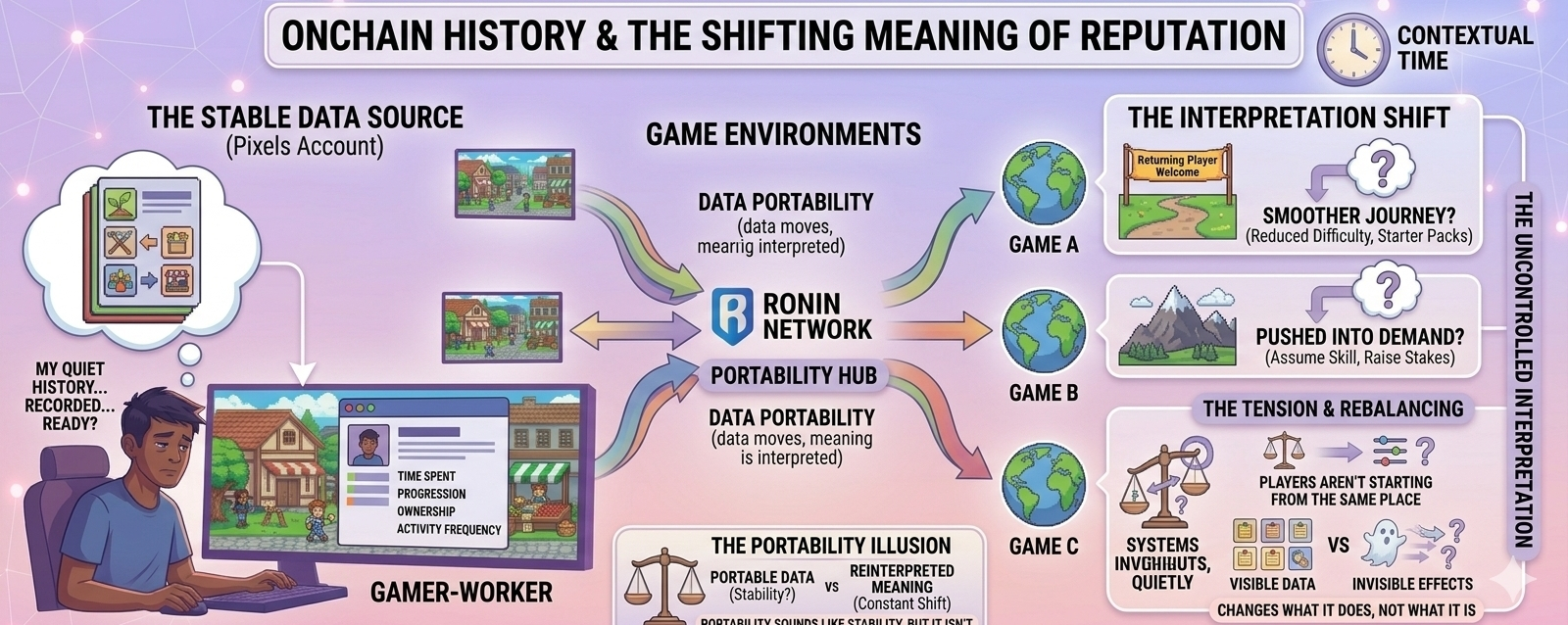
I was walking back home one evening, phone in hand, half-distracted, opening Pixels just to check on things. Nothing serious—just the usual habit. Harvest a bit, look around, maybe fix something on the land.
I wasn’t even thinking about progress.
Then a thought came out of nowhere, the kind that doesn’t leave quickly: all of this… comes with me, right?
At first, the answer feels obvious. Of course it does.
That’s what everyone says. One account. One history. Everything connected across the ecosystem. You don’t lose what you’ve built—you carry it forward.
It sounds simple. Almost reassuring.
But the more I thought about it, the less simple it felt.
Because yes, the data moves with you.
But what that data actually means… that doesn’t move in the same way.
I’ve spent enough time in Pixels to build up a kind of quiet history. Not something I actively track, but it’s there—how I play, what I own, how often I show up, how I spend, how I progress.
It all adds up.
And technically, none of that disappears. It sits there, recorded, ready to be used somewhere else.
But the moment you step into another game, something subtle happens.
That new system doesn’t just read your history—it interprets it.
And that interpretation isn’t fixed.
That’s where things start to shift.
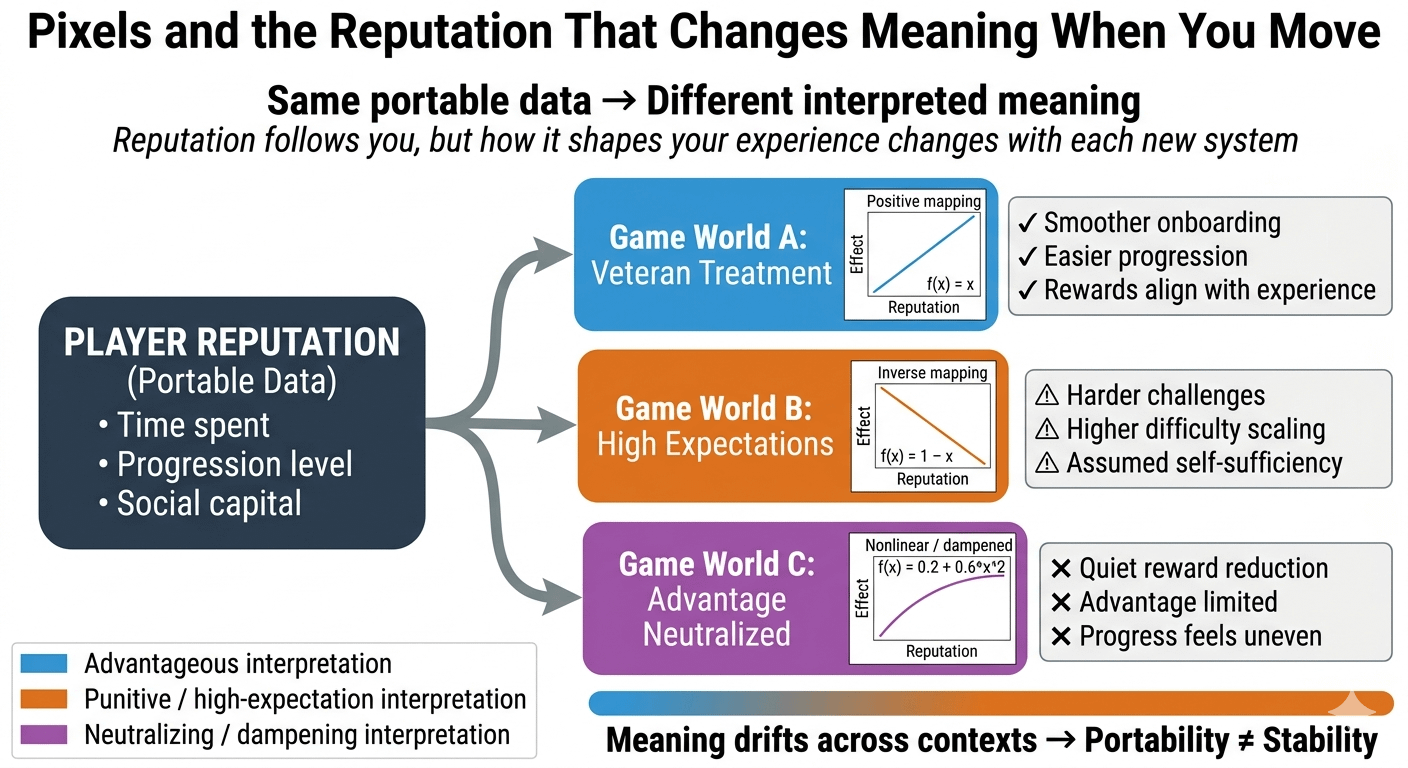
Take something like time spent or progression level. In Pixels, it just feels like experience. You’ve been around, you know how things work, you’ve built something.
But somewhere else, that same signal might be read differently.
One game might treat you like a returning player and make things smoother, easier to get into.
Another might assume you don’t need help and push you into a more demanding environment right away.
And in systems that adjust things quietly—difficulty, rewards, pricing—you might not even realize what’s happening. It just feels like the game behaves differently around you.
Not better. Not worse.
Just… different.
And the strange part is, you don’t get told any of this.
There’s no message saying, “your past activity is shaping your experience here.” No clear explanation of why things feel the way they do.
You just notice small differences.
Maybe things feel slightly harder than expected.
Maybe rewards don’t match what you thought they would be.
Maybe progression feels uneven compared to someone starting fresh.
And you can’t quite point to why.
That’s because the meaning of your history isn’t something you control.
It’s something each system decides on its own.
And none of those decisions are necessarily wrong.
That’s what makes it hard to see clearly.
Because everything still works. Nothing breaks. There’s no obvious issue.
But underneath, your past is being translated in different ways, depending on where you are.
Over time, that creates a kind of tension.
Not something loud or obvious—just a quiet imbalance.
Because players aren’t really starting from the same place anymore. But those differences aren’t visible. They’re not labeled or explained.
So when things feel off, the system adjusts.
Maybe it tones down certain advantages. Maybe it changes how progression works. Maybe it limits how much your past actually affects the present.
From the outside, it just looks like normal updates. Balancing changes.
But underneath, something deeper is shifting.
The value of your reputation is being redefined.
Not all at once. Not in a way you can track.
But slowly, across different systems, different games, different decisions.
And here’s where it gets interesting.
The more connections there are—the more games that read and react to your history—the less stable that meaning becomes.
What helped you in one place might not help you in another.
What gave you an advantage before might get reduced later.
What felt important once might stop mattering entirely.
And you won’t always know when or why that happens.
Because the system doesn’t change what your reputation is.
It changes what it does.
That’s a big difference.
At some point, I stopped thinking about cross-game reputation as something fixed. It’s not like a profile that means the same thing everywhere.
It feels more like a signal that keeps getting reinterpreted.
Adjusted depending on context.
Shaped by different goals.
Used in ways you don’t always see.
In one place, it opens doors.
In another, it raises expectations.
Sometimes, it quietly works against you without making it obvious.
And all of that happens without changing the surface idea: your progress carries over.
Which is true.
But incomplete.
Because carrying data is one thing.
Carrying meaning is something else entirely.
By the time I got home that evening, I wasn’t really thinking about rewards or progress anymore.
I was thinking about how something can follow you everywhere—and still feel different every time you arrive somewhere new.
Not broken. Not misleading.
Just… constantly shifting.
And maybe that’s the part people don’t really talk about.
Portability sounds like stability.
But it isn’t.
It just means nothing gets left behind.