
I usually get nervous when a crypto game starts winning too fast.
Not because growth is bad.
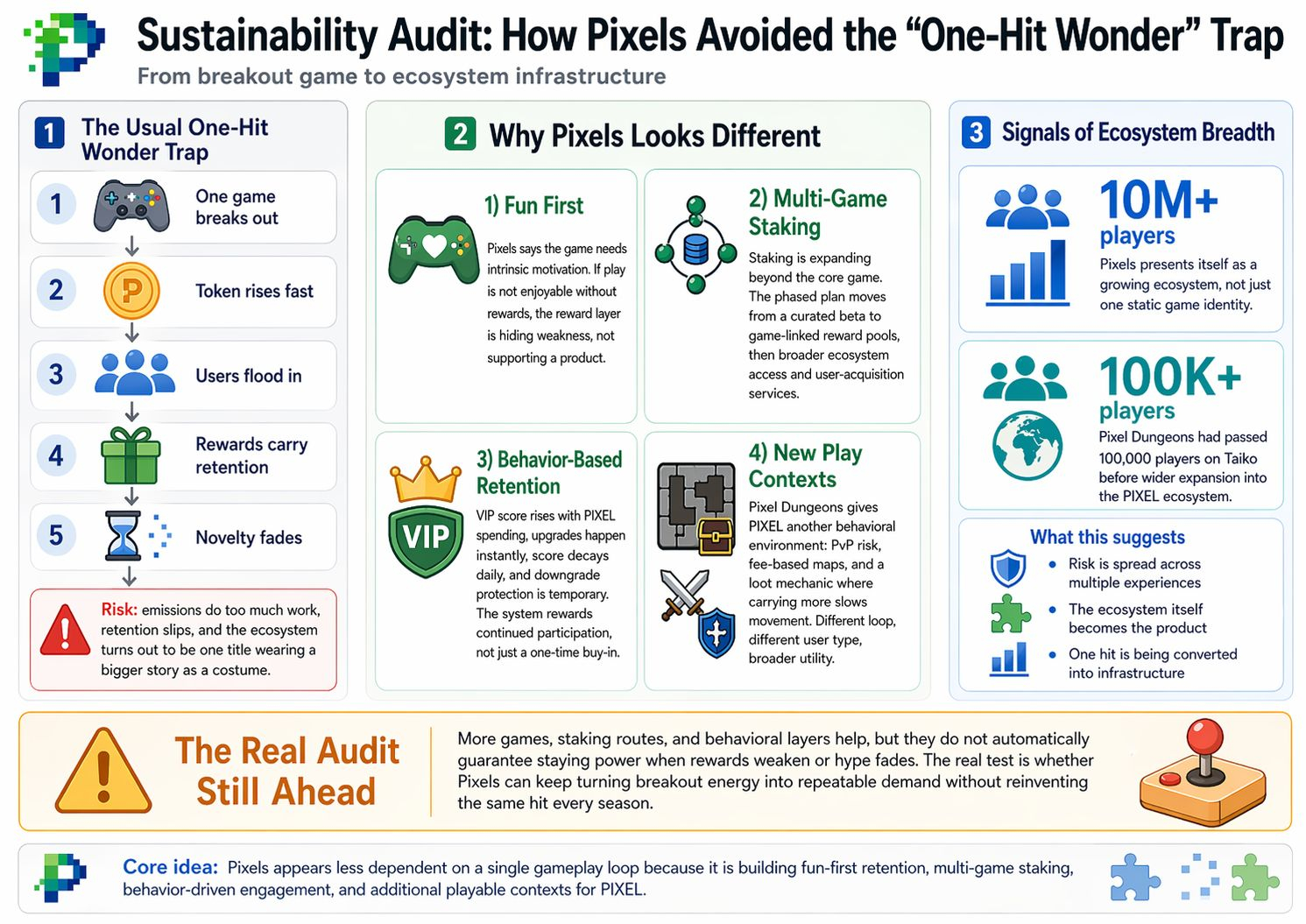
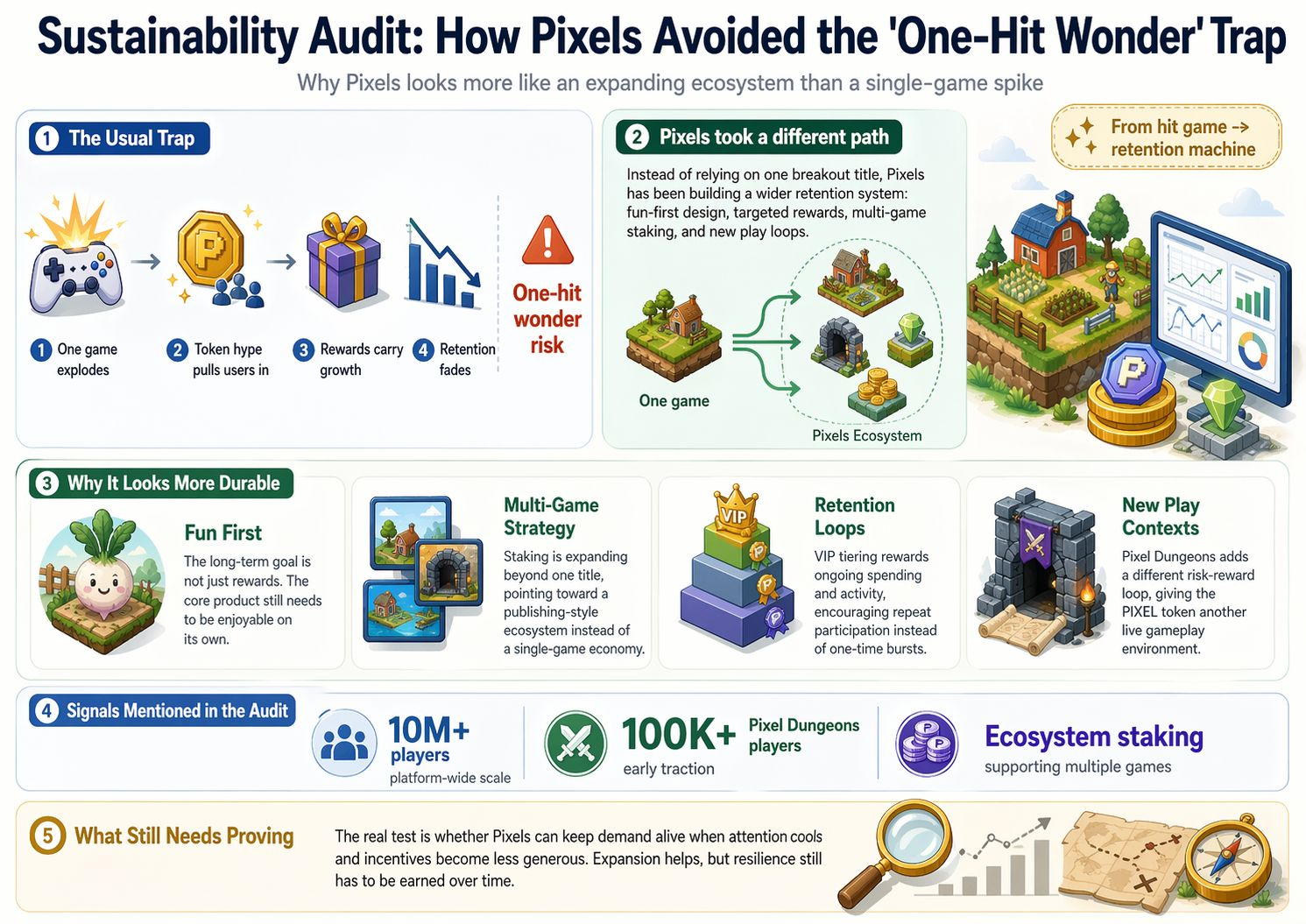
This stands out to me because I have seen it before. One game pulls people in, the token rises quickly, users arrive in big numbers, rewards do most of the work, and for a while it feels like the model has been proven. Then the music changes. Retention slips. Emissions start carrying too much weight. The ecosystem turns out to be one title wearing a bigger story as a costume.
That is the trap I keep checking for with Pixels.
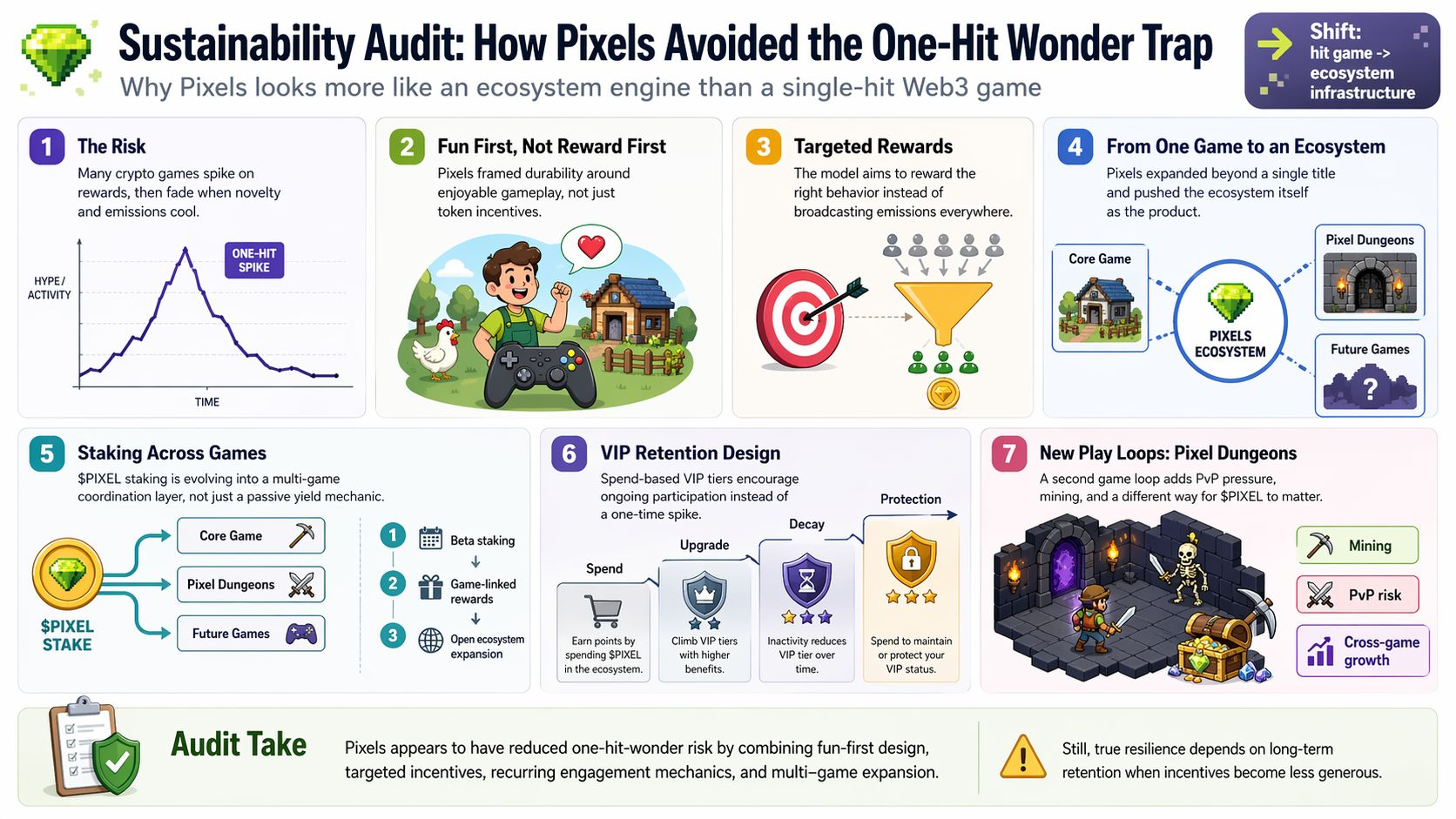
The more I read, the more it seems they never wanted to rely on just one big success.Their own whitepaper says Pixels may have become widely known as a farming game first, but the broader goal was always bigger than one game. They frame the project as an attempt to solve play-to-earn through targeted rewards, stronger incentive alignment, and a model for game growth and user acquisition that goes beyond a single title. That matters, because it means the team is not describing success as “our main game got popular.” They are describing success as building a system that can keep producing durable engagement.
What changed my mind a bit is that the whitepaper does not lean only on token language. It starts with “fun first.” That sounds obvious, maybe even boring, but in crypto gaming it is still one of the clearest ways to tell whether a team understands the difference between attraction and durability. If the game is not enjoyable without the reward layer, then the reward layer is not supporting a product. It is hiding its weakness. Pixels explicitly says there needs to be an intrinsic motivator that drives people to use the platform, and for games that means users genuinely wanting to spend time there.
That alone does not prove sustainability, of course. Plenty of projects say the right thing.
What makes Pixels more interesting is that the design seems to be moving away from dependence on a single gameplay loop. The staking rollout is probably the clearest example. Instead of treating $PIXEL as something that only serves the core game, Pixels has been building a broader staking structure where players can stake toward different games in the ecosystem. Their staking post lays out a phased plan: first a curated beta, then reward pools tied more directly to where players stake, then eventual expansion to any game that hits activity thresholds, and later even user acquisition services supported with other tokens like USDC while $PIXEL remains necessary for staking rewards. That is not the architecture of a one-off hit. That is the architecture of a publishing system trying to spread risk across multiple experiences.
I think that part is easy to underestimate.
A one-hit wonder usually dies because everything depends on one center of gravity. One audience. One loop. One emotional habit. Once novelty wears off, the whole structure shakes. Pixels seems to be trying to prevent that by turning the ecosystem itself into the product. The main site now puts staking right inside “The Pixel Economy” and says players can earn rewards, boost gameplay, and help shape the universe by staking $PIXEL. It also presents the platform as having over 10 million players and pushes regular updates and ecosystem expansion rather than just one static game identity.
Then there is behavior.
This is where I think Pixels has gotten more deliberate. The newer VIP tiering model is not just status dressing. VIP score increases with $PIXEL spending, upgrades happen instantly when thresholds are reached, the score decays a little each day, and downgrade protection is temporary. In plain terms, Pixels is rewarding continued participation, not just a one-time buy-in. It is a small but important distinction. A lot of fragile ecosystems know how to monetize attention once. Fewer know how to keep asking, quietly, whether that attention is still alive.
That kind of design is less glamorous than a giant user spike. It is also more sustainable.
Pixel Dungeons fits into this picture too. On paper it could look like a side experiment. But the help docs describe it as a separate high-pressure loop where players mine $PIXEL, face PvP risk, use fee-based maps for higher rewards, and carry a vulnerability mechanic where holding more loot slows movement. It had already passed 100,000 players on Taiko before expanding to Ronin and the wider $PIXEL ecosystem. What I like about that is not just the number. It is the fact that Pixels is giving the token another behavioral environment to live in. Different tempo. Different risk profile. Different user type. That is healthier than forcing one game mode to carry all economic meaning forever.
So yes, I think Pixels has avoided the classic one-hit-wonder trap better than a lot of Web3 games.
Not because it escaped hype. It definitely benefited from hype. But because it seems to have used that attention to start building systems that make the ecosystem less dependent on a single moment. The whitepaper talks in terms of targeted rewards and long-term engagement. The staking model points toward a multi-game economy. The VIP changes reward recurring activity. Pixel Dungeons expands the token into another playable context. Put together, that looks less like a hit being stretched out and more like a project trying to convert one hit into infrastructure.
My only hesitation is the obvious one.
A lot of ecosystems look diversified before they are truly resilient.
Expanding the system with new games, staking paths, and behavior-based features is useful, but it does not automatically keep people around when rewards feel weaker or hype fades. Pixels may have already moved past its first one-hit-wonder risk.The harder test is whether this broader design still holds when the ecosystem has to prove it can create staying power, not just more surfaces for distribution.
That is the real audit for me now.
Not whether Pixels had one big breakout. It did.
Whether it can keep turning breakout energy into repeatable demand without needing to reinvent the same hit every season. $Chip