
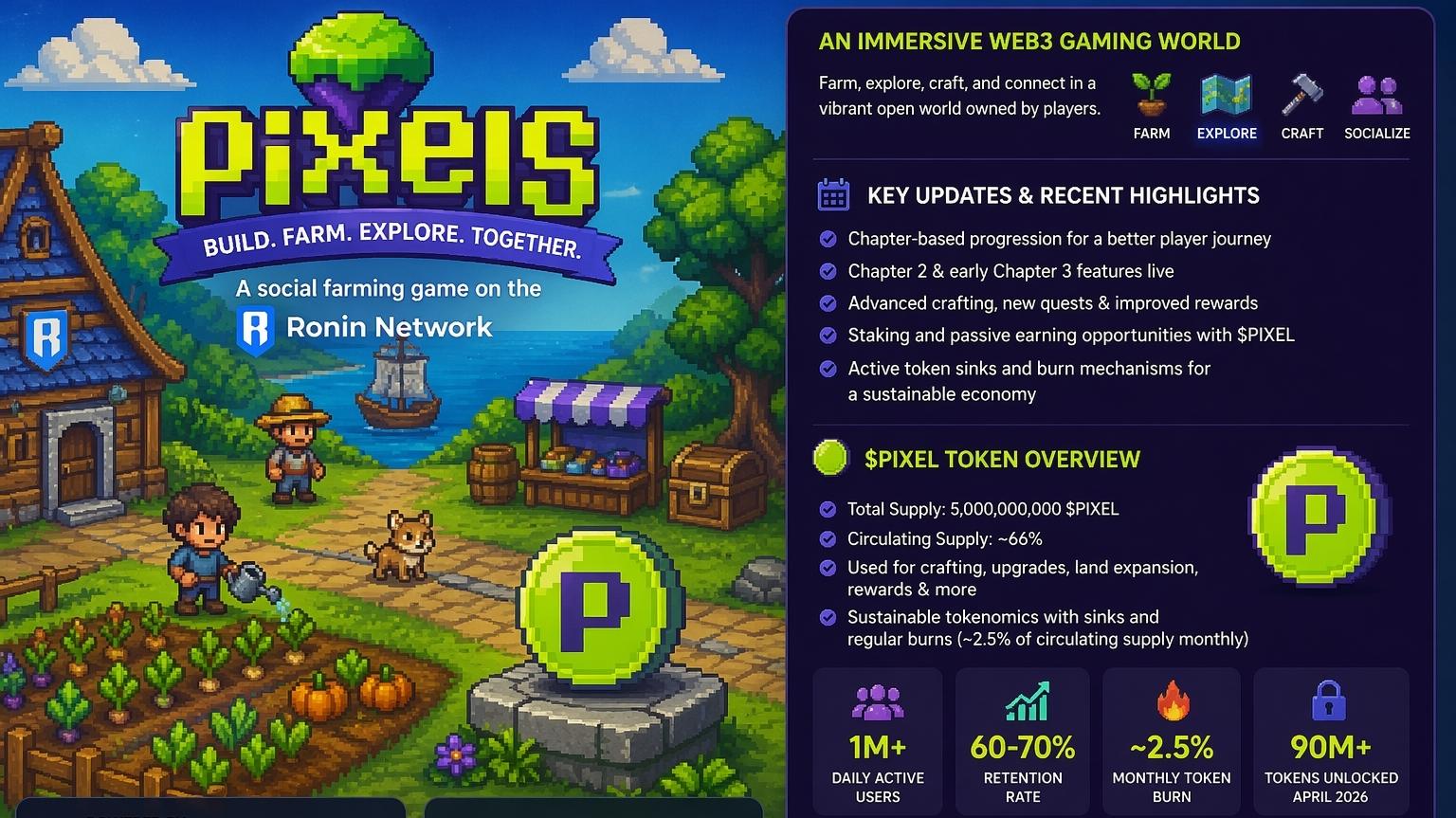
people keep coming back to. At first glance, it’s a simple farming and exploration game built on the Ronin Network. You plant crops, gather resources, craft items, and interact with other players. But once you spend some time in it, you start to realize there’s something deeper going on especially when you look at how fast the game is evolving and how tightly everything is connected to the $PIXEL token.
What makes Pixels stand out is how easy it is to jump into. You don’t need to be a crypto expert. You just log in, start farming, and gradually discover how the economy works. Every action you take whether it’s harvesting crops or crafting items feeds into a bigger system powered by $PIXEL. And because it’s built on Ronin, everything feels smooth and fast, without the usual blockchain friction.
Now here’s where things get interesting. Over the past year, Pixels hasn’t just grown it’s exploded. The game has crossed over 1 million daily active users, which is a huge deal in Web3 gaming. But what’s even more impressive is that people aren’t just trying it and leaving. The retention rate is sitting around 60–70%, meaning most players actually stick around. That’s rare in this space, where many projects struggle to keep users engaged beyond a few days.
A big reason for this growth is the constant stream of updates. The developers didn’t just launch the game and walk away they’ve been actively building. The introduction of chapter-based progression changed everything. Instead of feeling lost, new players now move through structured gameplay, unlocking features step by step. With Chapter 2 and early Chapter 3 updates, the game added deeper mechanics like better rewards, more complex crafting, and even passive earning opportunities tied directly to $PIXEL.
And that brings us to the token itself. $PIXEL isn’t just there for trading it actually has a purpose inside the game. You use it for upgrades, crafting, and unlocking new features. This creates real demand, especially as more players join. On top of that, the team has been working on balancing the economy by introducing token sinks (ways to spend $PIXEL) and even burn mechanisms to control supply.
Still, the token side hasn’t been without drama. In April 2026, a large unlock released over 90 million tokens into circulation. Normally, that kind of event can crash prices. But interestingly, the market handled it relatively well. That suggests there’s genuine confidence in the project not just hype.
Price-wise, has seen some wild moves. There were moments where it pumped over 200% in a short time, driven by new updates, player growth, and overall GameFi momentum. Even now, trading volume remains strong, showing that people are still paying attention.
Another thing worth noting is how the in-game economy is becoming more balanced. The developers are clearly trying to avoid the mistakes that killed many earlier play-to-earn games. Instead of just handing out rewards, they’re creating systems where players also need to spend. Crafting, upgrading land, and progressing through the game all require $PIXEL, which helps keep the economy sustainable.
Of course, it’s not risk-free. The GameFi space is still unpredictable, and many projects that looked promising in the past didn’t survive. Pixels is doing a lot right, but its long-term success will depend on whether it can keep players engaged and continue delivering meaningful updates.
Looking ahead, the future of Pixels feels promising but not guaranteed. If the team keeps building, expands gameplay, and strengthens the token’s role, it could become one of the leading examples of how Web3 gaming should work. But like any crypto project, it needs to maintain momentum.
In simple terms, Pixels is no longer just a farming game it’s turning into a full digital economy. With millions of players, frequent updates, and a token that actually matters inside the game, it’s one of the few projects in Web3 that feels alive rather than speculative. And that’s exactly why so many people are still watching it all farand me
