
I was sitting outside on a plastic chair, the kind that’s been in the same spot for years, phone in my hand with Pixels already open. It wasn’t a planned session. Just something to fill the time before heading inside.
I did what I always do without thinking. Collected crops. Walked across the land. Crafted something small. Put an item up for sale.
Nothing special.
But I didn’t log out right away.
I stayed, just looking.
And when I stopped rushing through it, something started to feel different—not in what I was doing, but in how everything around it was moving.
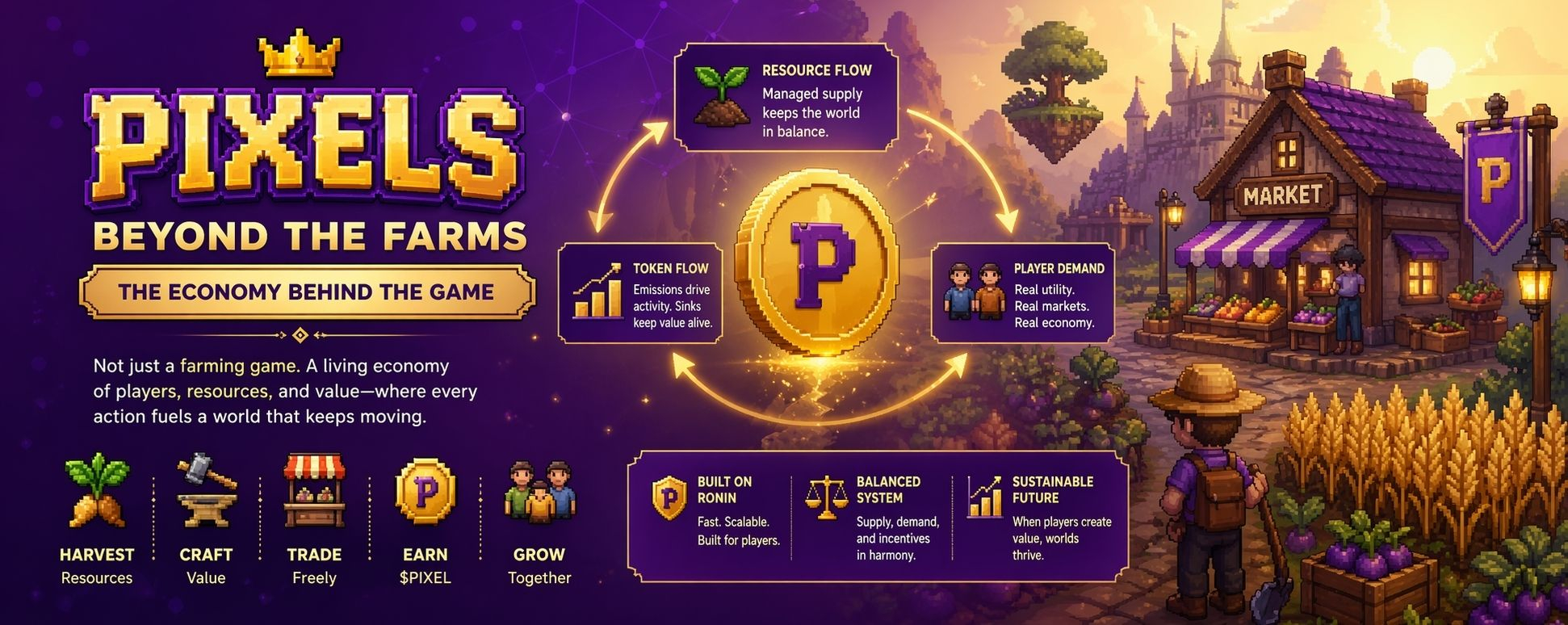
Most people still describe Pixels in a very simple way. A farming game, with a token layered on top. You play, you earn $PIXEL, you trade a bit, and that’s the loop.
That version isn’t wrong.
It’s just… shallow.
Because if you sit with it long enough, you start to realize the farming isn’t really the point. It’s more like a cover for something else—something that’s constantly managing how things flow from one player to another.
I kept replaying the same basic chain in my head.
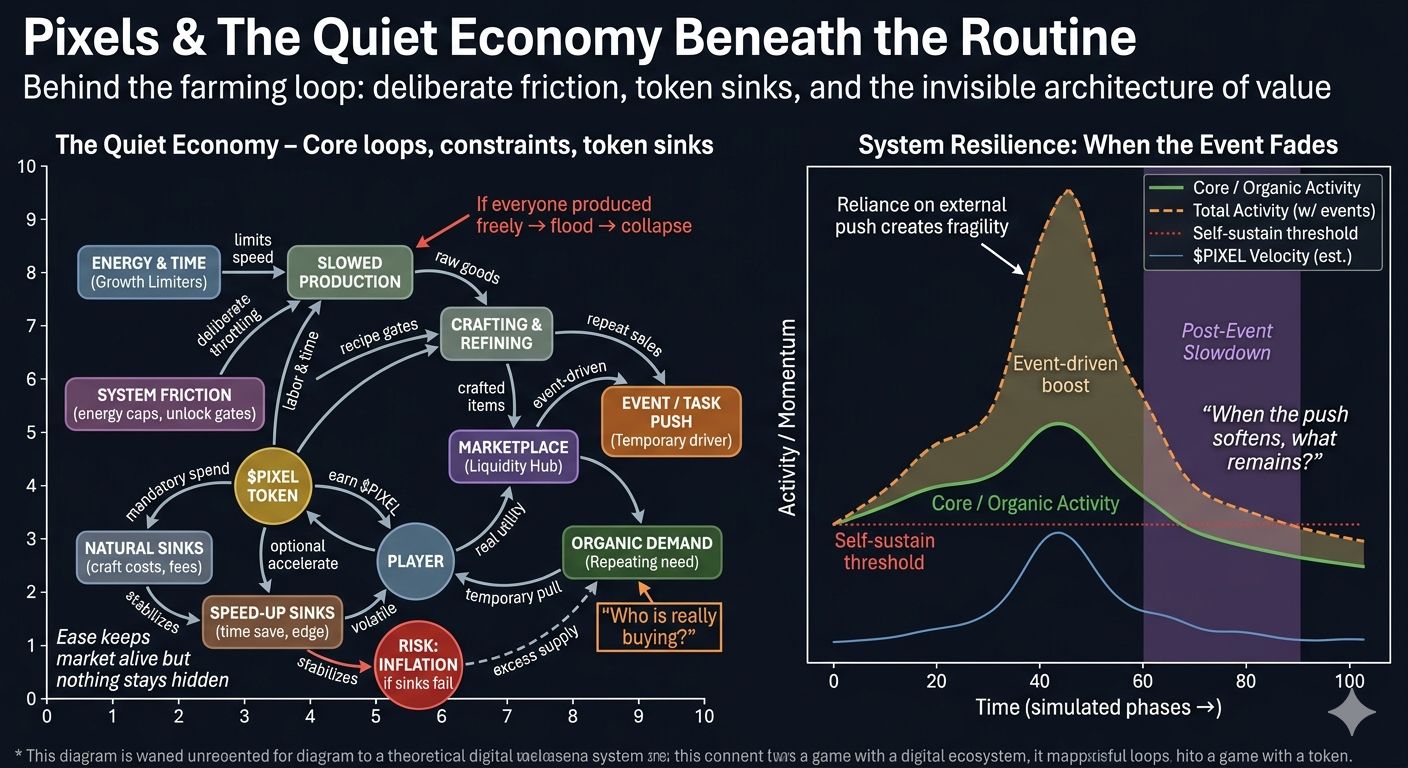
You grow something.
You turn it into an ingredient.
You craft it into something more useful.
Then you sell it to someone who needs it.
At first, it feels normal. Just people trading, helping each other move forward.
But then you notice—you’re never producing freely.
There’s always something in the way.
Energy runs out faster than you expect.
Some processes take longer than they should.
Recipes don’t unlock all at once.
Better tools take effort to reach.
Certain resources aren’t always easy to access.
None of it feels heavy on its own.
But together, it creates a rhythm.
A limit.
Like the game is quietly deciding how fast things are allowed to move.
And the more I thought about it, the more it made sense.
Because if everyone could produce everything, all the time, the market wouldn’t hold for long. People would rush toward whatever is profitable, flood it, and within days, it wouldn’t be worth doing anymore.
I’ve seen that happen in other places.
Here, it feels like the system is trying to prevent that—not by stopping players, but by slowing them just enough.
Then there’s the token side of things.
At the start, earning $PIXEL feels like the reason behind everything. It gives structure to your time. Even if what you’re crafting isn’t selling well, the token makes it feel like you’re still moving forward.
It keeps you engaged.
But the longer I sat there, the more I started thinking about where that value actually ends up.
Because it doesn’t just sit there—it moves through the system.
And if it keeps coming in, something has to take it out.
That’s where spending comes in.
Some of it feels natural. You spend because you need to keep going—crafting costs, items that get used up, things that are part of the loop itself.
That kind of spending feels stable.
But then there’s the other kind.
Spending to save time. To move faster. To get a small edge.
That kind depends on how you feel.
When everything seems worth it, people spend easily. When things feel uncertain, that spending disappears quickly.
And in a system where you can leave anytime, that change happens fast.
So I found myself thinking about something simple.
If I’m selling something… who’s really buying it?
If other players need it again and again, then it means something. It has a place in the system.
But if demand mostly comes from whatever the game is pushing at the moment—events, tasks, shifting requirements—then it feels different.
Like the system is guiding attention to keep things moving.
That works, of course.
But it also means things rely on that push.
When it’s there, everything feels active.
When it fades, things slow down.
And that’s when you start seeing what’s actually holding the system together.
What makes all of this possible is how easy everything feels.
You don’t think about costs when you trade. You don’t hesitate before listing something. You just act.
That ease keeps the market alive. Small trades happen constantly. Items move without resistance.
But it also means people figure things out quickly.
If there’s a better way to produce something, it doesn’t stay hidden.
If there’s an imbalance, it gets pushed immediately.
Nothing stays quiet for long.
So the system isn’t just running—it’s always being tested.
That’s where I keep getting stuck on the same thought.
Is Pixels building something where players create value for each other…
Or is it mostly a system that distributes rewards and keeps everything moving just enough?
Maybe it’s a bit of both.
But the real answer probably doesn’t show up when everything is busy.
It shows up when things slow down.
When rewards feel normal, not exciting.
When there’s no event pulling everyone in one direction.
When fewer new players are arriving.
That’s when you find out if the system stands on its own.
Sitting there that night, doing nothing important, just watching the game instead of playing it, I realized something.
I wasn’t thinking about what I could earn next.
I was thinking about whether all of this would still make sense if the pace changed.
If things became quieter.
If the push behind everything softened.
And that question stayed with me longer than anything I crafted or sold.
Because sometimes, you understand a system better not when it’s moving fast—
but when you imagine what happens if it slows down.