
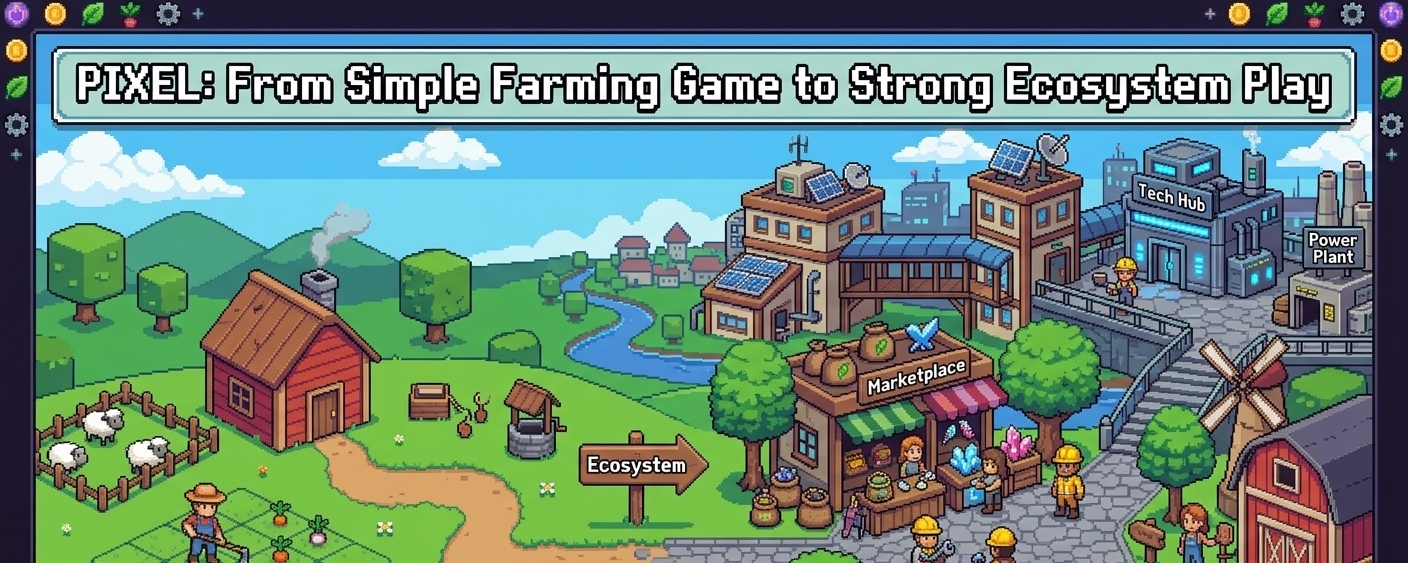
Pixels does not rely on engagement in the usual sense; it constructs a system where stopping becomes economically irrational. The Stacked design links farming, crafting, and land progression into a chain where each action feeds the next. A player plants crops, converts them into crafted goods, and reinvests those goods into land upgrades that increase future output. This is not a loop you can casually pause. If farming stops, crafting queues stall. If crafting stalls, upgrades are delayed. If upgrades are delayed, future production efficiency drops. The system ensures that inactivity is not neutral but creates measurable loss through missed harvest cycles and broken production flow.
The core mechanism is compounding dependency. Each layer is built to rely on the previous one while simultaneously increasing expectations for the next. When a player upgrades land to boost output, that upgrade implicitly demands consistent input to justify itself. Higher production capacity without continued farming leads to idle assets. Idle assets mean lost yield. This creates a condition where progress locks the player into maintaining momentum, not because of explicit penalties, but because the system converts inactivity into opportunity cost. The more efficient a player becomes, the more expensive it is to stop.
This is where progression becomes economically irreversible. Time spent is not just recorded; it is embedded into structures that cannot be unwound without loss. Land expansions, production chains, and efficiency upgrades cannot be liquidated or reset to recover value. Exiting the loop means forfeiting future gains tied to those investments. A player who leaves for even a short period sacrifices harvest cycles, delays upgrade timelines, and falls behind in output scaling. The system does not trap the player directly; it makes exit inefficient enough that staying becomes the logical choice.
The trade-off is clear. Retention is strengthened by reducing optionality. A player can technically stop at any time, but the cost of stopping increases with every layer of progress. What appears as freedom is structurally constrained by how systems interlock. Choosing not to participate means accepting loss across multiple dependent systems. This shifts behavior from voluntary play to maintenance-driven activity, where players log in to preserve efficiency rather than to explore or experiment.
This design introduces a behavioral risk. As long as players believe that continued participation leads to meaningful gains, the system holds. The moment that perception changes, the same dependency structure accelerates disengagement. When players realize they are maintaining systems rather than enjoying them, the motivation collapses. The shift is not gradual. Once future rewards no longer justify present effort, the entire chain loses value instantly, and players exit despite prior investment.
The system also increases cognitive pressure as progression deepens. Farming cycles, crafting queues, land optimization, and upgrade timing begin to overlap. Managing these simultaneously requires consistent attention. The more advanced the player becomes, the more coordination is required to maintain efficiency. This structure favors highly committed users while pushing out those who prefer flexible or low-effort gameplay. Complexity becomes a filter, not a feature.
There is also a structural imbalance in how value accumulates. Early players build layered advantages through expanded land, optimized production chains, and higher efficiency outputs. New players enter a system where catching up requires disproportionately more time and coordination. Because progress cannot be easily reversed or redistributed, advantages compound rather than reset. This makes the system less accessible over time and reinforces the position of those already embedded in the loop.
Pixels’ Stacked system is not designed to maximize engagement alone. It is built to convert progression into dependency by embedding time, effort, and output into interconnected systems that resist interruption. Retention emerges not from enjoyment alone but from the increasing inefficiency of stopping. The system succeeds in keeping players active, but it does so by narrowing their ability to disengage without cost, turning participation into a sustained economic decision rather than a purely voluntary one.
