
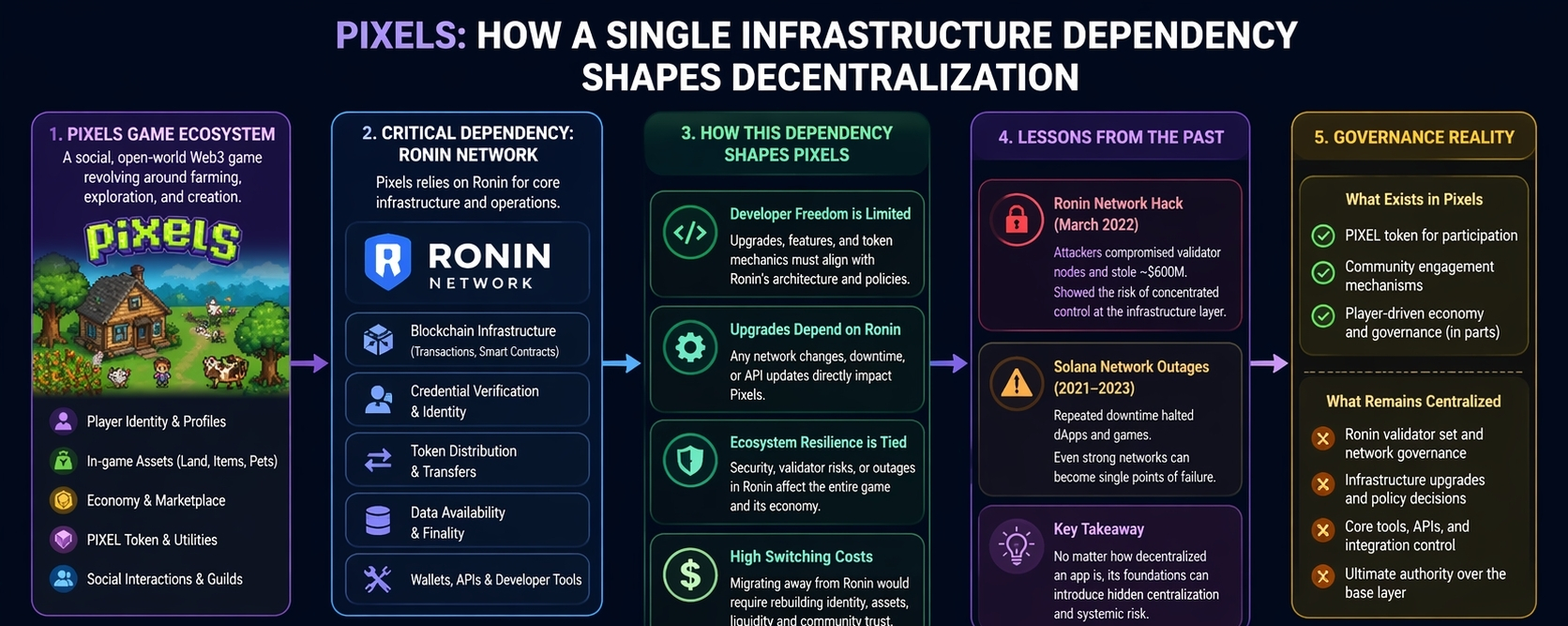
There’s something quietly frustrating about how easily we accept the word “decentralized” without asking what it really depends on. Pixels (PIXEL) feels, on the surface, like a living, breathing open world—players farming, exploring, building, owning pieces of something that looks shared. But underneath that experience sits a quieter truth: much of what makes Pixels function is deeply tied to the Ronin Network, and that reliance shapes more than most people notice.
It’s not just that assets are stored there or transactions are processed there. Ronin effectively acts as the spine of the system—handling identity, ownership, and how value moves. That kind of integration is powerful, but it also means Pixels doesn’t stand entirely on its own. It leans. And when something leans, it inherits the stability—and instability—of whatever it rests on.
Ronin itself, built by Sky Mavis, was designed to make games like this possible at scale. Faster transactions, lower fees, smoother onboarding—it solves real problems. But it also introduces a boundary that isn’t always visible. Decisions about validators, upgrades, and network rules aren’t made inside Pixels. They happen one layer below it. And that layer quietly defines what Pixels can and cannot become.
For developers, this creates a kind of invisible fence. Creativity still exists, but it has edges. Any major shift—whether it’s changing how tokens behave, how credentials are verified, or how systems interact—has to fit within Ronin’s structure. If Ronin evolves, Pixels must adjust. If Ronin stalls, Pixels waits. It’s a relationship that looks collaborative but isn’t entirely equal.
We’ve seen what happens when these foundations crack. The Ronin Network hack wasn’t just a technical failure; it was a reminder that control concentrated at the infrastructure level can ripple outward in ways no single application can prevent. It didn’t matter how well-designed something on top was—once the base layer was compromised, everything built on it felt the shock.
Even outside Ronin, the pattern repeats. Incidents like the Solana network outages showed how entire ecosystems can pause, not because of their own flaws, but because of what they depend on. It’s a strange kind of vulnerability—one where you can build something seemingly independent, yet still be bound to decisions made elsewhere.
Pixels does try to move toward something more open. The PIXEL token gives players a sense of participation, a stake in the system. There’s an effort, at least in spirit, to let the community shape parts of the experience. But ownership of tokens isn’t the same as ownership of direction. The deeper mechanics—the ones that decide how the system evolves—still sit closer to the infrastructure layer than the player base.
And even if the community wanted to push further—say, to change the underlying network or redefine how the system works—it wouldn’t be simple. The cost of leaving Ronin isn’t just technical; it’s structural. Identity systems, economies, integrations—all of it would need to be rebuilt. That kind of dependency doesn’t just support the system; it anchors it.
So what emerges is something more nuanced than the usual Web3 narrative. Pixels isn’t centralized in the traditional sense, but it isn’t fully decentralized either. It lives somewhere in between—a space where players can influence the surface, but the foundation remains shaped by a smaller set of actors.
And that leads to a question that doesn’t have a clean answer. When you plant crops, trade assets, or build inside Pixels, who are you really trusting? The developers who design the world? The community that gives it life? Or the network beneath it, quietly setting the limits of what’s possible?
Maybe the harder truth is that decentralization isn’t just about who owns the assets—it’s about who can change the rules. And until that power is shared all the way down, the idea of a world that fully belongs to its players will always feel just slightly out of reach.