
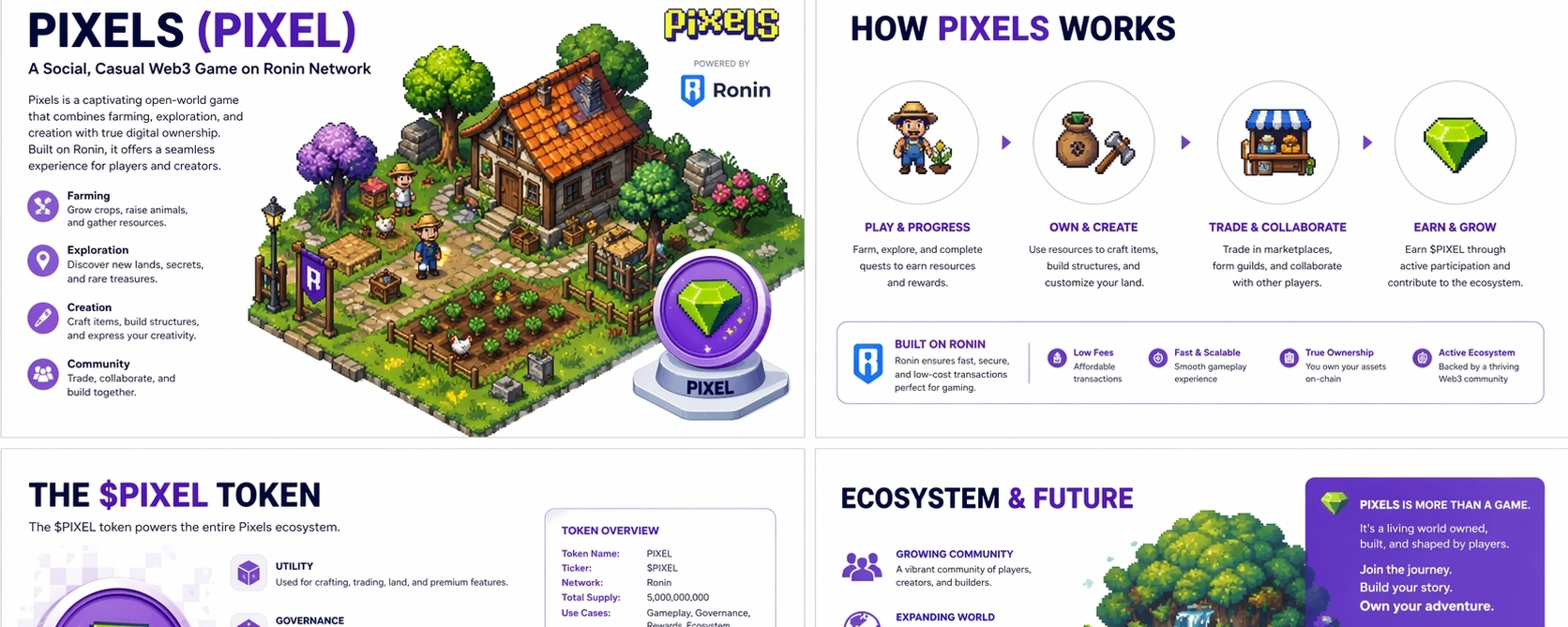
Lately I’ve noticed something interesting in crypto — as liquidity rotates and people keep chasing the next infrastructure narrative, there’s also this quieter shift happening where attention is drifting back toward products people actually want to spend time in. Not just protocols to farm, not just tokens to speculate on, but digital places people return to. That’s what made me pause when I started looking deeper into and the whole ecosystem forming around .
At first, I didn’t fully get it.
A farming game? In this market?
I’ve seen enough GameFi cycles to be skeptical. Most of them over-financialized gameplay so hard that the game itself became secondary. Rewards pulled people in, emissions pushed them out, and once token incentives weakened, so did the “community.” So when Pixels kept showing up in conversations, I assumed it was another recycled playbook.
But what caught my attention was that the core loop didn’t seem built around extraction. It felt built around participation.
The more I looked, the more I realized Pixels isn’t really pitching itself as “play-to-earn,” which honestly may be one of its strengths. It feels closer to an onchain social world with an economy attached, not a token economy pretending to be a game.
And that difference matters.
I started seeing it less like a farming simulator and more like a digital village. You gather resources, trade, craft, explore, collaborate. The token layer sits underneath coordinating incentives, but it doesn’t scream for attention every second. I actually think that subtlety is underrated.
What confused me initially was why this was gaining traction now, in a market obsessed with AI, modular everything, and higher-beta narratives.
Then it clicked.
In risk-off or uncertain cycles, people often underestimate retention narratives. Speculation gets noisy, but products with habit loops quietly compound. I think Pixels sits in that zone. It’s less about short-term token excitement and more about whether Web3 can produce a persistent social economy people care about.
That’s a bigger question than a game.
From what I’m seeing, one real problem it’s trying to solve is something crypto still struggles with — how do you make ownership meaningful without making everything financialized to death?
Pixels experiments with that through land, resources, guild coordination, progression, and the incentive layer. The token isn’t just there as a speculative wrapper; it’s tied into the game’s economic coordination. That matters because sustainable game economies usually depend less on emissions and more on circular activity.
And the underlying stack matters too. Building on wasn’t random. I’ve always thought infrastructure matters most when users barely notice it. Ronin gives cheaper transactions, gaming-native distribution, and an audience already conditioned for digital ownership. It’s like building a town next to a highway instead of in a desert.
That’s where decentralization here feels practical, not ideological.
It’s not decentralization as a slogan. It’s players owning assets, economies emerging from users rather than only developers, incentives coordinated by a shared system instead of a closed database. That’s a much more tangible expression of Web3.
I’ve also noticed something underrated: social casual games may actually onboard users better than complex DeFi products ever did.
That sounds obvious, but crypto often forgets onboarding is emotional before it’s technical.
People stay where identity forms.
And Pixels seems to understand that.
Compared with older GameFi names that leaned heavily on yield mechanics, or even metaverse projects that felt too abstract, Pixels feels more grounded. Less “future of virtual worlds,” more “here’s a world, come live in it.” That’s a subtle but important difference.
Of course, I don’t think this is risk-free at all.
Gaming tokens can face brutal volatility. Unlock pressure matters. User growth can flatten. Execution risk in live economies is huge because balancing rewards and sustainability is incredibly hard. Competition is real too — Web3 gaming is crowded, and Web2 games remain ruthless competitors.
And regulation? Still an open question around tokenized ecosystems generally.
I also wonder whether social farming economies can maintain novelty over years, not just cycles.
That’s a real test.
Still, what keeps me watching is one personal observation I didn’t expect: Pixels may be less a bet on gaming and more a bet on crypto rediscovering culture.
That feels different.
Because if the next phase of Web3 isn’t driven only by better rails but by better worlds built on those rails, then projects like this may matter more than people assume.
I’m not looking at Pixels as “just a game token.”
I’m looking at it as an experiment in whether ownership, community, and everyday digital labor can actually coexist without collapsing into speculation.
And honestly, I’m still thinking about that.
Are projects like this early sketches of where crypto becomes lived-in and human… or are we watching another fascinating experiment testing the limits of tokenized worlds in real time? I’m not sure yet.
That uncertainty is exactly why I keep paying attention.