
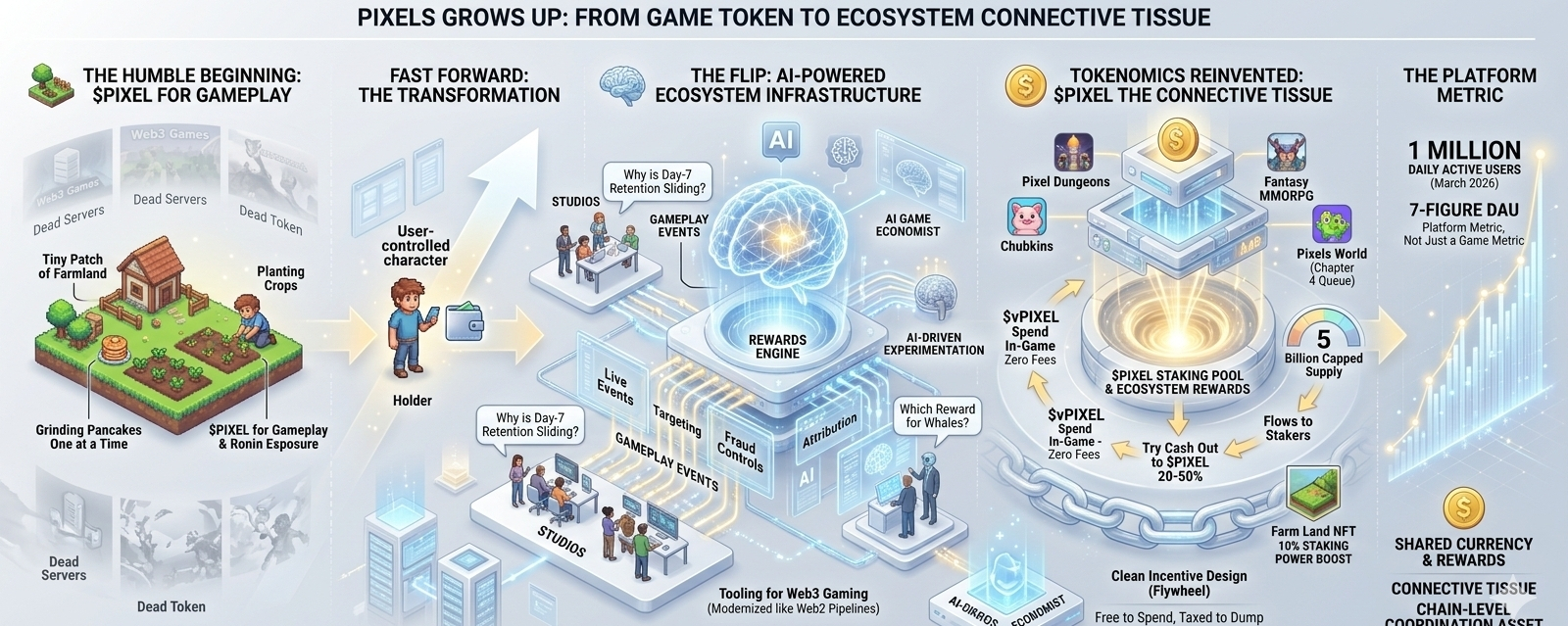
Two winters ago I was out there planting crops on a tiny patch of farmland, grinding pancakes one at a time.
Half of me was already convinced this project would end the same way every other Web3 game ends.
Dead servers.
Dead token.
Moving on to the next shiny thing.
Fast forward to today and I'm looking at a completely different project than the one I signed up for.
Pixels grew up.
And honestly, I don't think most of crypto Twitter has caught on yet.
My original thesis on pixel was pretty basic.
I bought some for the gameplay.
Grabbed a bit more for the Ronin exposure.
Figured I'd farm, maybe flip, move on.
That was the plan.
It's not my plan anymore.
I'm holding this bag for reasons which have almost nothing to do with farming now.
The thing which flipped my whole view on this project was the rewards engine the team pushed live earlier this year.
When it first launched I almost scrolled past it.
On the surface it looked like another quest app.
Log in.
Finish missions.
Build streaks.
Pull your rewards.
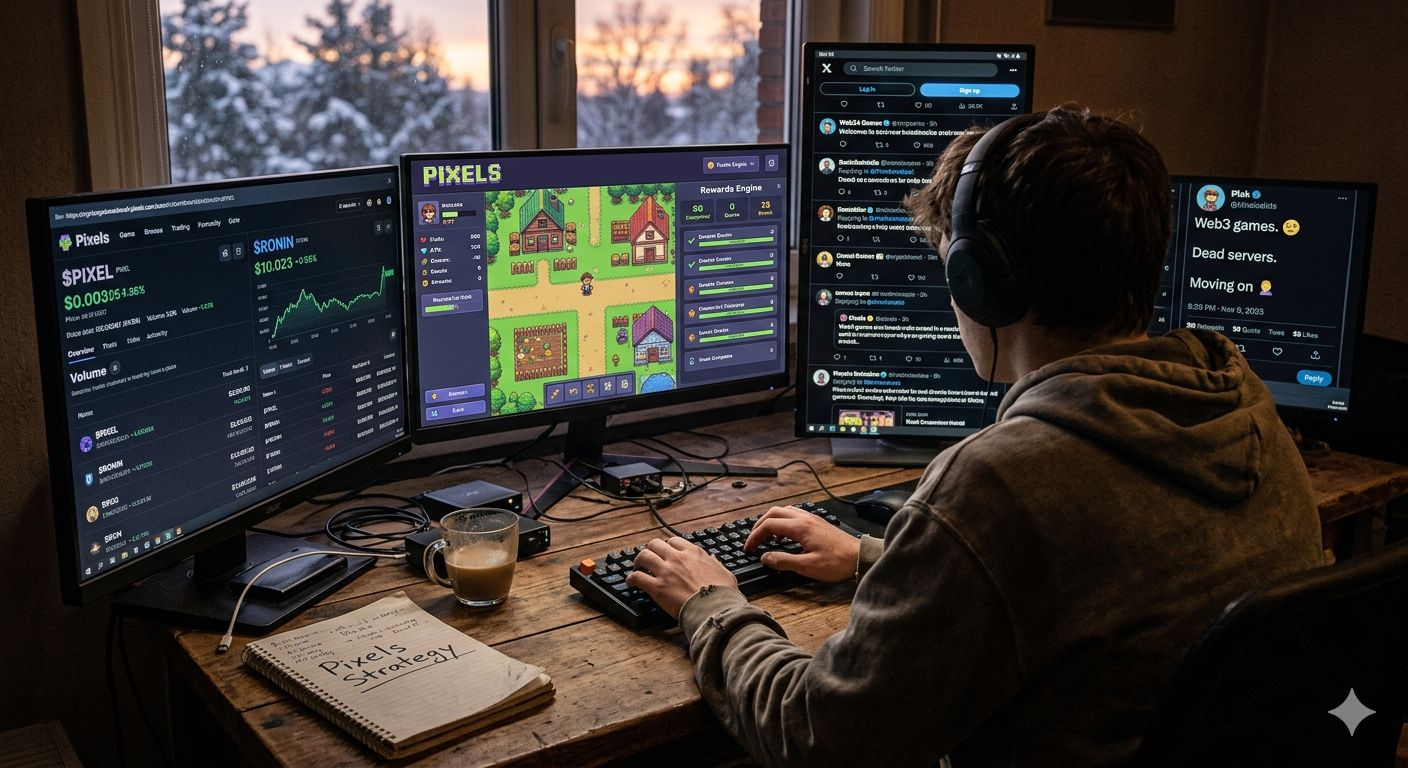
Fine, whatever, every Web3 game has one.
Then I read how studios actually use it on the backend and I had to stop and really pay attention.
Game teams feed their live gameplay events straight into the system.
It handles targeting.
Fraud controls.
Attribution.
Automated payouts.
And sitting right in the middle of everything is an AI game economist.
Studios literally ask it questions in plain English.
Stuff like "why is my day-seven retention sliding."
Or "which reward should I run on my whales next week."
The system writes the experiment.
Measures the outcome.
Recommends the next move.
Closes the loop.
In my view this is the tooling Web3 gaming has been missing since the Axie collapse three years back.
Every real mobile studio in Web2 runs on pipelines which look like this.
Web3 studios have been guessing blindly for years.
The Pixels team just shipped the whole toolkit to the industry.
And they're using it on their own games first.
Pixel Dungeons is plugged in.
Chubkins is plugged in.
The main Pixels world runs on it.
That's a head start nobody else on the chain has.
Now let me talk about the tokenomics, because this is where I actually got convinced long-term.
I've seen a lot of Web3 game economies blow up in slow motion.
SLP hyperinflation is still burned into my memory.
So when the new pixel design dropped I spent a whole weekend just re-reading it looking for the crack.
Couldn't find one.
Here's how it works.
You stake pixel into game-specific pools and earn a share of the monthly ecosystem rewards.
That pool caps at 28 million tokens per month right now.
Hold a Farm Land NFT and you pick up a 10% staking power boost.
Up to 100k pixel per plot.
Massive deal for anyone who grabbed land during the original migration era.
The $vPIXEL piece is what sealed it for me.
Spend inside the game?
Zero fees, no friction, no drag.
Try to cash out straight to raw $PIXEL?
You're paying a Farmer Fee between 20% and 50%.
And every single piece of that fee flows back to stakers.
Free to spend.
Taxed to dump.
Say what you want about the crypto space but that is one of the cleanest incentive designs I've seen ship in GameFi.
Full stop.
It turns the whole economy into a flywheel instead of the leaky bucket we saw in the last cycle.
Let me also be real about the price action.
I think a lot of these articles skip the uncomfortable stuff so I won't.
Pixel printed a 193% candle in 24 hours back in March.
Volume went parabolic.
Over 6,000% above its baseline.
I was watching the depth chart live as it unfolded.
It had every sign of a short squeeze feeding into momentum chasers.
Classic setup.
But the fundamentals underneath weren't noise.
Liquidity held up clean through the whole move.
Turnover ratio stayed around 1.02.
And the project crossed 1 million daily active users in March 2026.
One million.
Most Web3 games would sell a kidney for fifty thousand DAU.
Pixels is running seven figures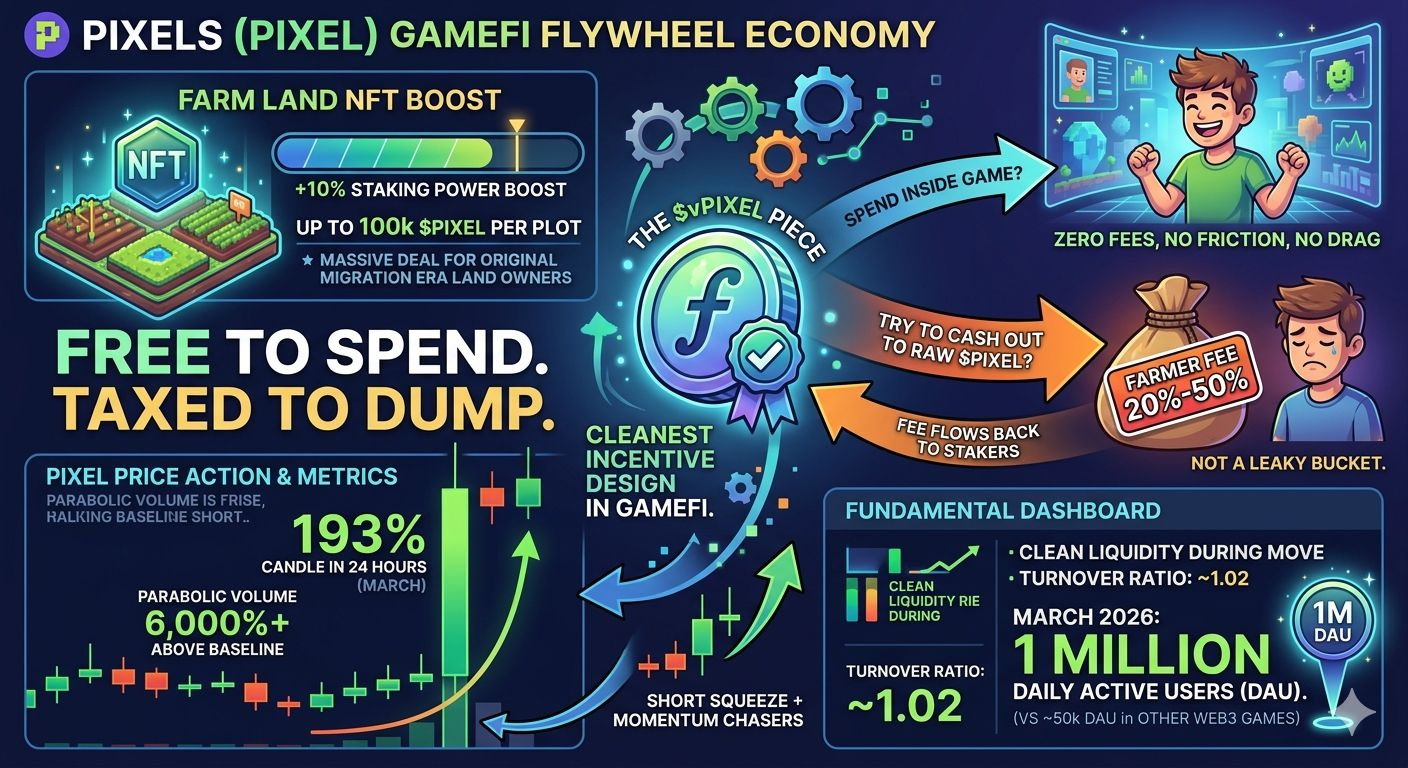 .
.
That's not a gaming metric anymore.
That's a platform metric.
I did what I always do with GameFi parabolas.
Trimmed some into strength.
Rebought on the retrace.
Kept my core position in the staking pool completely untouched.
The 5 billion capped supply matters for the long game.
The staking sink matters more, because it pulls tokens off the market every single month.
What keeps me on edge isn't the Pixels side.
It's the broader chain risk.
If the Ronin ecosystem stalls, every token on it stalls too.
I've been through enough cycles to know gaming tokens don't decouple from their home chain.
Now for the AI in crypto angle.
Because honestly, this is the part most writers don't want to say out loud.
Most AI x crypto projects I've looked at this year have been embarrassing.
Agent frameworks with no real agents running anything.
Compute tokens with no compute buyers.
Roadmap theater dressed up as product.
Vibes over substance.
Meanwhile the Pixels team quietly shipped a working AI product.
Real studio customers.
Live integrations.
Measurable outcomes for the game economies it touches.
No whitepaper gymnastics.
No fake TPS charts.
Just a system which helps real game teams figure out what to reward and when to reward it.
That's it.
Simple on paper.
Huge in practice.
Let me run through the latest updates too, because there's been a lot happening.
The multi-game staking system keeps expanding through 2026.
More titles are being lined up to plug into the shared reward pool.
That's the index-style model the founder has been talking about for months.
Stake once, earn across every game in the ecosystem.
Chapter 4 of the main game is queued up for an early-to-mid 2026 release.
Following the same three-to-four month cadence the team has kept since Chapter 2.
More quests.
More mechanics.
More utility sinks for $PIXEL.
A fantasy MMORPG partner title integrated $PIXEL into its own economy earlier this year.
Players swap their local in-game currency for $PIXEL to grab boosts, mana, and gacha pulls in the partner world.
The founder has also been pretty open about the bigger strategy.
He wants Pixels to work as a user acquisition layer for the entire chain.
Not just a game.
A front door.
Players walk in through Pixels.
Get routed out to partner titles.
All feeding into the same reward engine.
All using pixel as the shared currency.
And here's the framing I haven't seen anyone else land on yet.
Pixel is slowly morphing from a game token into something closer to a chain-level coordination asset.
One token.
Many games.
Shared rewards.
Shared economics.
Shared user base.
That is a completely different animal than what the market is currently pricing.
As for me, I'm staked into the multi-game pool.
Holding my land for the staking boost.
Spending $vPIXEL on pet upgrades and quality-of-life stuff because paying fees to dump my own rewards feels kind of stupid.
I track studio onboarding pace into the rewards engine way more seriously than I track the pixel chart itself.
That onboarding count is the real leading indicator.
If three or four more studios plug in before December, I think the market starts repricing this token as infrastructure instead of a GameFi bag.
And that's where the asymmetric upside lives.
So I'll leave you with this.
If a gaming token stops being about the game and starts being the connective tissue between every game on its chain, are we still supposed to price it off daily active users?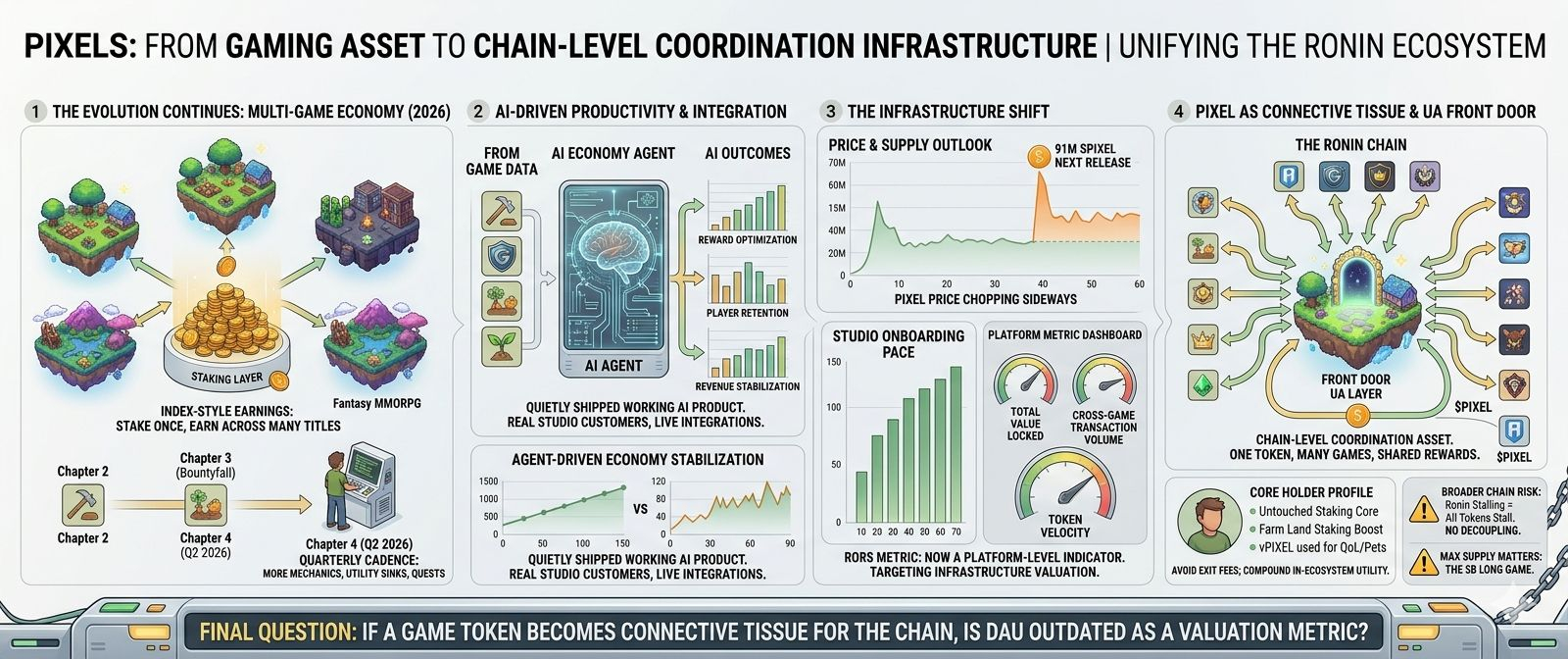
Or is the whole framework we've been using to value GameFi about to look as outdated as the play-to-earn model it's quietly replacing?