
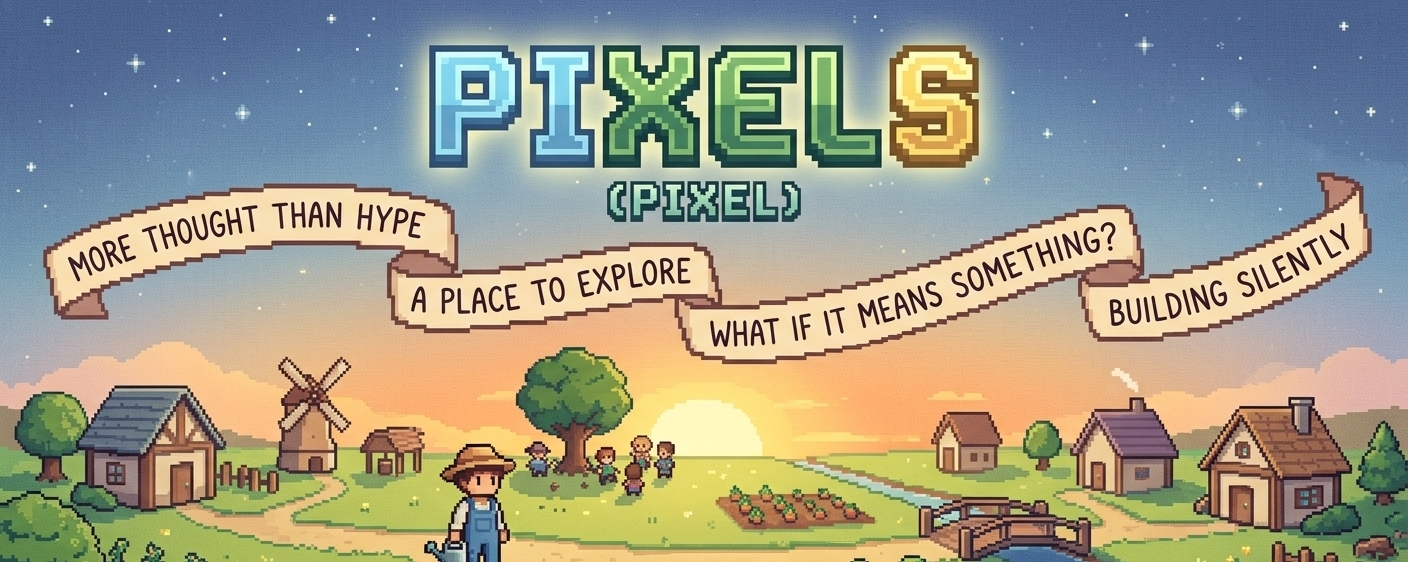

I’ve spent enough time around crypto projects to recognize a pattern before it fully reveals itself. A new name appears, wrapped in a mix of technical ambition and creative storytelling, and somewhere between those two lies the real substance—or the lack of it. When I first came across JimPixels (PIXEL), it didn’t immediately strike me as radically different. A Web3 game, open-world, farming, exploration—these are not new ideas. But I’ve learned not to dismiss things too quickly either. Sometimes the nuance is buried under familiar language.
So I approached it the way I tend to approach most projects now: not with excitement, but with curiosity tempered by a bit of skepticism.
At a surface level, JimPixels presents itself as a social, casual game built on the Ronin Network, leaning into farming mechanics, open-world interaction, and player-driven creation. That description alone could apply to a dozen projects I’ve seen over the past few years. The real question, though, isn’t what it claims to be—it’s how those pieces are actually put together, and whether they form something coherent or just another iteration of the same design loop dressed differently.
What caught my attention first wasn’t the gameplay itself, but the decision to frame it as “social casual.” That phrasing is doing a lot of work. Crypto games often struggle with identity—they want to be financially rewarding, technically innovative, and genuinely fun, all at once. In trying to do everything, they usually end up doing none of it particularly well. By contrast, leaning into “casual” suggests a step back from that pressure, almost an admission that not everything needs to be optimized for extraction or competition.
But I’ve seen this pivot before. The industry goes through cycles. First it was “play-to-earn,” then the backlash came, and suddenly everything became “play-and-earn,” then “fun-first,” and now we’re somewhere in this softer, more lifestyle-oriented framing. The language evolves, but the underlying tension remains: is the game actually designed for players, or is it designed for token mechanics?
As I looked deeper into JimPixels, I found myself trying to trace that tension through its structure. The farming and exploration loop is inherently slow paced, almost deliberately so. That’s interesting, because speed and immediacy are usually what Web3 projects chasevfast rewards, quick engagement, constant feedback loops. Slowing things down suggests a different philosophy, or at least an attempt at one.
And yet, I can’t help but wonder how that interacts with the blockchain layer. Farming games, by their nature, rely on time, patience, and gradual progression. When you introduce tokenization into that system, you risk distorting those rhythms. Suddenly, time isn’t just time it’s yield. Land isn’t just land—it’s an asset. Exploration isn’t just curiosity—it’s optimization.
This is where many projects quietly lose their original intent. They start with a simple idea—build a world, let players exist in it and then gradually reshape that world around economic incentives. The question for JimPixels is whether it can resist that gravitational pull, or whether it will eventually conform to it like so many others.
To be fair, the choice of the Ronin Network is not insignificant. Ronin has a history tied to gaming, and that context matters. It suggests an environment where developers are at least thinking about player experience alongside technical infrastructure. That’s not always the case in crypto, where the chain often feels like an afterthought or, worse, the main attraction.
Still, infrastructure alone doesn’t solve the deeper issue. The real problem JimPixels seems to be addressing—whether explicitly or not—is the disconnect between gameplay and ownership in Web3. For years, projects have promised players “true ownership,” but in practice, that ownership often feels hollow. You own assets, yes, but what do they actually mean within the game? Are they tools for expression, or just units of value?
In traditional games, farming and world-building are about immersion. You’re not thinking about resale value when you plant crops or decorate a space—you’re thinking about how it feels, how it looks, how it fits into your personal narrative. Web3 tries to layer financial meaning on top of that, and the result is often a kind of cognitive dissonance. You’re both a player and an investor, and those roles don’t always align.
JimPixels, at least in its framing, seems to lean more toward the player side of that equation. The emphasis on creation and social interaction hints at a world where value isn’t purely transactional. But I’ve learned to be cautious about taking that at face value. Intentions can shift, especially once a token is involved.
What I do find somewhat refreshing is the lack of aggressive complexity. Many crypto projects try to impress with intricate tokenomics, layered systems, and technical jargon that obscures more than it reveals. JimPixels feels comparatively restrained. That simplicity could be a strength, assuming it’s intentional and not just a lack of depth.
There’s also something to be said about the open-world aspect. Open worlds in crypto are often more conceptual than real—vast spaces with very little meaningful interaction. If JimPixels can create a world that actually feels alive, even on a small scale, that would already set it apart. But that’s a high bar. It’s easy to promise a world; it’s much harder to make it feel inhabited.
As I think about where the broader industry tends to go wrong, I keep coming back to this idea of misaligned priorities. Too many projects start with the question, “How do we monetize this?” instead of “Why would anyone want to be here?” The result is a kind of hollow architecture systems that function technically but lack any real emotional or experiential core.
JimPixels, in its quieter way, seems to be asking the second question, or at least gesturing toward it. But asking the question isn’t the same as answering it. The real test will be in the details—the pacing of progression, the depth of interaction, the subtle design choices that determine whether players stay because they want to, not because they feel incentivized to.
There’s also the issue of sustainability, which is where many Web3 games ultimately struggle. A farming game thrives on consistency and long-term engagement. Players return because there’s a sense of continuity, a feeling that their actions accumulate into something meaningful. In a tokenized environment, that continuity can be fragile. Market fluctuations, shifting incentives, and external speculation all have a way of disrupting the internal logic of the game.
I find myself wondering how JimPixels plans to navigate that. Is the token meant to be central to the experience, or more of a background layer? How tightly is gameplay tied to economic outcomes? These are the kinds of questions that don’t always have clear answers early on, but they tend to define the trajectory of the project over time.
At a more philosophical level, there’s something interesting about the persistence of farming as a theme in crypto games. It’s almost symbolic. Farming is about patience, cycles, growth concepts that stand in contrast to the often frenetic, speculative nature of the crypto market. Maybe that’s part of the appeal. It offers a kind of counterbalance, a slower rhythm within a fast-moving space.
But symbolism only goes so far. The challenge is translating that into a system that actually works, both as a game and as a Web3 application. Too often, projects lean on the aesthetic of farming without fully embracing its implications. They keep the visuals but abandon the underlying philosophy, replacing it with mechanics that prioritize extraction over experience.
As I reflect on JimPixels, I don’t feel the usual sense of either excitement or dismissal. It sits somewhere in between—a project that feels aware of the space it’s entering, but still subject to the same pressures that shape everything in this ecosystem. That ambiguity is, in a way, more honest than the overconfidence I see elsewhere.
If there’s anything I’ve learned from watching this space evolve, it’s that success rarely comes from novelty alone. It comes from execution, from restraint, from a willingness to prioritize the user experience even when it conflicts with short-term incentives. Whether JimPixels can do that remains an open question.
For now, I see it as an experiment one that’s trying, perhaps cautiously, to find a different balance between play and ownership. It’s not a radical departure, but it doesn’t feel entirely derivative either. And in a space that often swings between extremes, that middle ground might be worth paying attention to.
I wouldn’t call it a breakthrough. Not yet, anyway. But I also wouldn’t write it off. Sometimes the more interesting projects are the ones that don’t immediately declare themselves as such the ones that take their time, that evolve quietly, that reveal their strengths gradually rather than all at once.
Maybe JimPixels will follow that path. Or maybe it will drift toward the same patterns that have defined so many before it. At this stage, it’s hard to say. But it’s the uncertainty that makes it worth watching, even if only from a distance.
