
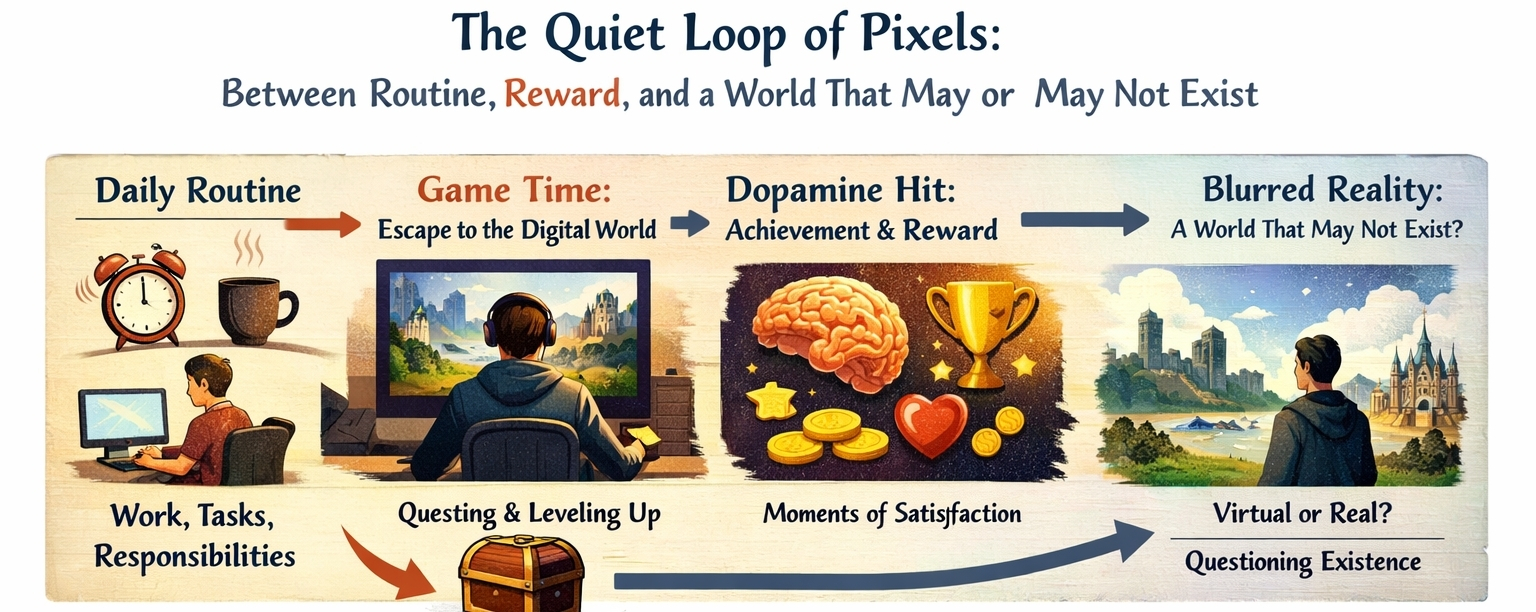
Some mornings I catch myself doing things on autopilot. Reaching for my phone, opening an app, tapping through a few actions before I’ve even fully woken up. It’s not excitement that drives it. It’s familiarity. A quiet kind of repetition that settles into the day without asking much from me.
That’s the feeling I keep circling back to when I think about Pixels.
At its core, it’s not trying to reinvent anything. It’s a simple, open-world farming game—planting, collecting, trading, wandering around a shared space. Built on Ronin, designed to be easy to access, easy to understand. The kind of thing you don’t need to “learn,” just fall into. And maybe that’s the point. We’ve seen versions of this before, both in traditional games and across Web3. Land, loops, light social layers, a token somewhere underneath it all. None of it is new.
But something about this one lingers a bit longer than I expected.
It doesn’t push too hard. It doesn’t feel like it’s trying to convince you of anything. You log in, tend to whatever needs tending, maybe chat a little, maybe not, and then you leave. There’s no dramatic pull, no big moment. Just a steady presence. In a space that usually leans on hype and urgency, that kind of quiet consistency stands out.
And to its credit, people actually show up. Not just wallets passing through for incentives, but players who seem to stick around, at least for a while. That alone separates it from a lot of projects that burn bright for a moment and then fade once the rewards start thinning out.
Still, I’ve been around long enough to recognize the pattern beneath it.
The whole play-and-earn structure always carries this underlying tension. It works smoothly when there’s momentum—new users coming in, activity building on itself. But that balance is fragile. When it slows down, even slightly, things begin to feel different. Rewards don’t stretch as far. Systems get tweaked. What once felt effortless starts to feel managed.
Pixels hasn’t ignored that reality. You can see the adjustments—changes to emissions, multiple in-game currencies, small recalibrations meant to keep everything from tipping too far in one direction. It shows the team is paying attention. But attention doesn’t always equal resolution. Sometimes it just delays the moment where the system has to prove itself.
Then there’s the market layer sitting on top of all of it. The token had its moment—strong attention, sharp movement, the usual cycle—and then the slow fade that tends to follow. It’s a familiar story. Price runs ahead of product, and eventually, it comes back down to meet it again. Watching that happen here doesn’t feel surprising. If anything, it feels expected.
And yet, the game keeps going.
That’s the part I find myself thinking about more than anything else.
There’s a subtle difference between something people use and something they genuinely care about. Pixels seems to exist somewhere in between those two states. For some, it’s clearly about the loop—the daily tasks, the incremental progress, the quiet accumulation. For others, it feels more like a casual space to exist in for a bit, without pressure.
Which brings me back to the question I can’t quite shake: is this actually a world, or is it just a well-designed routine?
A world holds you even when there’s nothing to gain. A routine keeps you coming back because it fits neatly into your day. Web3 games often blur that line, but the distinction matters. The more players start optimizing—time spent versus rewards earned—the harder it becomes to believe in the “world” part of it.
Pixels sits right in that tension.
Around it, the broader ecosystem is shifting too. Ronin is trying to evolve, to rebuild, to expand into something more durable after everything it’s already been through. That could create space for projects like this to grow into something deeper. Or it could just scale the same dynamics we’ve seen before, only faster.
Right now, Pixels doesn’t feel early anymore, but it doesn’t feel settled either. It’s somewhere in the middle—carrying both momentum and uncertainty at the same time. There’s enough there to keep people engaged, but also enough questions that haven’t been answered.
I don’t think it’s heading toward some clear, defining outcome. Not yet, at least.
It just keeps moving. Quietly. Consistently.
And maybe that’s why I keep opening it in the background of my day, almost without thinking. Not because I’m convinced by it, but because I’m still trying to understand what it actually is.
I can’t quite tell yet.
And that’s what keeps it interesting.
