

If you’ve been around $SUI DeFi for a while, you’ve probably noticed the problem: you stake your SUI, get haSUI, and then… it just sits there. Earning a little. Meanwhile you’re watching other opportunities and wishing your capital could be in two places at once.
That’s exactly the gap Current was built to fill.
And honestly? I learned this the hard way.
Last year, before the market crash, I was manually looping my lent assets and LSTs trying to figure out how to squeeze more yield out of my positions. No protocol was doing exactly what I needed, The idea was simple enough: lend, borrow against what I lent, swap the borrowed amount back into more haSUI, re-supply, borrow again. Rinse and repeat until the yield starts to actually mean something.
And it worked in practice, for a while. But the execution was exhausting. Every loop was a separate transaction. Every step had its own timing, its own gas cost, its own window where the market could move against me between actions. If utilization spiked mid-loop, my borrow rate would shift before I finished. If the price moved between my swap and my re-supply, my LTV would land somewhere I didn’t plan for. I was essentially running a leveraged strategy with no real coordination between the steps and required constant attention.
Then October 10th happened. The crash hit, and because everything was manually stitched together with no real safety rails, my positions got caught in the chaos. Timing was off, the market moved faster than I could react, and that was that.
That experience is actually what makes Current click for me more than anything else. Everything I was trying to build manually, the looping, the leverage, the compounding Current just does it. In one transaction. With proper risk parameters. If I’d had this then, October 10th would’ve been uncomfortable, not damaging.
So What Is It?
Current (@CurrentSUI) is a lending and leverage protocol native to Sui. Not ported over, not adapted but built specifically for how Sui works. it lets your assets earn yield and work as collateral at the same time, so nothing’s sitting idle.
It’s backed by the Sui Foundation, which isn’t nothing. And if you check
app.current.finance
right now, you’ll see real TVL, real borrow volume that people are actively using this thing daily.
⭐️ The Three Products (And What They Actually Do)
● Lending
The base layer. Deposit assets like SUI, haSUI, USDC, USDSUI, and others into isolated markets and earn from borrower interest. Clean, straightforward, flash-loan powered so it runs efficiently. Think of it like a transparent savings account where you can see exactly who’s borrowing your money and why.
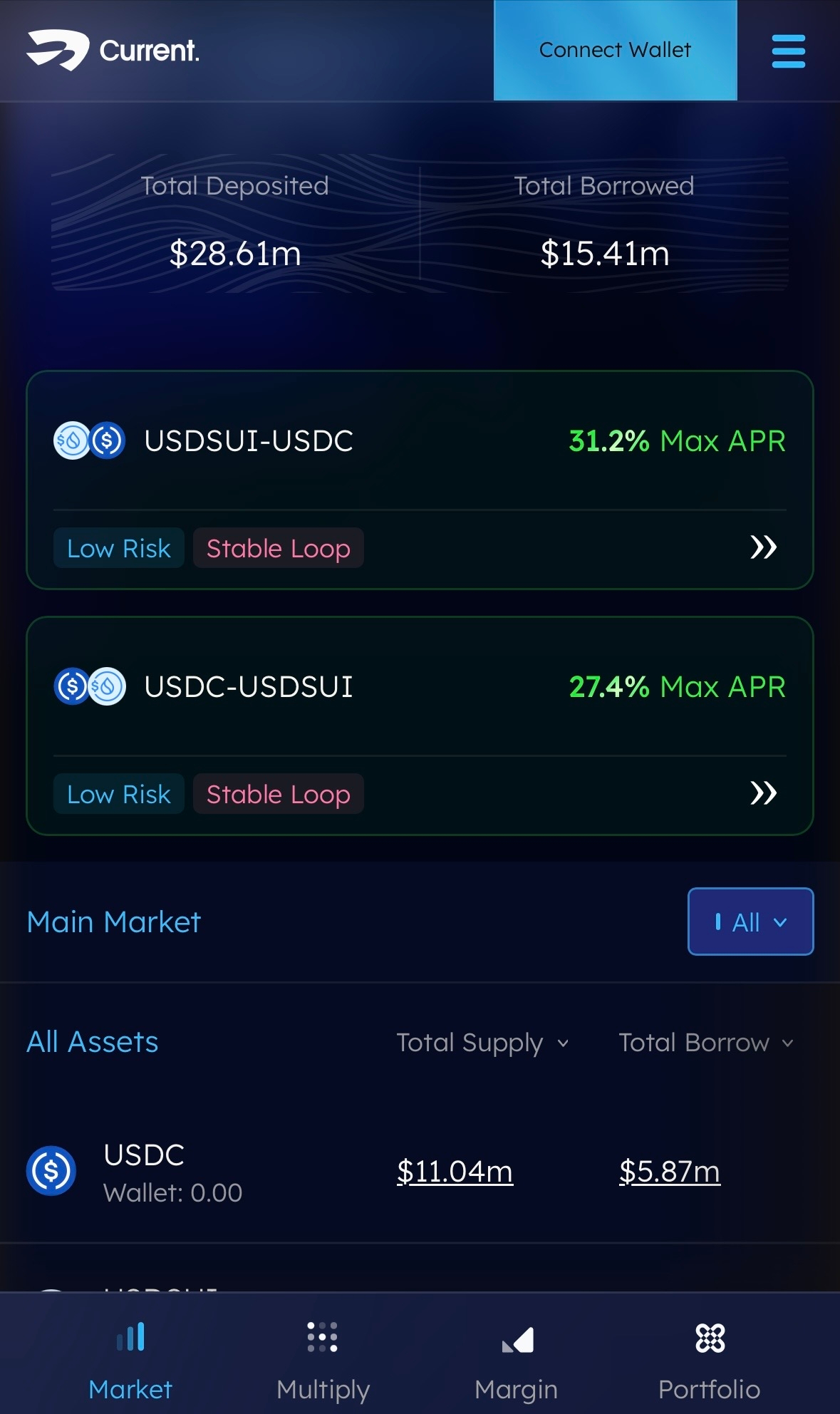
A preview of how the lending part looks like
● Multiply
This is the one worth paying attention to. You drop in a yield-bearing asset (haSUI is the popular choice), pick your leverage up to 9x, and Current handles everything else in a single transaction borrowing, swapping, looping. No manual steps, no extra gas eating into returns. What you’re actually doing is increasing your exposure to either the underlying yield or the price movement of that asset the returns don’t come from somewhere new, they’re just amplified. For example, if you’re earning yield on $1,000 worth of SUI, Multiply lets you structure exposure closer to $2,000–$3,000 depending on your leverage.
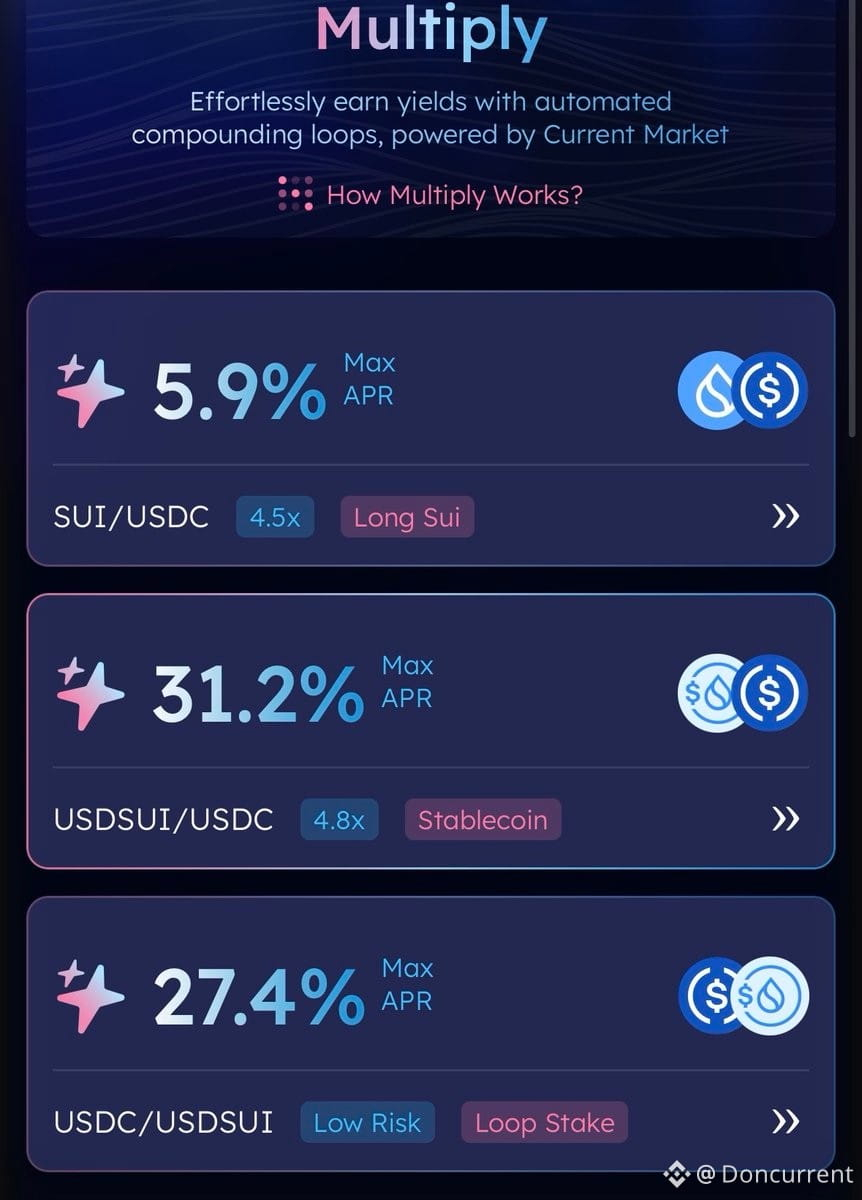
Below is the boosted APR on this meaning your returns are goated 🥶
This is literally what I was doing by hand last year. Except when I did it, one bad market move could unravel the whole thing because each step was a separate transaction with separate timing risk, and every swap in that loop introduces slippage, which quietly adds to your cost basis over time. Multiply collapses all of that into one atomic action. If something goes wrong, nothing executes you don’t get caught halfway through a loop with an exposed position.
for context: haSUI base staking sits around 2–4% APR. With Multiply running, effective yields can push well past 20% depending on the pool, part of that APR comes from incentives (like the current campaign rewards), not just the base yield so it can vary over time. It compounds automatically. You’re not doing anything fancy, you’re just letting the protocol do what it was designed to do.
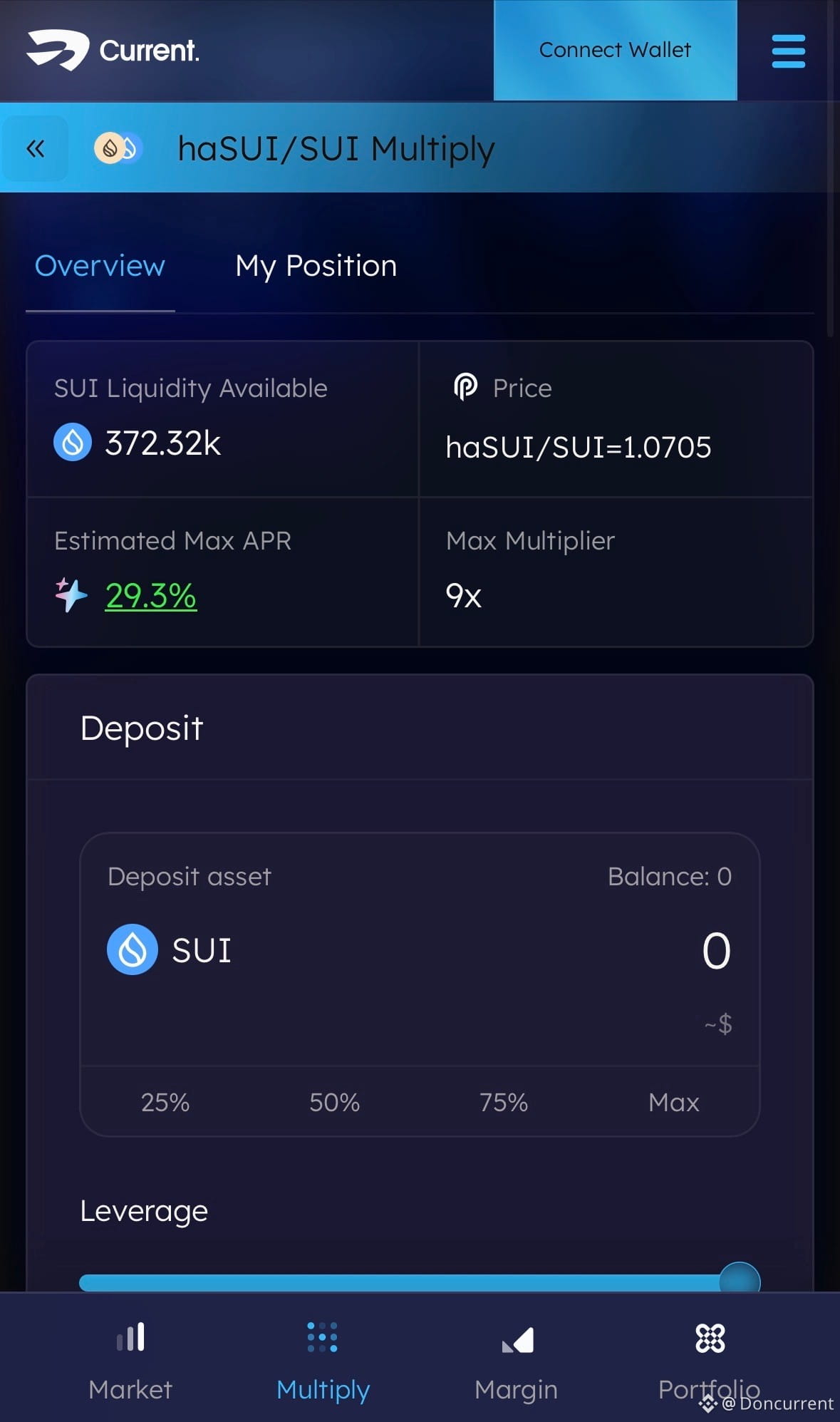
On the page you scroll down and it’s the first option there with a 1-9x leverage and it’s super cool seeing this live!!!!
But it’s important to remember that this comes with leverage your upside scales, but so does your downside
Cost-wise, you’re mainly looking at borrow rates, execution, and protocol fees. Depending on the pair, entry and exit can involve swaps (and slippage), or more efficient mint/redeem paths. It’s not zero-cost leverage, but the structure is generally cleaner than manual looping.
● Margin
For when you want a directional trade long or short without pulling your collateral out of yield. Your SUI stays productive while you trade against it. Unlike a traditional margin account where your cash just locks up, here the collateral keeps working.
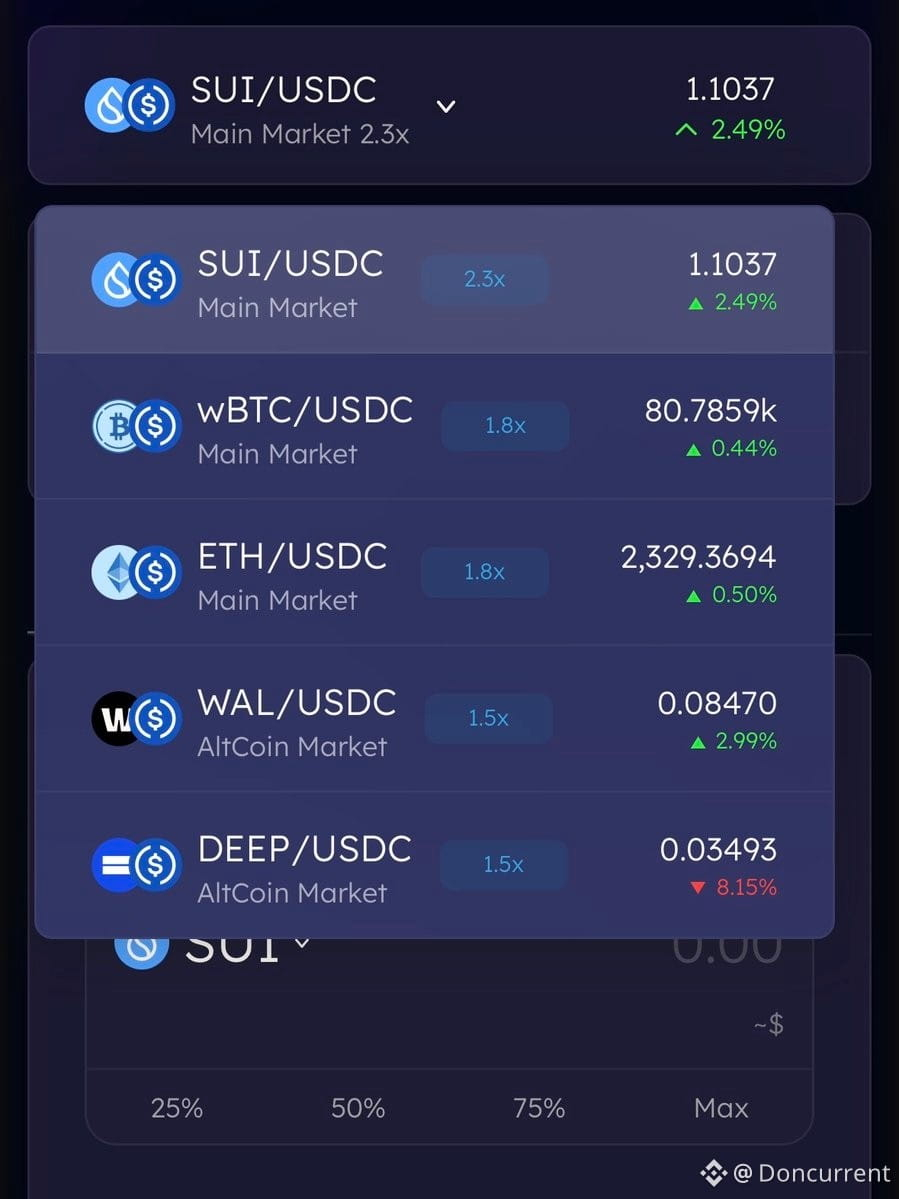
Above is the markets available on the Margin part and you can see its max leverages all attached
⭐️ Why It’s Different From Other Lending Protocols
Most protocols treat your assets like separate buckets. LSTs go here, stables go there, and if you want leverage you’re manually looping transactions and praying it doesn't wreck your math. I know because that was my entire workflow for months.
Every action ( deposit, borrow, swap, re-supply) happens atomically in one transaction. Nothing fails halfway. Nothing gets stuck. It also uses eMode for correlated asset pairs (like SUI/haSUI), which means tighter loan-to-value ratios (which is why pairs like SUI/haSUI can support higher leverage — because the assets move closely together.), and safer leverage on positions that move together.
Capital efficiency is the real pitch here. Your collateral earns while you borrow. On most other protocols, that’s not how it works.
⭐️Getting Started
Go to
app.current.finance
and connect your Sui wallet (Sui Wallet, Nightly, etc.) just make sure you have a bit of SUI for gas
2. If it’s your first time, start with Lending. Deposit something, watch how it works, get comfortable (dropping an onboarding video soon)
3. When you’re ready for Multiply: head to the Multiply tab, pick your pool, set your leverage (start at 2–3x, seriously), review the projected APR, confirm
4. One transaction. Done. Monitor from the dashboard, adjust anytime — no lockups
The dashboard shows utilization rates, LTV, and projected returns clearly. You’re not guessing at anything.
Security
• Audited by Asymptotic Tech and MoveBit
• Audit contest run through Sherlock
• Risk modeling done by Allez Labs
• Formal verification on top of all of that
Isolated risk pools mean one bad position doesn’t contaminate the whole protocol. No hidden admin controls. Everything’s verifiable on-chain.
⭐️ What’s Happening Right Now Spring Tide (April 22 – May 22)
There’s a 30-day campaign running through May 22nd. Open a Long SUI position on Multiply or Margin and you’re automatically entered into a 5,000 SUI reward pool, on top of regular daily liquidity mining. Combined with reduced fees during the campaign, it shifts the cost/reward balance slightly more in your favor right now.
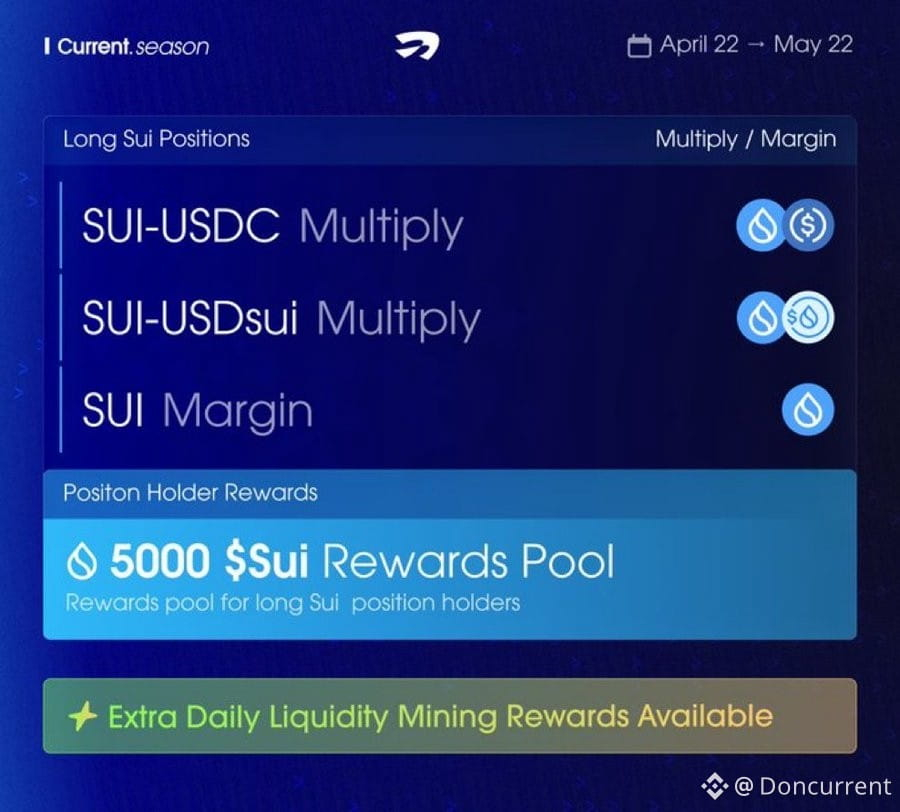
Rewards are based on your 30-day average position size:
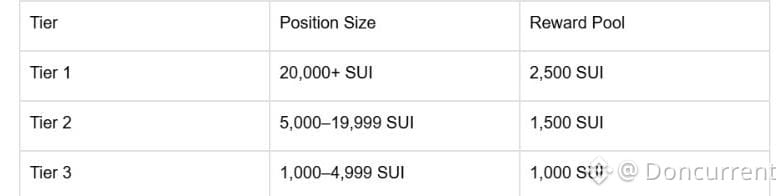
You don’t need to time entries perfectly. Just open your position, keep it running, and the rewards stack on top of whatever yield you’re already earning.
To participate:
1. Go to
app.current.finance/multiply
2. Choose a Long SUI pool (SUI-USDC or SUI-USDsui)
3. Deposit, set leverage, confirm
Also do you know?
Using a referral code gives you a 4% rebate anytime you explore a flash loan and this occurs when you interact on Multiply & Margin trading
Use code to reduce the fees your being charged: yautn2
That’s the whole process.
Links
• App:
https://app.current.finance/
• Website:
https://www.current.finance/
• X/Twitter:
https://x.com/CurrentSUI
Spring Tide won’t run forever. If you’ve been meaning to actually put your SUI to work instead of just staking and passively earning a few percent, this is a reasonable time to start. Open small, learn the interface, scale from there.
The protocol is solid. The incentives are live. Worth a look. 🌊
Let’s explore the tide together let’s go current