
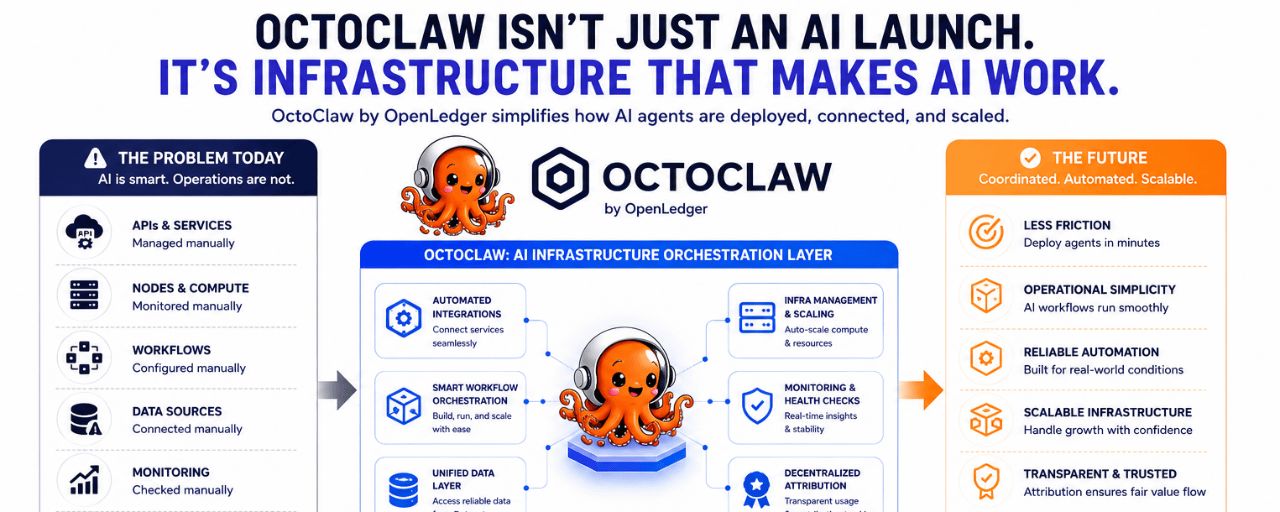
I think one of the biggest misconceptions in crypto right now is that people still confuse visible intelligence with usable infrastructure.
The market gets excited every time a new AI agent appears. New interface. New assistant. New “autonomous” workflow. But after using enough of these products, the experience usually feels the same underneath.
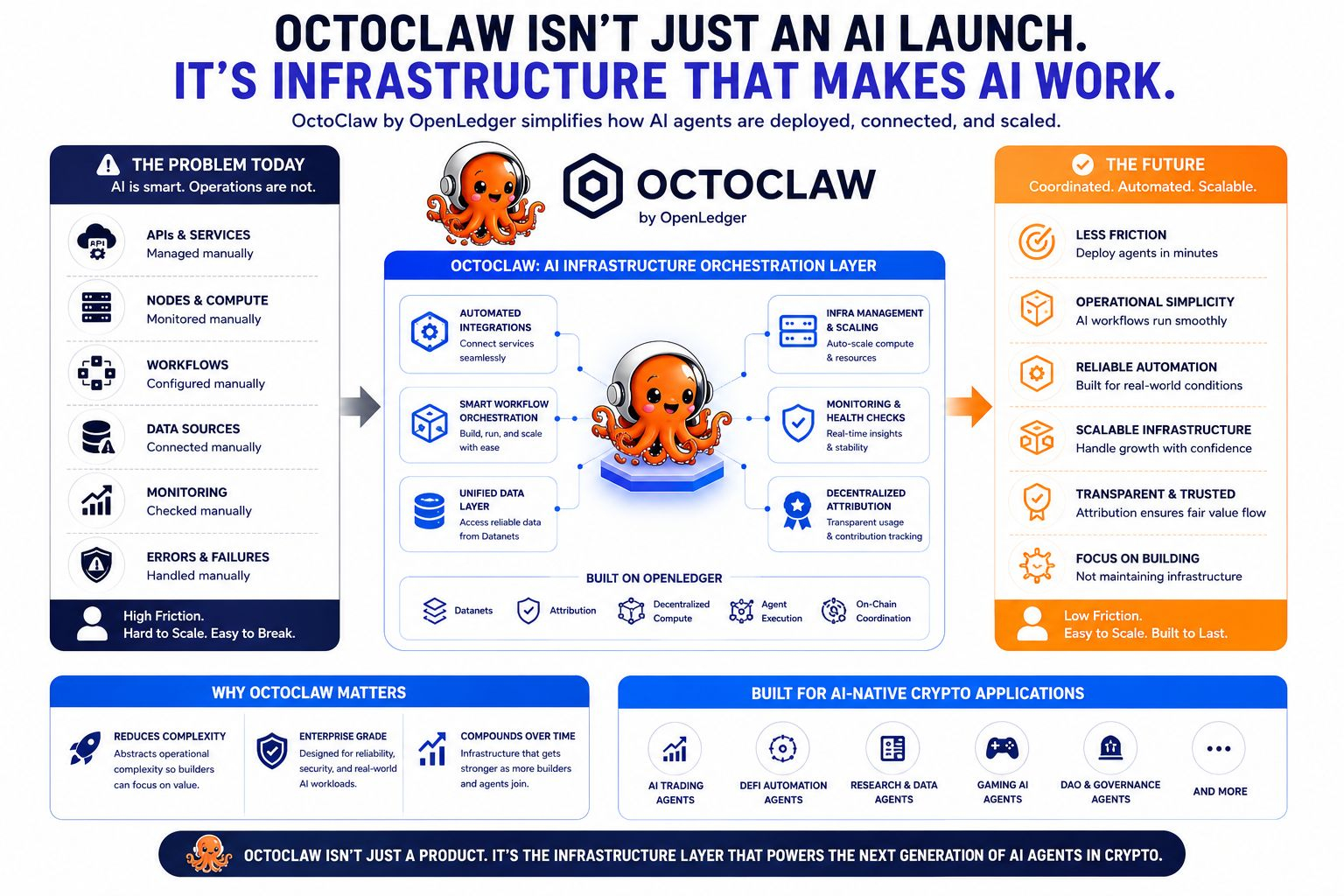
You still manage APIs manually.
Still monitor nodes manually.
Still configure workflows manually.
Still spend hours making sure every service is connected correctly.
The AI sounds smart, but the operational layer still feels fragile.
That’s why the OctoClaw launch from OpenLedger caught my attention more than I expected.
Not because it introduces another AI narrative. Honestly, crypto already has enough of those. Every cycle invents new terminology for roughly the same promise: autonomous systems, intelligent coordination, decentralized agents, self-operating networks.
But when you strip away the language, the real problem remains surprisingly boring:
most AI systems are still difficult to operate reliably at scale.
And that’s exactly where OctoClaw seems interesting to me.
The way I see it, OpenLedger is not trying to make AI feel more futuristic. They seem to be focusing on reducing the operational friction between infrastructure, workflows, compute coordination, and deployment itself.
Which sounds small until you realize how much crypto still depends on manual maintenance.
I actually think AI infrastructure today resembles early cloud infrastructure more than people realize.
Back then, deploying servers was technically possible, but the process was painful enough that only highly technical users could manage it comfortably. Eventually companies like AWS won not because they invented computing, but because they simplified operational complexity.
That’s partly the lens I’ve started looking through when thinking about OctoClaw.
If OpenLedger can make AI workflow deployment feel less fragmented, less dependent on constant human oversight, and more scalable for developers building agents or AI-powered systems, then the value proposition becomes much bigger than just “another AI tool.”
Because operational simplicity compounds over time.
Especially in crypto environments where everything is already fragmented:
multiple chains,
different execution environments,
decentralized data sources,
fluctuating compute demands,
changing network conditions,
unstable APIs,
and constantly shifting incentives.
Trying to coordinate AI agents across all of that manually becomes exhausting very quickly.
And honestly, I think the industry underestimates how much user fatigue slows adoption.
People talk about intelligence constantly, but users usually care more about reliability than sophistication. A system that works consistently with fewer steps often beats a smarter system with more complexity.
That’s why OctoClaw feels like an important signal for OpenLedger’s direction.
It suggests the project is moving deeper into infrastructure orchestration rather than staying at the surface-level “AI assistant” layer that most crypto products stop at.
I also think this aligns naturally with OpenLedger’s broader architecture around Datanets, attribution systems, and decentralized coordination.
Because once AI agents become more integrated into crypto systems, the challenge is no longer just generating outputs. The challenge becomes:
workflow management,
execution coordination,
infrastructure scaling,
data reliability,
and sustainable automation.
That’s operational infrastructure territory.
And usually, infrastructure products only become appreciated after enough people start depending on them daily.
Of course, I still have a lot of questions.
Can OctoClaw actually reduce complexity long term, or does it simply abstract complexity into another layer? Will developers continue building on it once the early excitement fades? Can the system maintain reliability once usage scales beyond controlled environments?
Those are the real tests.
Because infrastructure always looks clean during demos. The difficult part begins when real users introduce unpredictable behavior, unstable demand, and messy operational conditions.
Still, compared to most AI launches lately, OctoClaw feels more grounded in a real problem.
Not “how do we make AI look impressive?”
But:
“How do we make AI systems easier to operate inside crypto without overwhelming users and developers?”
That’s a much harder problem than marketing autonomous agents.
And probably a much more important one too.