
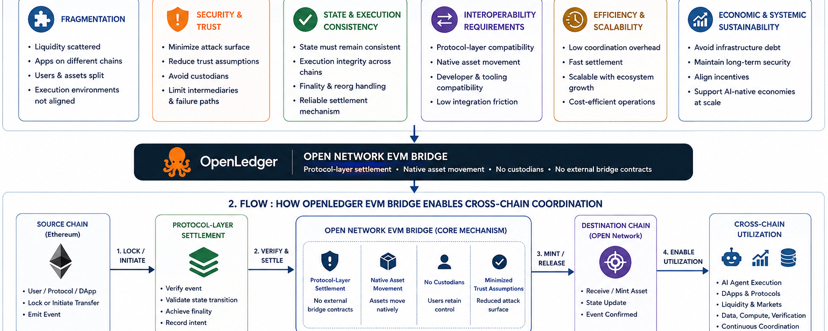
I kept thinking about something after seeing OpenLedger push the OPEN Network EVM Bridge live between Ethereum and OPEN Network.
People usually treat bridges like movement infrastructure.
Move asset A from chain A to chain B.
Done.
Transaction complete.
Problem solved.
But after spending enough time around crypto systems, that explanation always feels incomplete.
Because assets moving is rarely the hard part.
State consistency is hard.
Trust assumptions are hard.
Execution integrity is hard.
Cross-chain systems keep expanding, but fragmentation expands with them. Liquidity sits in one place. Applications live somewhere else. Users hold assets across different environments. AI systems operate across increasingly fragmented execution layers.
The industry solved expansion.
It still struggles with coordination.
That is the layer I keep noticing inside OpenLedger.
The OPEN Network EVM Bridge is not positioned like traditional infrastructure trying to add another dependency layer on top of execution. The mechanism matters more than people initially realize.
Protocol-layer settlement.
Native asset movement.
No custodians.
No external bridge contracts sitting as extra assumptions between environments.
That changes architecture.
Most bridge discussions stay trapped around speed.
Few stay around attack surface.
Every extra intermediary creates more complexity.
More trust assumptions.
More failure paths.
Crypto history keeps teaching the same lesson.
Infrastructure becomes fragile when coordination depends on too many moving parts.
OpenLedger feels increasingly focused on reducing coordination friction itself.
That matters more as AI-native systems become larger.
Because future autonomous execution systems will not live inside one chain.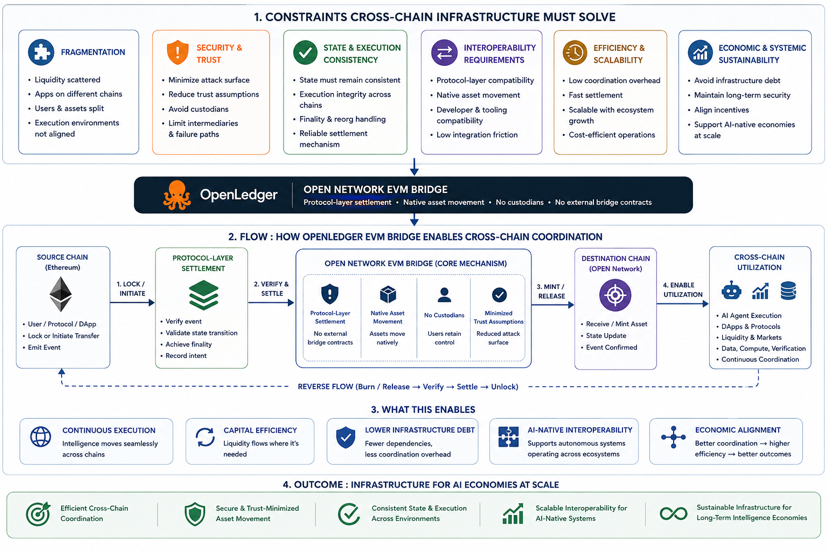
They cannot.
Data moves.
Execution moves.
Intelligence moves.
Capital moves.
Verification moves.
An AI coordination layer eventually collides with chain fragmentation whether builders like it or not.
That collision quietly becomes infrastructure debt.
OpenLedger increasingly feels architected around removing those invisible penalties.
Its EVM compatibility already lowers integration friction for developers building around Ethereum tooling, wallets, contracts and existing ecosystems. Builders do not need to rebuild workflows from zero before experimenting with AI-native infrastructure.
The bridge layer extends that thinking.
Because interoperability is no longer optional infrastructure.
It becomes survival infrastructure.
Markets increasingly behave like connected execution environments rather than isolated ecosystems.
An intelligence economy operating across fragmented chains eventually creates a bottleneck.
Not intelligence bottlenecks.
Movement bottlenecks.
Verification bottlenecks.
Settlement bottlenecks.
Coordination bottlenecks.
That bottleneck quietly leaks efficiency.
I keep coming back to this idea with OpenLedger.
People still look at AI infrastructure mostly through model quality.
Better models.
Faster inference.
Smarter agents.
But autonomous systems eventually run into something less visible.
Execution continuity.
Can intelligence move where it needs to move without creating trust expansion?
Can capital synchronize across execution environments without adding hidden complexity?
Can systems coordinate continuously while conditions mutate underneath them?
That feels closer to what infrastructure starts becoming here.
Not chain expansion.
Coordination expansion.
Because future AI economies probably do not fail because intelligence disappears.
They fail because intelligence cannot move efficiently between systems that were never designed to coordinate.
OpenLedger increasingly feels like it is building for that future earlier than most people realize.
And infrastructure usually matters most right before people finally notice it.
