
I used to think DeFi automation mostly meant making actions faster.
Faster execution.
Faster rebalancing.
Faster movement.
The assumption felt simple. Markets move quickly, so infrastructure wins by reacting quickly.
The more time I spent looking deeper into OpenLedger’s autonomous collateral direction, the less complete that idea started feeling.
Speed matters.
But speed without coordination creates different problems.
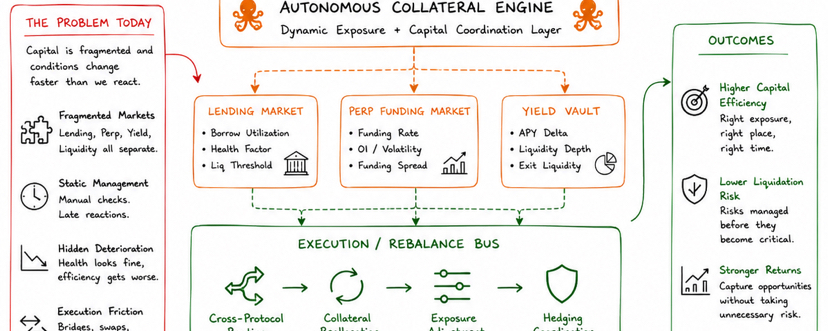
A lot of DeFi capital today still lives inside fragmented environments. Lending markets sit in one place. Yield opportunities sit somewhere else. Liquidity conditions change somewhere else. Funding environments move independently. Stablecoin pools carry their own conditions. Cross-chain movement introduces another layer entirely.
Most people do not think about all of it together.
Usually we focus on one thing.
Health factor looks fine.
Yield looks attractive.
Position survives.
Move on.
The more I sat with OpenLedger’s framework, the more one uncomfortable thought stayed with me.
A position can stay alive while becoming worse.
Not liquidation worse.
Efficiency worse.
That difference feels heavily underestimated.
One thing that kept pulling my attention back toward OpenLedger was that the framework does not treat collateral like an isolated number.
The system starts treating capital like something sitting inside changing conditions.
That feels closer to how real markets behave.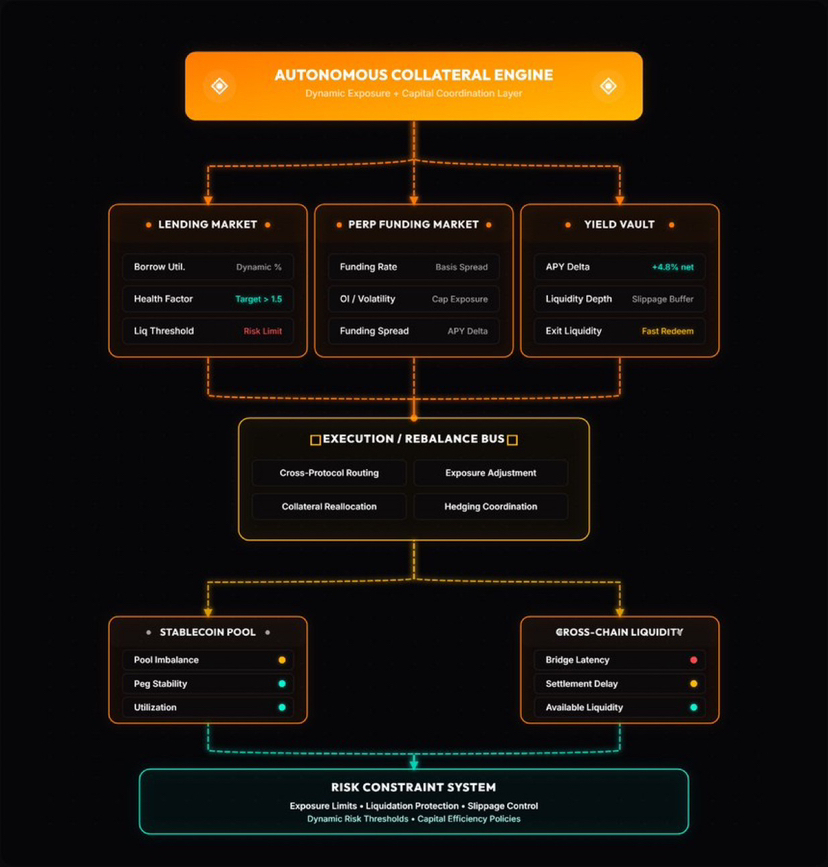
Looking through the autonomous collateral structure, the part that stood out was not APY optimization.
People already understand APY.
The more interesting layer was coordination.
Borrow utilization gets monitored.
Funding environments get monitored.
Liquidity depth matters.
Vault conditions matter.
Cross-chain movement conditions matter.
Stablecoin conditions matter.
Not separately.
Together.
That changes what capital management becomes.
Normally DeFi collateral systems rely heavily on static thinking.
Deposit collateral.
Maintain health factor.
Watch liquidation thresholds.
Maybe rebalance manually later.
The weakness shows up when conditions underneath the position shift quietly.
Borrow utilization changes.
Liquidity quality changes.
Funding conditions move against exposure.
Bridge conditions become less efficient.
Yield quality changes.
The dashboard still looks healthy.
The position slowly becomes weaker.
That operational deterioration feels more realistic than the usual liquidation discussion.
OpenLedger kept pulling me back toward that idea.
The framework increasingly feels designed around recognizing changing conditions before deterioration becomes obvious enough that humans finally react.
That changes the role autonomous systems play.
The diagram made something click for me.
The execution and rebalance layer sits in the center.
Cross-protocol routing.
Collateral reallocation.
Exposure adjustment.
Hedging coordination.
That architecture feels important because markets rarely punish isolated mistakes.
Markets punish delayed coordination.
The longer capital stays disconnected from changing conditions, the harder efficiency becomes to maintain.
Cross-chain liquidity made this feel even more relevant.
People usually describe capital movement very cleanly.
Move liquidity.
Find better opportunity.
Optimize returns.
Real conditions rarely behave that cleanly.
Bridge latency changes movement quality.
Settlement timing matters.
Available liquidity matters.
Execution quality changes depending on operating conditions underneath movement itself.
That operational layer kept staying in my head while looking deeper into OpenLedger.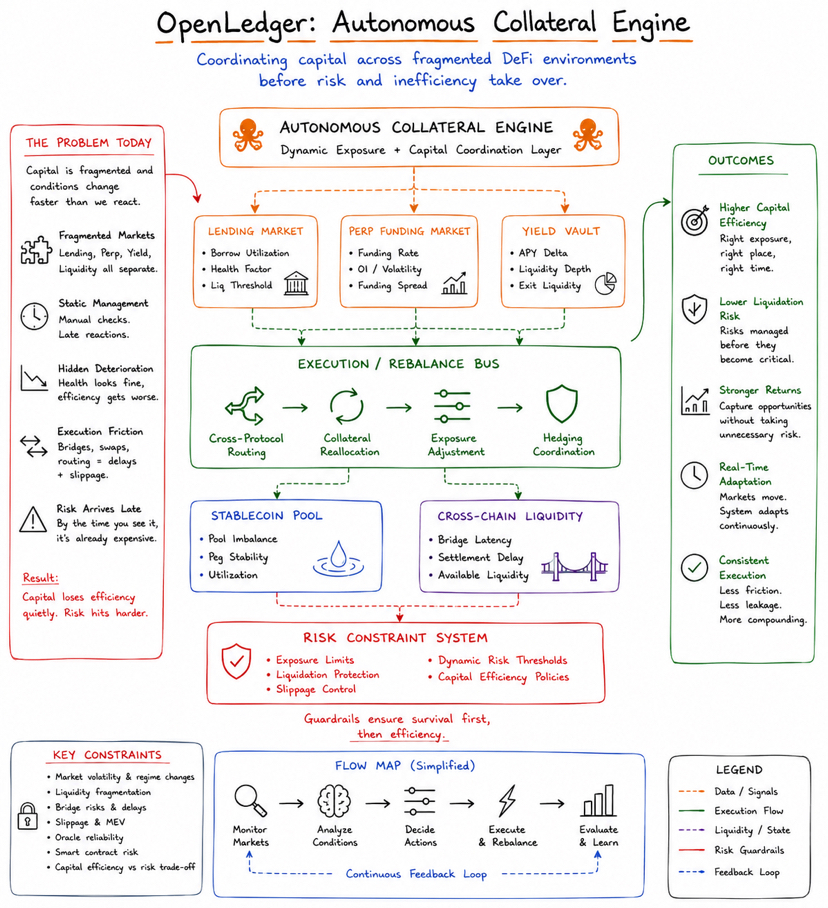
Because users already carry enough invisible burden.
Open dashboards.
Monitor positions.
Track conditions.
Interpret changes.
Adjust manually.
Repeat.
Most people think they are managing positions.
Sometimes they are managing complexity.
That distinction stayed with me.
The stablecoin side stood out too.
Pool balance.
Peg stability.
Utilization conditions.
People ignore those variables when markets feel calm.
During stress conditions they suddenly become critical.
The framework increasingly feels designed around that reality.
Capital efficiency does not disappear all at once.
It leaks quietly.
OpenLedger’s autonomous collateral direction kept pushing me toward that thought.
Maybe future DeFi infrastructure matters less because it helps users react faster.
Maybe it matters more because it reduces how much invisible deterioration builds before reaction becomes necessary.
That feels bigger than automation.
Because fragmented environments keep expanding.
Liquidity keeps fragmenting.
Yield keeps fragmenting.
Capital coordination becomes harder.
The longer I sat with OpenLedger’s framework, the less autonomous collateral coordination felt like another AI feature.
It started feeling closer to infrastructure built around protecting capital quality while conditions keep changing underneath it.
That feels increasingly important as DeFi becomes larger.
Because future systems probably do not win simply by finding opportunity.
They win by maintaining efficiency while environments refuse to stay stable.
