
I think one of the biggest misconceptions in crypto right now is how people define automation 🔄📊
Every cycle introduces another “autonomous” platform, another AI workflow system, another orchestration layer promising a future where everything runs automatically in the background. But once you spend enough time actually using these products, the reality feels much less elegant.
Users still reconnect wallets manually. Still restart workflows manually. Still monitor APIs manually. Still check whether nodes, queues, or integrations silently failed somewhere along the pipeline 👀🧩
That’s the strange contradiction I keep noticing in AI x Crypto.
The industry talks constantly about autonomy, yet most systems still depend heavily on human supervision.
And honestly, I don’t think the main problem is intelligence anymore.
It’s coordination.
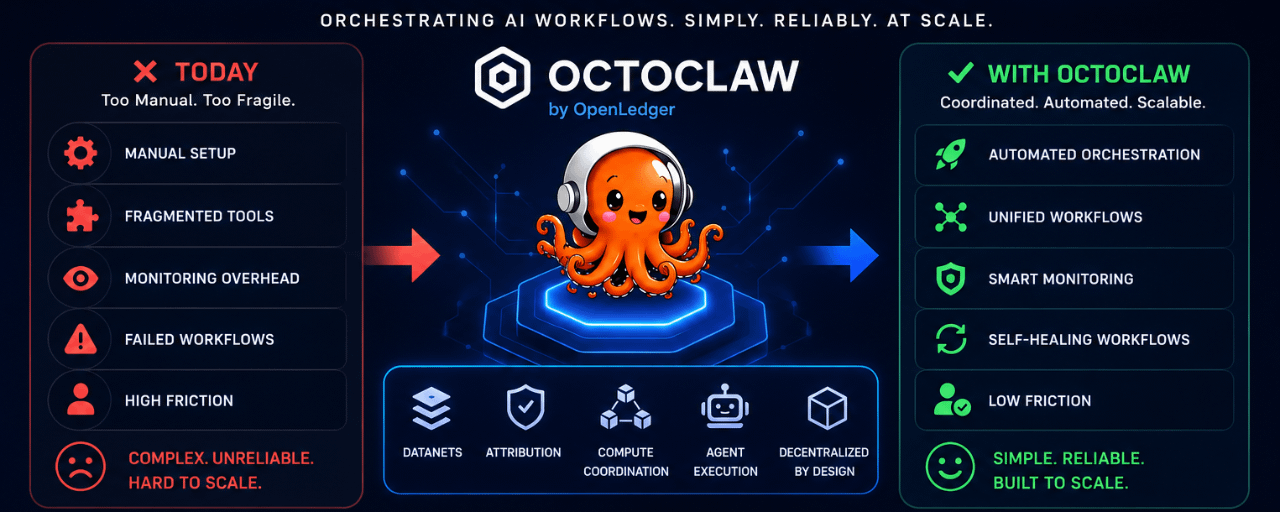
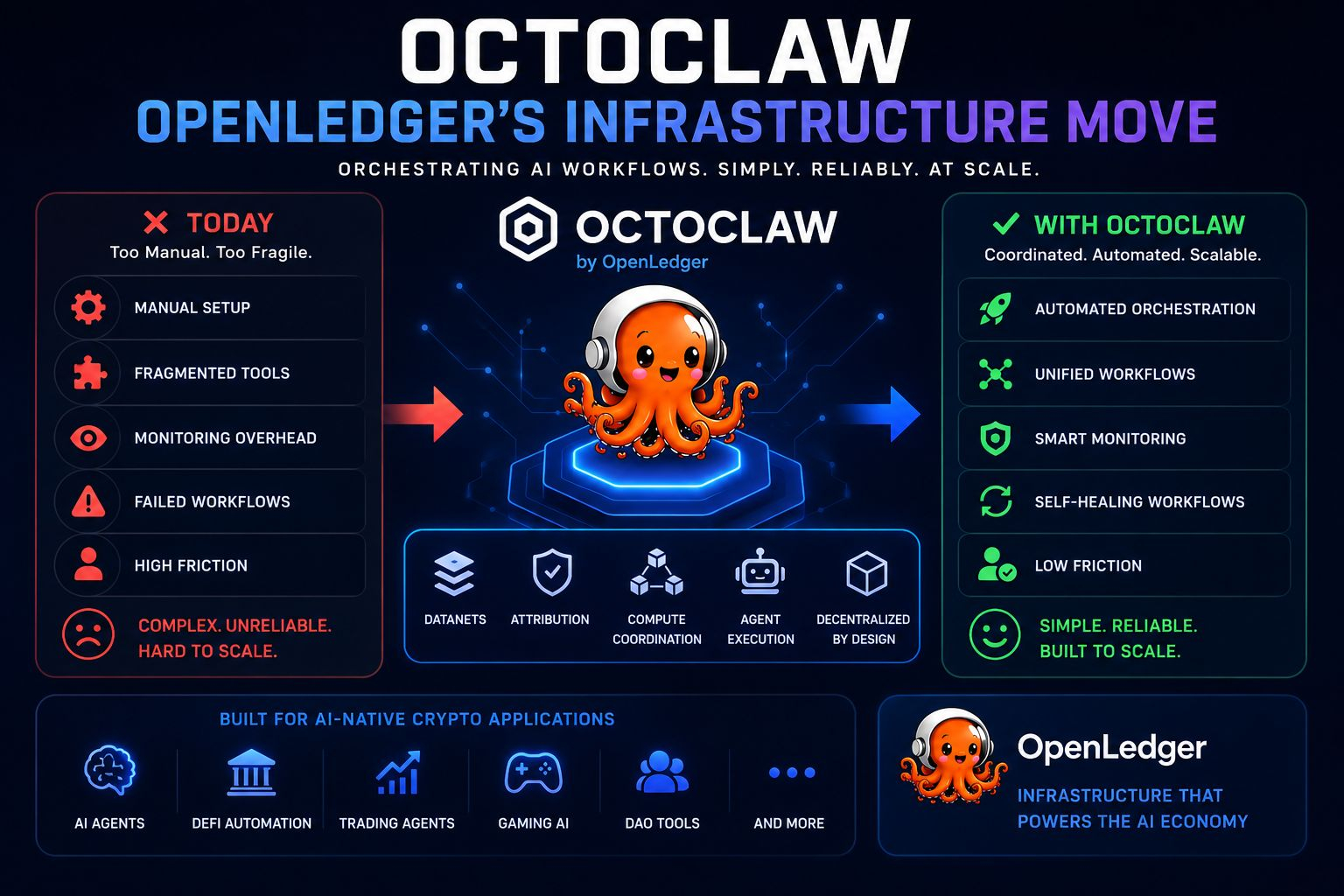
Most current AI systems feel like fragmented layers stitched together through middleware and interfaces. One tool handles data. Another handles execution. Another handles monitoring. Another manages permissions. Eventually the entire setup starts looking less like automation and more like infrastructure maintenance disguised as innovation ⚡🔧
That’s partly why OctoClaw caught my attention.
Not because OpenLedger is promising AGI or some futuristic AI replacement narrative. I’ve become pretty numb to those buzzwords at this point 🚀🌍
What feels different is that OctoClaw seems focused on reducing operational fragility rather than simply adding another “smart” layer on top of existing complexity.
And I think that distinction matters more than people realize.
A lot of projects are obsessed with making agents appear more human. Better conversations. Better reasoning. Better personalities.
OpenLedger seems to be taking a quieter infrastructure-first approach instead.
Less: “how intelligent can the agent sound?”
More: “how reliably can automation function once real-world complexity appears?”
That’s a much harder problem.
Because automation inside crypto is messy by nature 📈⚙️
Networks change. APIs break. Data becomes noisy. Latency spikes unexpectedly. User behavior shifts constantly. Even simple workflows can become fragile once they interact across multiple chains and services simultaneously.
The more layers added to a system, the more points of failure appear.
Ironically, many projects call that scalability.
That’s why I think OctoClaw is an important step for OpenLedger’s broader vision around decentralized AI infrastructure.
From my perspective, it feels less like a standalone product and more like an orchestration layer trying to stabilize how AI workflows actually operate under real conditions.
And honestly, that operational layer is probably where most AI systems eventually succeed or fail.
Because users do not truly care how sophisticated the backend sounds if the workflow itself still creates fatigue.
Crypto already overwhelms people with repetitive operational tasks:
reconnecting wallets,
monitoring automations,
restarting failed workflows,
checking whether executions completed,
tracking fragmented data across different dashboards 🔄📊
At some point, the “automation” itself becomes another thing users have to babysit.
That’s the paradox the industry still hasn’t solved.
And maybe that’s why OctoClaw feels more interesting to me than many recent AI launches. It’s not trying to sell a fantasy of fully autonomous intelligence overnight. It seems more focused on making automation less brittle, less fragmented, and less dependent on constant user oversight 🧠💡
Of course, I’m still cautious.
Infrastructure always looks impressive during demos. The real pressure begins when systems face unpredictable usage, edge cases, scaling bottlenecks, and thousands of concurrent workflows operating outside controlled environments 👀⚡
That’s usually when abstraction layers either simplify complexity… or simply hide it temporarily behind cleaner interfaces.
So I don’t see OctoClaw as a finished answer yet.
But I do think it signals something important about OpenLedger’s direction.
The project seems increasingly focused on operational reality rather than pure AI narrative.
And in crypto, the projects that quietly reduce friction often end up surviving longer than the ones creating the loudest hype 🌐🚀🧩
I’ll keep watching how this evolves once real usage starts putting pressure on the system.
Because infrastructure products are rarely remembered for the announcement itself.
They’re remembered when users rely on them so naturally that they stop noticing the infrastructure entirely.