
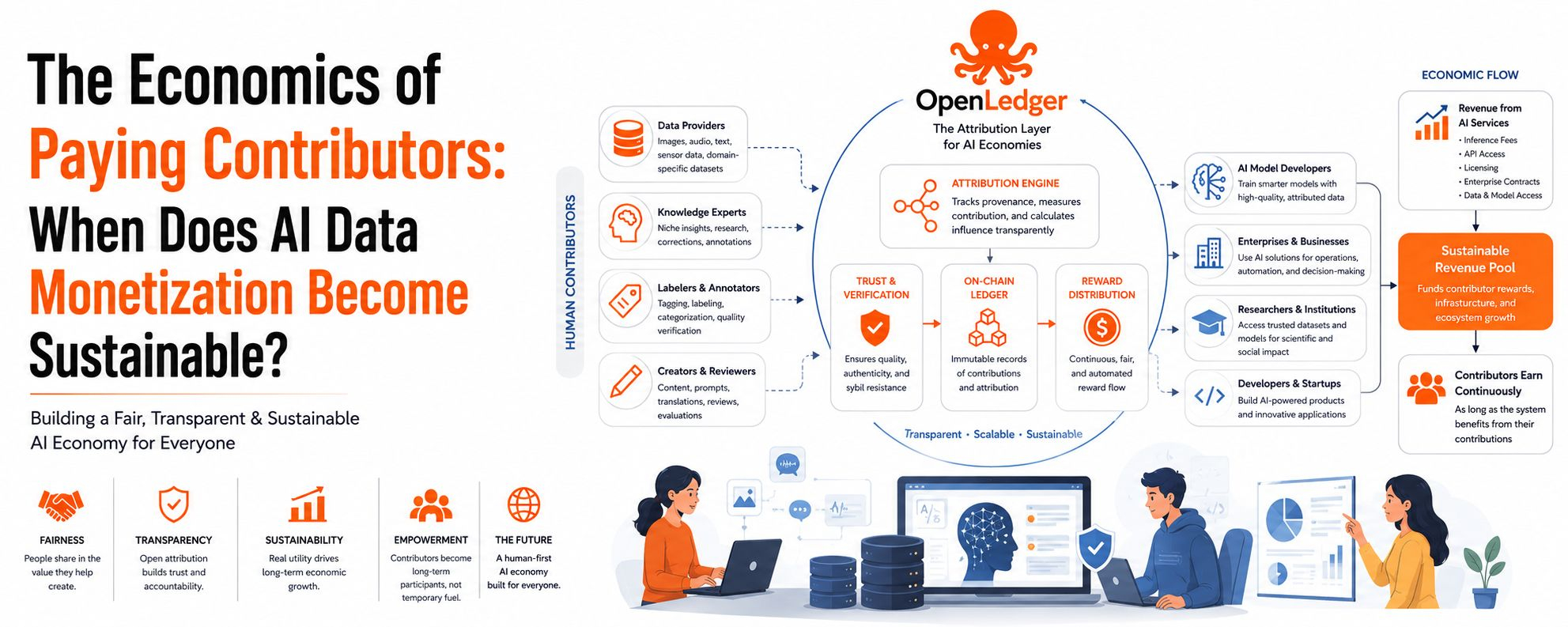
There’s something deeply strange happening in the AI world right now.
Millions of people are quietly feeding intelligence into machines without ever really being seen. Someone records voice samples for a few dollars. Someone labels medical images late at night after work. Someone writes corrections, translations, prompts, captions, reviews, or niche research that eventually helps train a smarter AI system. Piece by piece, human experience is being converted into machine capability.
And yet most contributors disappear the moment the model becomes successful.
The AI gets the spotlight. The platform gets the valuation. Investors get the upside. But the people whose data, knowledge, and labor helped shape the intelligence are often treated like temporary fuel.
That imbalance is exactly why projects like OpenLedger are starting to attract attention.
The idea behind it feels emotionally simple even if the technology underneath is complex: if your data, your model, or your contribution helps create value inside an AI system, then you should share in that value. Not once. Not symbolically. But continuously, for as long as the system keeps benefiting from what you helped build.
And honestly, that idea touches something the AI industry has ignored for too long.
Because beneath all the hype around artificial intelligence, there’s a very human question hiding underneath everything:
What happens to the people teaching the machines?
One of the biggest illusions in technology is the phrase “artificial intelligence.” The intelligence itself is still deeply human. AI systems learn from human conversations, human decisions, human mistakes, human creativity, human corrections, and human behavior patterns. Even the most advanced models are reflections of enormous amounts of human input layered together over time.
For years, the internet worked like an open mine. Companies scraped articles, forums, videos, conversations, and public websites at enormous scale. The assumption was simple: data was abundant, mostly free, and endlessly available.
That era is slowly breaking apart.
High-quality public data is becoming harder to access. Copyright concerns are growing. Platforms are restricting scraping. Specialized datasets are becoming expensive. And at the same time, AI companies are realizing that quality matters far more than quantity.
A million weak samples are often less useful than a few thousand highly curated ones created by people who actually understand a subject deeply.
And suddenly, contributors matter again.
Not as background noise. As infrastructure.
That changes the economics completely.
A lot of people think the challenge is simply figuring out how to pay contributors. But paying contributors is actually the easy part. The hard part is making those payments sustainable long after the excitement fades away.
Anyone can launch rewards during a hype cycle. Anyone can distribute tokens when growth is fast and attention is high. But sustainability begins the moment speculation slows down and the system has to survive on real economic activity.
That’s where reality becomes uncomfortable.
A contributor economy only survives if the value being created is larger than the cost of maintaining the network itself. The long-term revenue generated by models has to consistently exceed the cost of collecting data, verifying it, storing it, governing it, attributing contributions correctly, and rewarding people fairly.
If those numbers stop making sense, even the most beautiful vision eventually weakens.
And this is where OpenLedger’s core idea becomes interesting.
It isn’t just trying to create a place where people upload data for one-time rewards. It’s trying to build a system where contributions remain economically connected to downstream usage through attribution.
That difference matters more than people realize.
Imagine spending years helping train systems that continue generating enormous value long after your original contribution was made. In most systems today, the relationship ends the moment you get paid once. After that, your contribution keeps working while you slowly disappear from the economic picture.
That creates a quiet emotional resentment.
People can tolerate imperfect systems. They can tolerate volatility. They can even tolerate small rewards in the early stages. But what people hate is feeling invisible. They hate feeling extracted from.
Nobody wants to feel like they helped build something powerful only to discover they were treated as disposable labor the entire time.
And honestly, that feeling is spreading across the AI industry right now.
Writers are watching language models become stronger. Designers are watching image generation improve rapidly. Programmers are helping train coding assistants. Voice actors are contributing to speech systems. Everywhere you look, people are starting to ask themselves the same uneasy question:
Am I helping build the thing that eventually replaces me?
That fear is not irrational.
And that’s why sustainable AI monetization cannot rely only on short-term payouts. If contributors feel disposable, trust eventually collapses. If rewards feel exploitative, participation weakens over time.
A lasting AI economy needs contributors to feel like participants in ownership rather than temporary suppliers of raw material.
That emotional trust matters more than many blockchain systems realize.
But this is also where things become technically difficult.
The moment you promise ongoing rewards, you need a reliable way to measure contribution. And that sounds simple until you actually try to do it.
How much did one dataset improve a model? Which contributor mattered most? How do you calculate influence fairly when thousands of people contribute overlapping information? How do you prevent manipulation? How do you track provenance at scale without making the system unbearably expensive to operate?
This is where many idealistic AI economies quietly collapse.
The ethics sound beautiful. The economics break underneath them.
Because attribution itself can become extremely costly. If measuring contribution costs more than the value generated, the system eventually suffocates under its own complexity.
That’s why attribution may actually be the most important layer in the entire future AI economy.
Not the token. Not the branding. Not the marketing.
The attribution layer.
Because if attribution becomes scalable, transparent, and cheap enough to operate efficiently, then entirely new digital labor economies become possible. People stop being anonymous data suppliers and start becoming measurable economic participants.
And honestly, that changes the emotional relationship between humans and AI in a profound way.
Instead of feeling consumed by the system, contributors begin feeling connected to its success.
But the economics only work if real value keeps flowing through the network.
This is the uncomfortable truth most people avoid talking about: contributor rewards cannot survive forever on hype alone. Eventually the models, datasets, and AI services need to generate real usage from real users solving real problems.
Sustainable monetization comes from utility.
It comes from businesses paying for inference. Developers paying for high-quality models. Researchers paying for trusted datasets. Companies paying for specialized intelligence they cannot easily replicate themselves.
Without that flow of real economic activity, contributor rewards slowly become subsidies instead of sustainable income.
And users are becoming increasingly good at spotting the difference.
What’s happening now feels similar to the early internet before creators realized the value of their content. At first, people gave everything away freely because the systems were new. Later, creators started demanding ownership, licensing rights, subscriptions, royalties, and revenue sharing.
AI may be entering that exact phase now.
Contributors are beginning to ask harder questions.
Where did this model learn from?
Who owns the training data?
Who gets paid?
Who gets ignored?
Who captures most of the value?
Those questions are not going away.
In fact, they may define the next era of AI infrastructure entirely.
Because eventually the industry runs into a simple truth that cannot be avoided forever:
Human intelligence is expensive.
Not emotionally. Economically.
High-quality expertise, niche knowledge, emotional nuance, domain-specific reasoning, cultural understanding, and accurate human judgment are incredibly difficult to replace. As AI systems become more advanced, trustworthy human contribution may actually become even more valuable instead of less.
That’s the irony at the center of all this.
The smarter AI becomes, the more valuable high-quality human input may become too.
And maybe that’s why this entire conversation feels bigger than technology.
It’s really about whether the future AI economy will continue treating humans like invisible infrastructure or finally start treating them like long-term participants in the value they help create.
That’s the real lilne between extraction and sustainability.
And sooner or later, every AI platform will be forced to choose which side of that line it stands on.
