
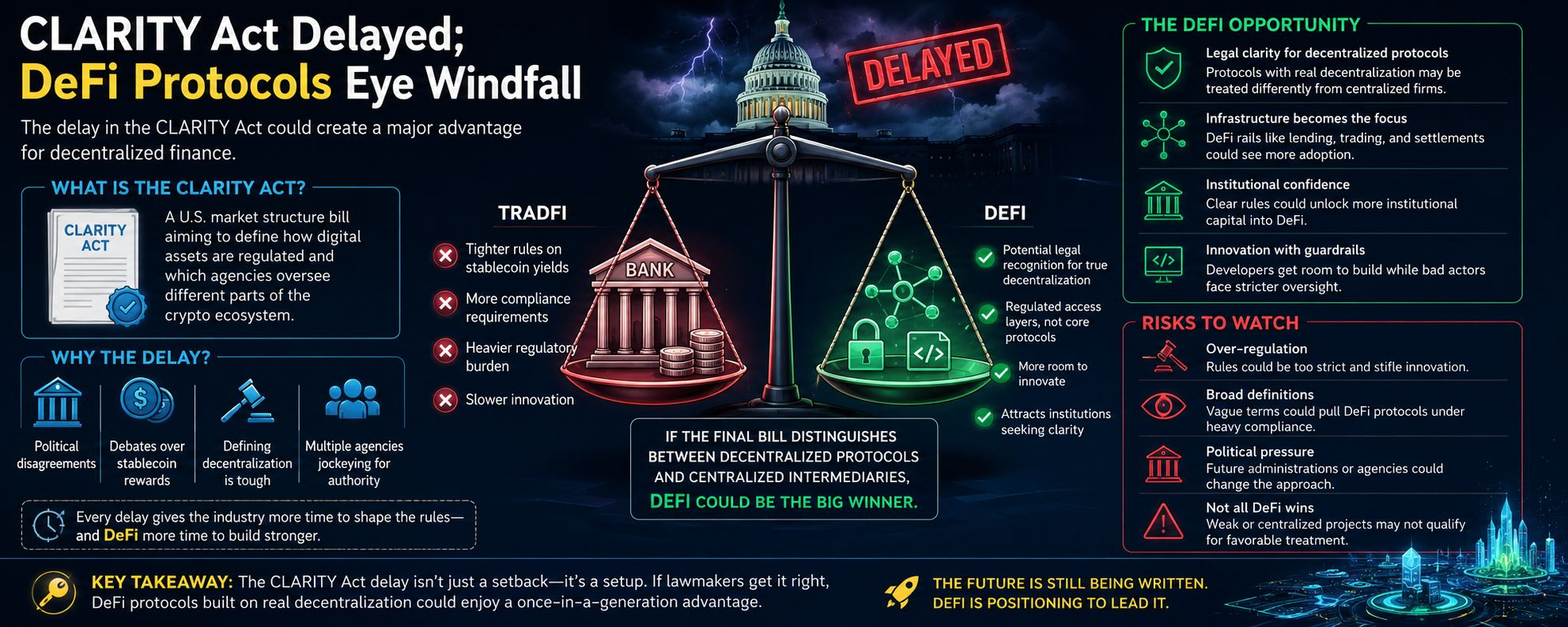

The Delay Is Starting to Matter More Than the Bill Itself
I’ve been watching the CLARITY Act discussions for months now, and what stands out to me isn’t just the bill itself anymore. It’s the delay around it.
At first, the slowdown looked like another familiar Washington story. Lawmakers debating definitions, financial institutions pushing back against crypto expansion, regulators trying to divide authority, and the industry waiting for answers that always seem one meeting away.
But the longer the negotiations drag on, the more this situation starts exposing something bigger underneath the surface.
The delay is beginning to reshape the crypto market before the law is even finalized.
And oddly enough, DeFi protocols may end up benefiting the most from that uncertainty.
Why the CLARITY Act Became So Important
For years, crypto companies operated inside a confusing legal environment where nobody fully agreed on what digital assets actually were.
Some regulators treated tokens like securities.
Others leaned toward commodities.
Different agencies interpreted the same products in completely different ways.
That uncertainty became part of the industry itself. Exchanges built products carefully. Developers launched protocols while hoping enforcement priorities wouldn’t suddenly shift. Investors learned that legal interpretation could move markets almost as much as technology.
The CLARITY Act was supposed to simplify part of that chaos.
The goal of the legislation is straightforward on paper: define which regulators oversee different parts of the digital asset market while creating clearer rules for exchanges, brokers, stablecoins, trading platforms, and decentralized systems.
But once lawmakers started working through the details, the difficult part became obvious.
Crypto is not one thing anymore.
And that creates a problem for regulation.
The Stablecoin Fight Changed the Tone
One of the biggest disagreements surrounding the bill centered around stablecoin rewards.
Traditional financial institutions became increasingly uncomfortable with the idea that crypto firms could offer yield-like incentives tied to digital dollar holdings. From the banking side, the concern is obvious. If users can hold stablecoins and earn rewards outside the traditional banking system, deposits slowly become less sticky.
That threatens one of the core strengths banks rely on.
So lawmakers started debating whether stablecoin rewards should face tighter restrictions.
Some proposals focused on limiting passive rewards tied to simply holding stablecoins while still allowing incentives connected to network activity or transactions.
That distinction may sound technical, but it changes user behavior in a very real way.
Because once centralized platforms face tighter limitations around yield products, users naturally start looking elsewhere.
And in crypto, “elsewhere” usually means DeFi.
Why DeFi Suddenly Looks Different
This is where the conversation gets more interesting.
The biggest opportunity for DeFi isn’t necessarily price speculation. It’s legal positioning.
For years, decentralized finance existed in a strange area where regulators often struggled to determine who was actually responsible for protocol activity. Some projects claimed to be decentralized while still relying heavily on insider control, admin permissions, or small governance groups capable of changing major system behavior.
Lawmakers noticed that contradiction.
Now the discussions around the CLARITY Act are starting to separate truly decentralized infrastructure from centralized businesses operating on top of crypto networks.
That distinction changes everything.
Because if regulators ultimately decide that autonomous protocol infrastructure should not be treated exactly like centralized financial companies, then DeFi protocols with stronger decentralization models suddenly gain a major advantage.
And that advantage goes beyond headlines.
Decentralization Is Becoming a Regulatory Strategy
For a long time, decentralization was mostly treated as a philosophy inside crypto.
Now it’s becoming something else.
A survival strategy.
Protocols that spent years reducing centralized control, distributing governance authority, minimizing privileged permissions, and separating infrastructure from company-operated front ends may suddenly find themselves in a much stronger position than projects that only marketed themselves as decentralized.
That’s the part many people still underestimate.
The market is slowly moving toward a future where decentralization is no longer just a branding term. It becomes part of legal interpretation.
And once regulation starts rewarding systems with lower centralized control, protocol design itself begins to change.
Governance structures change.
Treasury management changes.
Upgrade permissions change.
Security architecture changes.
Even how front ends interact with protocols starts evolving differently.
The law begins influencing how crypto systems are built.
The Industry Is Quietly Dividing Into Two Groups
The delay around the CLARITY Act is also exposing a deeper split inside DeFi itself.
Some protocols appear increasingly prepared for a future where regulators demand proof of decentralization rather than vague promises.
Others still rely heavily on insider coordination, centralized emergency powers, opaque governance, or hidden operational influence.
That difference matters more now than it did a year ago.
Because once regulators start drawing clearer lines between decentralized infrastructure and centralized operators, some projects may discover that their version of decentralization was never strong enough to survive serious legal scrutiny.
And honestly, that separation may already be happening behind the scenes.
Institutions Are Watching Carefully
Another reason this delay matters is because institutional firms are paying attention very closely.
Large financial players have always shown interest in blockchain infrastructure, but uncertainty kept many of them cautious around DeFi exposure.
Not because the technology lacked potential.
But because unclear rules create unpredictable risk.
If the CLARITY framework eventually establishes a system where decentralized protocols are treated differently from centralized intermediaries, institutions suddenly gain something they’ve wanted for years: a clearer legal framework.
That could affect everything from tokenized assets to on-chain settlement systems, lending markets, collateral infrastructure, and stablecoin liquidity.
The interesting part is that DeFi’s potential growth may come less from speculation this time and more from infrastructure demand.
That creates a very different type of market cycle.
The Delay Is Also Creating Risk
None of this means the situation is entirely positive for DeFi.
Political pressure remains strong.
Some lawmakers continue pushing for tighter authority over decentralized systems, especially around sanctions compliance, anti-money-laundering concerns, and illicit finance monitoring.
Others worry that overregulation could simply push development activity outside the United States again.
That tension still exists inside the negotiations.
And every delay creates room for new revisions, new lobbying pressure, and new compromises.
So the current optimism around DeFi comes with uncertainty attached to it.
Because the final wording matters enormously.
A few legal definitions inside the final version of the bill could determine whether certain protocols are treated as neutral infrastructure or regulated financial entities.
That’s not a small difference.
That’s the kind of distinction that shapes entire markets for years.
Why the Market Feels Different This Time
What stands out to me most is how different the mood around DeFi feels compared to previous cycles.
Earlier growth periods were driven heavily by speculation, aggressive token incentives, unsustainable yields, and rapid user farming behavior.
This environment feels more structural.
More cautious.
More infrastructure-focused.
The conversation is shifting away from whether DeFi can exist and toward how DeFi fits inside a regulated financial system.
That alone changes the tone of the entire sector.
The projects likely to benefit most from future clarity probably won’t be the loudest ones. They’ll be the protocols that already spent years preparing for scrutiny by improving transparency, reducing centralized influence, strengthening governance systems, and building infrastructure capable of surviving long-term regulation.
The Real Windfall May Be Credibility
The longer I watch the CLARITY Act negotiations unfold, the less this story feels like a short-term policy headline.
It feels more like a stress test for the entire DeFi sector.
The delay is forcing protocols, regulators, institutions, and investors to confront a difficult question that crypto avoided for years:
What does real decentralization actually look like when laws finally catch up?
And the answer to that question may decide who dominates the next phase of digital finance.
Not every protocol will survive that transition.
Some projects may struggle once legal definitions become stricter. Others may lose relevance entirely if regulation weakens the models they relied on.
But the protocols that genuinely built resilient infrastructure instead of temporary hype could emerge from this period much stronger than before.
That’s why the CLARITY Act delay matters so much.
Not because the market hates uncertainty.
But because the negotiations are quietly revealing which parts of crypto were actually built to survive clarity once it finally arrives.