
The more I think about future AI systems, the more I feel like the real challenge eventually stops being intelligence itself.
Not bigger models.
Not larger context windows.
Not faster inference.
Coordination becomes the harder problem.
Right now most infrastructure still assumes humans remain the center of operational control. Humans approve transactions, review permissions, supervise execution flows, and intervene when systems behave unexpectedly. That model works while software remains tool-like.
But autonomous AI systems do not behave like static software tools for very long.
Once agents begin interacting continuously with liquidity, APIs, datasets, execution environments, and financial incentives, the entire infrastructure layer inherits a different responsibility. The system is no longer supporting occasional human interaction. It is supporting machine-driven coordination operating at speeds humans realistically cannot supervise action by action forever.
And honestly, I think this is where OpenLedger starts feeling much more important than a simple “AI blockchain” narrative.
Because the architecture appears designed around constrained coordination rather than unrestricted automation.
That distinction matters a lot.
A lot of ecosystems still treat performance as the primary objective, as if higher throughput automatically creates stronger infrastructure. But speed and survivability are not the same thing. Actually, once AI systems operate economically at scale, speed without boundaries probably increases risk faster than it increases efficiency.
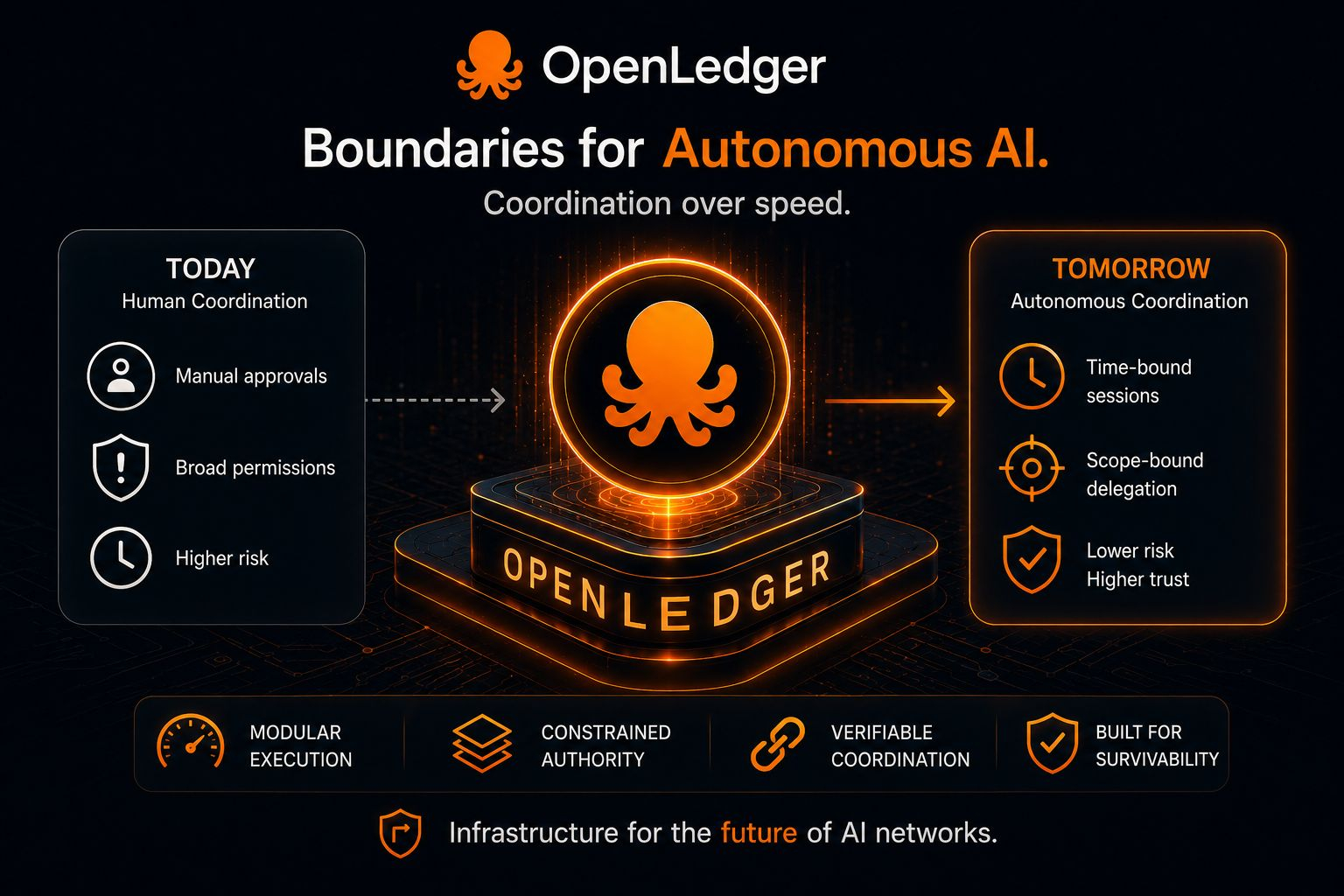
The Sessions framework inside OpenLedger is probably the clearest example of that design philosophy.
Time-bound and scope-bound delegation sounds procedural at first, almost administrative, until you realize how many failures across crypto came from the opposite assumption. Permissions that never expired. Wallet approvals left active indefinitely because revoking them became inconvenient. Delegated authority accumulating silently across systems nobody audits carefully anymore.
Most catastrophic incidents do not begin with insufficient TPS.
They begin with excessive trust.
One workflow inherits broader permissions than intended.
One emergency approval survives longer than expected.
One AI agent gains operational authority that nobody fully reviews because the system already became too complex to supervise manually.
Then eventually convenience compounds into infrastructure risk.
That is the uncomfortable side of autonomous economies most narratives avoid discussing.
The challenge is not simply making AI systems capable.
The challenge is making them governable.
Can machine-driven execution remain constrained?
Can authority expire properly?
Can autonomous systems coordinate economically without inheriting permanent permissions everywhere they operate?
Those questions probably matter more long term than benchmark speeds.
And I think OpenLedger understands that better than most AI infrastructure narratives in crypto right now.
The modular execution structure reflects it too. Fast execution layers encourage experimentation and scalability, while settlement and coordination layers require more conservative operational assumptions. Separating those responsibilities creates flexibility without forcing the entire system to optimize around the same risk profile.
That becomes extremely important once AI coordination scales.
Because AI systems do not sleep. They do not stop operating during weekends or office hours. Activity compounds continuously across workflows, liquidity systems, and data environments. If the architecture underneath lacks meaningful trust boundaries, exposure scales alongside automation.
That is the hidden asymmetry inside future AI economies.
Autonomy amplifies both efficiency and failure simultaneously.
OpenLedger seems architected around limiting blast radius instead of assuming perfect behavior forever. And honestly, that feels much closer to how mature infrastructure evolves historically.
Every large financial system eventually becomes obsessed with permissions.
Not because innovation failed.
Because scale changes the emotional cost of mistakes.
The larger the system becomes, the more dangerous unrestricted authority feels.
That is also why I increasingly think blockchain infrastructure eventually becomes necessary for machine-scale coordination environments. Not because blockchain magically improves intelligence, but because autonomous systems require verifiable coordination frameworks capable of enforcing boundaries even when activity becomes partially machine-driven.
At that point blockchain stops being purely transactional infrastructure.
It becomes behavioral infrastructure.
The system is no longer only processing transfers.
It is managing relationships between delegation, authority, automation, accountability, and operational trust.
That is a much harder problem than maximizing throughput.
And probably a more important one too.
The industry spent years believing faster systems automatically created safer systems. But speed without enforceable coordination boundaries eventually becomes permissionless fragility. A ledger capable of executing anything without meaningful operational constraints does not eliminate systemic risk.
It accelerates exposure.
That is why OpenLedger interests me more as a coordination architecture than as a short-term AI narrative.
The combination of modular execution, constrained delegation, utility design, and machine-scale coordination feels structurally more durable than ecosystems optimizing purely around activity metrics and attention cycles.
Not because the system removes risk completely.
No serious infrastructure can promise that.
But because the architecture appears built around the assumption that autonomous systems eventually require survivability mechanisms stronger than human supervision alone.
And historically, infrastructure preparing for future coordination pressure before everyone else notices the problem usually ends up mattering more than the market initially expects.