
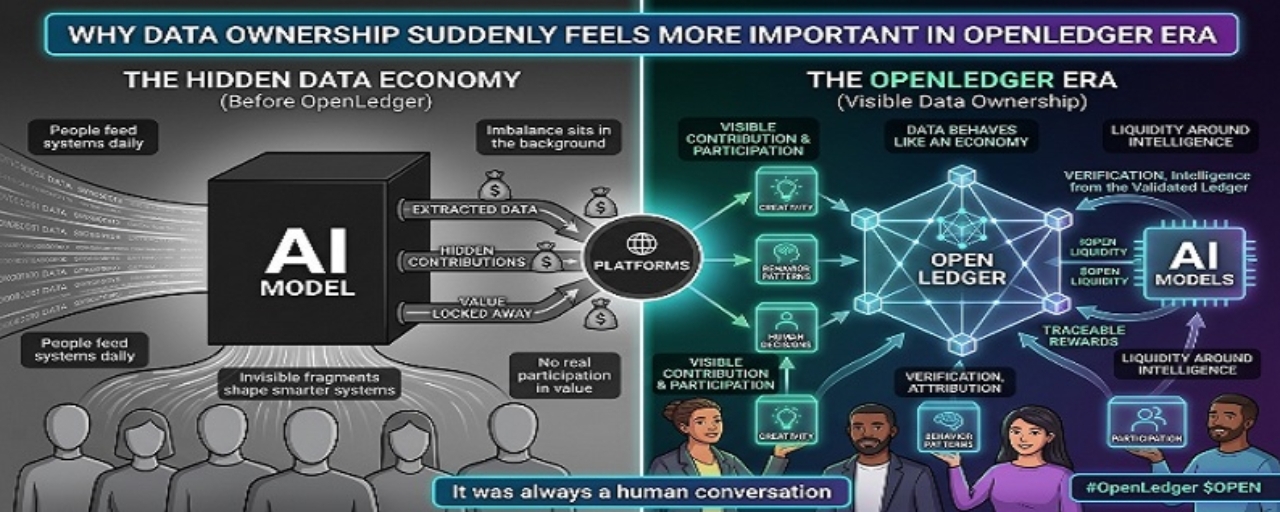

I’ve been thinking about this a lot lately.
For years, people kept saying that data is valuable, but honestly, most of us never really felt it directly. It was always happening quietly somewhere in the background. Apps collecting behavior, AI models learning from conversations, platforms tracking patterns we barely noticed.
Now it feels different.
The more AI becomes part of everyday life, the more obvious it becomes that data is no longer some invisible thing floating around the internet. It feels personal now. Almost like a digital extension of people themselves.
And maybe that’s why projects like @OpenLedger started staying in my mind more than I expected.
Not because of hype.
More because the timing suddenly makes sense.
I noticed something interesting while watching how AI tools evolved this past year. Everyone talks about models, speed, agents, automation… but very few people stop to ask where all the intelligence actually comes from in the first place.
It comes from data.
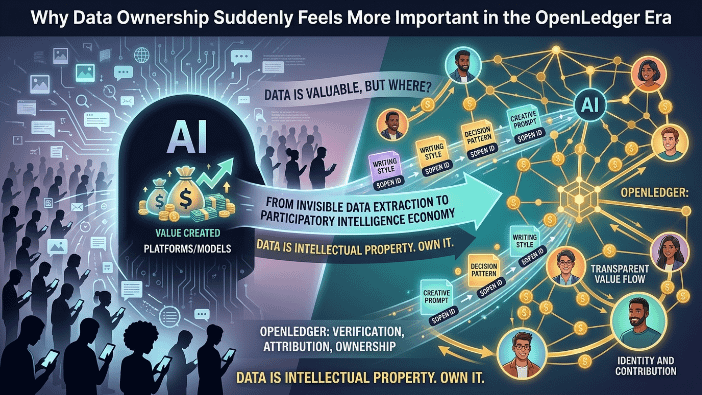
Human behavior.
Human decisions.
Human language.
Human patterns.
Without that, AI is just an empty shell repeating probabilities.
But somehow the ownership part became blurry over time.
A lot of people are feeding systems every single day without knowing what they’re really contributing. Photos, prompts, writing styles, corrections, reactions, browsing habits. Tiny fragments constantly shaping smarter systems.
And the strange part is that most contributors never really participate in the value created from it.
That imbalance has been sitting in the background for years.
I think that’s why the idea behind #OpenLedger feels more relevant now than it would’ve a few years ago.
Not because decentralization suddenly became trendy again.
It’s more because AI created a situation where data itself started behaving almost like an economy.
That shift feels important.
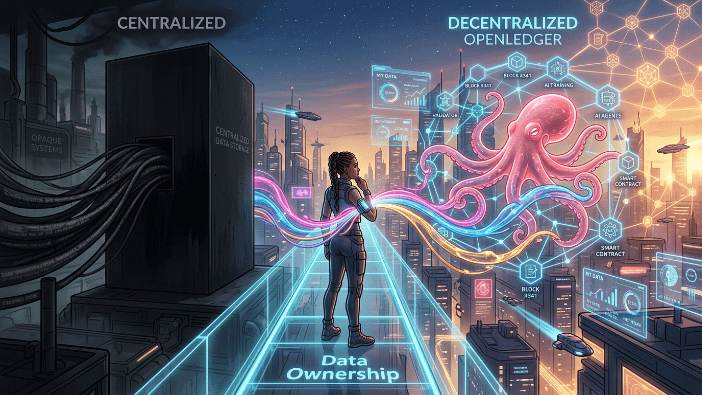
I was reading discussions around $OPEN recently and something clicked for me. The conversation wasn’t only about infrastructure or blockchain mechanics. It felt more connected to ownership and participation.
Who owns intelligence once machines learn from millions of people?
That question sounds simple at first, but the deeper you think about it, the stranger it becomes.
Sometimes I wonder if future internet systems will divide into two categories.
Systems where people unknowingly feed centralized intelligence forever.
And systems where contribution becomes visible, traceable, and maybe even liquid in some form.
That second direction feels closer to what @OpenLedger is trying to explore.
Not in an aggressive way.
More quietly.
Almost like building rails before the crowd fully notices why the rails matter.
I think people underestimate how emotional data ownership actually is.
Because it’s not only about money.
It’s about identity.
If an AI system learns from someone’s expertise, creativity, or behavior patterns over time, it feels natural to ask whether contributors should remain invisible forever.
Maybe that sounds idealistic.
But the current internet already showed what happens when value flows in only one direction for too long.
Creators burn out.
Communities lose trust.
Platforms become extractive.
And AI could easily amplify that problem if nobody questions the structure early enough.
That’s another reason why #openledger caught my attention.
It doesn’t feel focused only on building another isolated AI narrative. It feels more connected to how intelligence itself moves between people, networks, models, and agents.
Almost like creating liquidity around intelligence instead of locking it away.
I’m not even sure people fully realize how big that idea could become later.
Right now most conversations around AI are still surface-level. Faster models, bigger context windows, better outputs.

But underneath all of that, there’s a quieter layer forming.
Verification.
Ownership.
Attribution.
Contribution.
Those things used to sound boring compared to flashy AI demos.
Now they suddenly feel foundational.
Especially when AI agents are starting to interact with each other, generate value autonomously, and consume massive amounts of data continuously.
At some point the internet probably needs systems that can track where intelligence originates and how value moves through networks.
Otherwise the entire structure becomes difficult to trust.
That’s where the blockchain side starts making more sense to me now.
Not as speculation.
More as memory.
A transparent layer that records contribution in environments where AI becomes too complex to observe manually.
And honestly, that idea stayed in my head longer than I expected.
Because the future AI economy probably won’t only belong to whoever builds the biggest models.
It may also belong to whoever creates the fairest systems around data itself.
That feels like the deeper conversation slowly forming around $OPEN lately.
Not loud.
Not dramatic.
Just increasingly difficult to ignore.
Maybe it’s just me, but I think people are beginning to realize that data ownership was never really a technical conversation.
It was always a human one.
