
The crypto market is an ocean where many dive in with dreams of becoming overnight millionaires, only to end up losing their hard-earned capital due to the lack of a proper, structured plan. If you have a small starter portfolio of $300 and aim to make a consistent 1% daily profit (which is exactly $3 a day), is it actually possible? Yes, absolutely! However, achieving this requires moving away from emotional gambling and adopting a disciplined, professional "Spot Scalping" blueprint. Let's break down how this entire system works.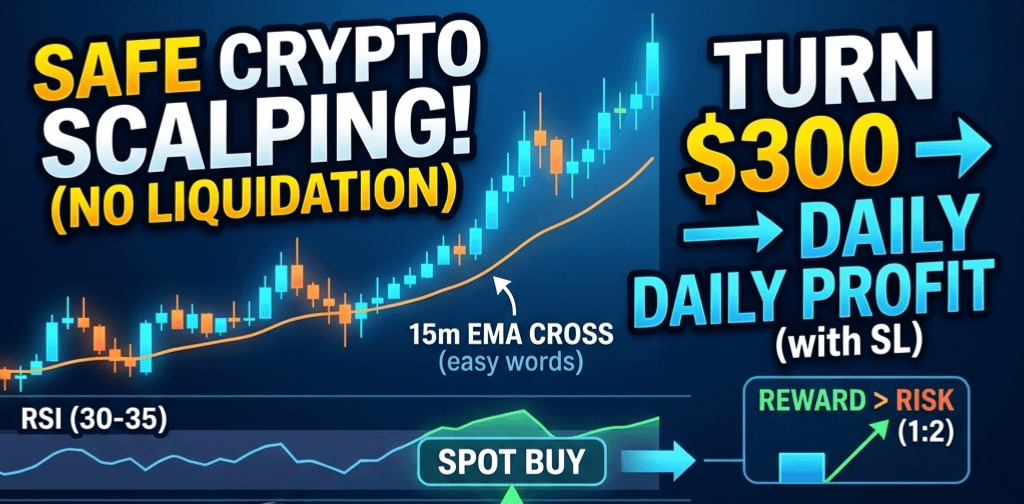
The Core Concept: Spot Scalping vs. Futures Trading
First and foremost, it is crucial to understand that this strategy relies strictly on Spot Trading, not Futures. While Futures trading lures beginners with high leverage (borrowed money), it comes with the extreme risk of liquidation, where a bad market move can instantly wipe your account down to zero. Spot trading, on the other hand, is significantly safer because you are buying the actual underlying asset. Your account can never be liquidated, even if the price fluctuates.
Scalping is a trading style focused on capturing small, rapid price movements (usually 1% to 2%), securing the profit, and exiting the market immediately. In this fast-paced game of minutes and seconds, you do not need to sit in front of a computer screen for hours. You simply need to wait for the right moment to execute a precise entry and exit.
Money Management: Protecting Your Capital At All Costs
The absolute golden rule of trading is: "Before you learn how to make money, you must learn how to preserve it." When managing a $300 capital, you should never throw the entire amount into a single trade. A professional approach involves dividing your capital and allocating a controlled portion, such as $150 per trade.
Because this strategy utilizes strict risk-mitigation orders, your remaining capital sits entirely untouched and completely safe on the exchange. Focusing on just one controlled trade at a time removes the psychological burden of trading, allowing you to execute decisions with a calm, clear mind.
The Golden Ratio: Why Your Take Profit Must Be Bigger Than Your Stop Loss
The true secret to long-term trading survival lies in the Risk-to-Reward Ratio. Many amateur traders risk the exact same amount they hope to gain (a 1:1 ratio). However, a professional setup dictates that your Take Profit (TP) must always be larger than your Stop Loss (SL), ideally maintaining a 1:2 ratio.
When deploying $150 into a trade, your structural formula should look like this:
Stop Loss (SL): 1% Price Drop (A maximum controlled loss of -$1.50).
Take Profit (TP): 2% Price Move (A potential gain of +$3.00).
The mathematical beauty of this setup is phenomenal: if you take 4 trades in a day and lose 2 while winning 2 (a humble 50% win rate), you still walk away at the end of the day in a net Profit! This happens because your winning reward is exactly double the size of your losing risk. Even better, if your very first trade hits its 2% target, your entire 1% daily portfolio goal ($3.00) is achieved in a single shot, allowing you to close the charts for the day.
The Execution Strategy: How to Use OCO Orders Like a Pro
To successfully execute this plan, you cannot blindly buy into any random coin. Stick strictly to top-tier, highly liquid, and high-volume projects (such as SOL or AVAX). Set your charts to a 15-Minute (15m) timeframe and apply the RSI (Relative Strength Index) indicator. When the RSI line dips near or below the 35 to 30 zone, it signals that the coin is temporarily oversold (cheap) and a short-term bounce is highly probable. This is your cue to execute a market buy.
The exact second your buy order goes through, you must immediately set up an OCO (One-Cancels-the-Other) order under the sell tab. This advanced feature allows you to place your target and your safety net simultaneously:
Target Price (TP): Program the input at exactly 2% above your entry price.
Stop/Limit Prices (SL): Program the input to trigger a hard sell at exactly 1% below your entry price.
The ultimate benefit of the OCO order is psychological freedom. Once submitted, you no longer need to nervously stare at the flashing tickers. You can close the app and go about your day. The exchange's automated system will handle the rest, either securing your intended profit or cutting the trade at a minor, pre-accepted loss.
Overcoming the Fear: The "Baby Step" Formula to Start Today
The biggest hurdle for any beginner is Fear, the paralyzing emotion that stops you from clicking the "BUY" button on a live account. The only way to systematically dismantle this fear is by eliminating the financial weight of the trade from your mind.
For the first 5 days, do not trade with $150. Instead, start your very first live trades with a tiny sum of just $15. Risking a 1% Stop Loss on a $15 trade means your maximum loss is a mere $0.15 (15 cents), the price of a tiny snack. Once your brain internalizes that a worst-case scenario results in losing just a few cents, the performance anxiety completely vanishes, and your hands will become native to configuring OCO orders. Once you build pure mechanical consistency over 5 days, you can gradually scale your trade sizes from $15 to $30, then $60, and finally up to your strategic target of $150.
Trading is a game of probability, risk control, and business discipline, not a trip to the casino. If you can master the self-control to walk away the moment your daily profit target is met, or the moment your daily loss limit is hit, your $300 portfolio will steadily compound and grow over time without ever threatening your peace of mind.
If you find this Article Helpful then like this 👍
Follow for more content 🙂