
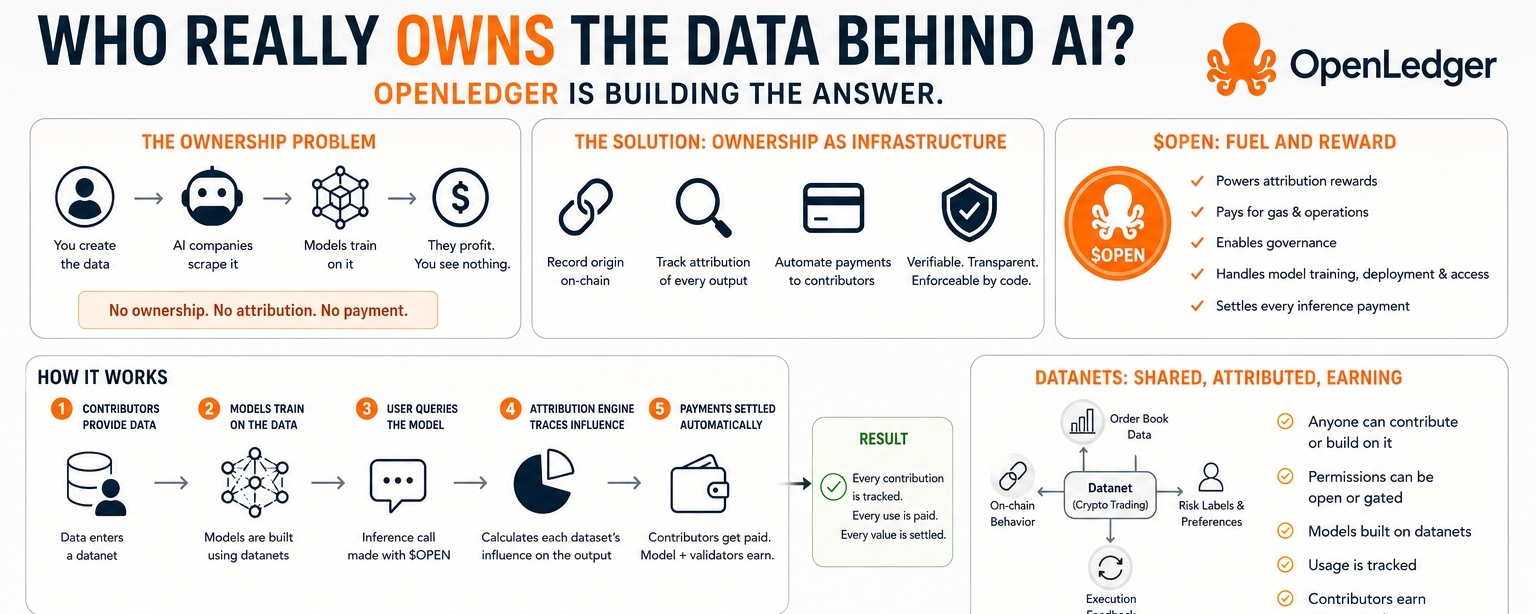
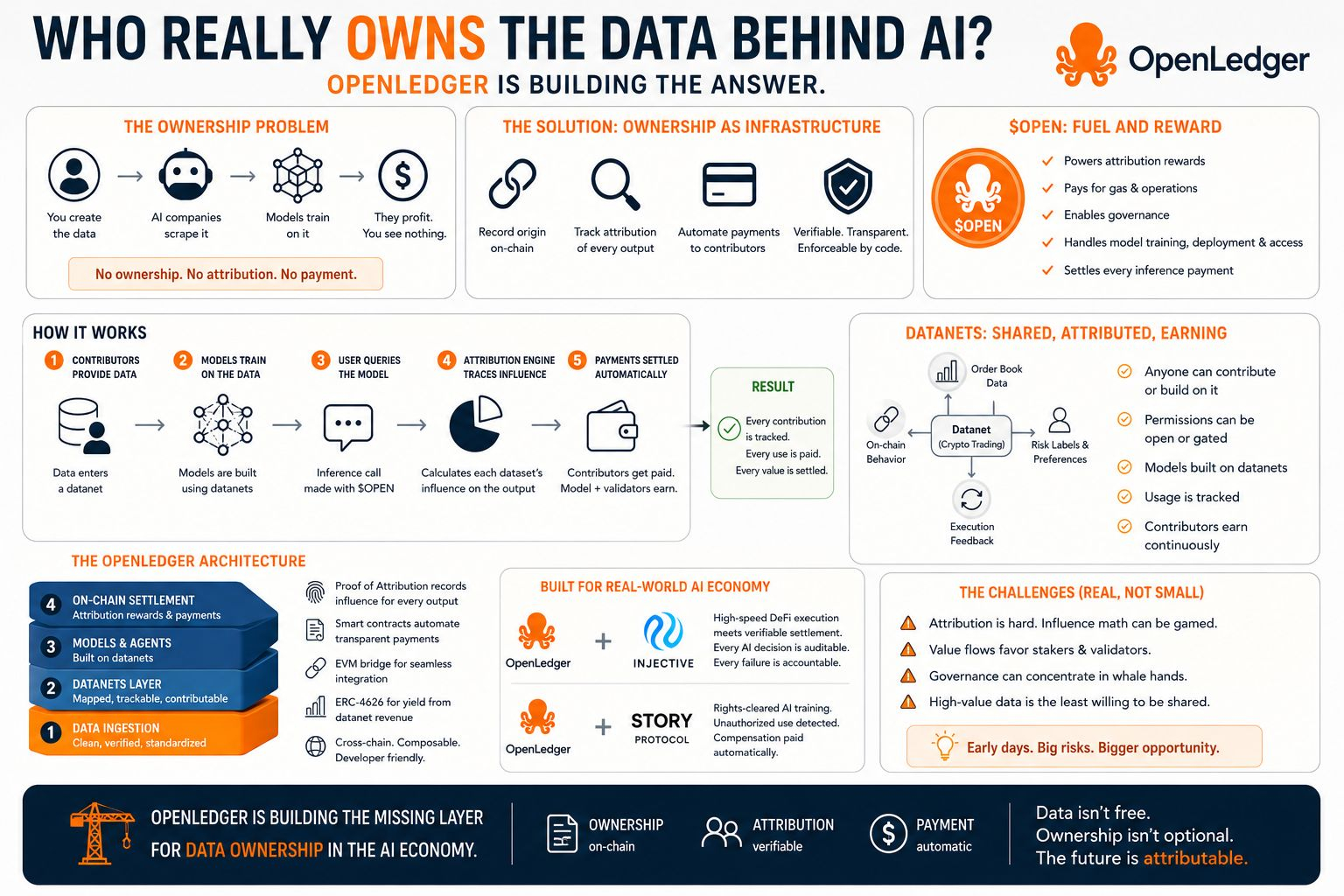
Here's a question that makes most AI projects uncomfortable.
Who actually owns the data their models are trained on?
Not the person who created it. Not the person who uploaded it. Not the person who cleaned it. Somewhere along the chain, ownership just… disappears. Becomes "public domain by default." Gets scraped, transformed, fed into a model, and suddenly nobody can trace where anything came from.
That's not ownership. That's a black hole.
The lie the industry tells itself
Most AI companies operate on a simple assumption: if data is publicly accessible, it's free to use. Train on it. Profit from it. Never look back.
But "publicly accessible" doesn't mean "publicly ownable." Your tweet belongs to you. Your Reddit post belongs to you. Your comment on a forum belongs to you. Just because someone can read it doesn't mean they can train a billion-dollar model on it without permission or payment.
That's theft. It's just slow and legal-shaped enough that nobody's stopped it yet.
Where ownership breaks down
Let me walk through a real example.
You write a detailed analysis post about crypto trading. Someone scrapes it. Someone else cleans it. A third person labels it. A fourth person feeds it into a model. That model generates trading advice that makes a company millions.
What do you see? Nothing. Zero. Not even a thank you.
Meanwhile, nobody can prove that your original post contributed to that output. The trail is gone. The ownership evaporated the moment the data changed hands.
That's broken. And it's getting worse as synthetic data and multi-step training pipelines become the norm.
What OpenLedger is actually doing
I've looked at a lot of data projects. Most of them are just oracles with better marketing. They verify that a piece of data existed at a certain time. Cool. That's the bare minimum.
OpenLedger is different. They're building a verifiable data layer that tracks every single transformation. Every merge. Every clean. Every label. Every time data moves from one person to another.
Start with a model output. Walk backwards through every contributor. See exactly whose data was used, when, and how.
That's not just verification. That's a ownership ledger.
Why this matters more than you think
Regulators are coming. Not because they love crypto. Because the current "scrape first, ask never" model is legally indefensible at scale. Europe is already moving. The US won't be far behind.
When the lawsuits start — and they will — the projects with clean data provenance will survive. The ones without will get crushed under discovery requests and class actions.
OpenLedger is building the fire extinguisher before the fire.
The trade that taught me this
Back in February, I bought into an AI project that had scraped huge amounts of user data without proper consent. I didn't ask the boring questions. Just chased the hype.
Lost around $700 when the lawsuits hit and the token bled out.
That experience stuck with me. The model wasn't the problem. The ownership problem was. Nobody could prove who owned what, who consented to what, or who deserved to get paid.
That's exactly what OpenLedger solves.
What ownership could look like
Imagine a different world.
You post something online. It gets hashed and timestamped on OpenLedger's layer. Every time someone uses your data to train a model, that usage gets recorded. Smart contracts automatically calculate payment. Micro-transactions flow back to you.
Not charity. Not "exposure." Actual payment. Programmable. Verifiable. Fair.
That's not fantasy. That's just infrastructure that hasn't been built yet. OpenLedger is building it.
What I actually think
I'm not saying this happens overnight. Legacy systems are sticky. Big tech won't go quietly.
But the direction is clear. Data ownership is going to become one of the biggest fights of the next decade. And the projects that provide the infrastructure for tracking, verifying, and compensating that ownership are going to be incredibly valuable.
Most people are fighting over which model is smartest. I'm watching who builds the ownership layer underneath.
That's OpenLedger.
One last thing
Stop assuming your data belongs to someone else just because you posted it online. It doesn't.
The infrastructure just hasn't existed to protect your ownership. Until now.
Not financial advice. Just someone who finally understands why this matters.