
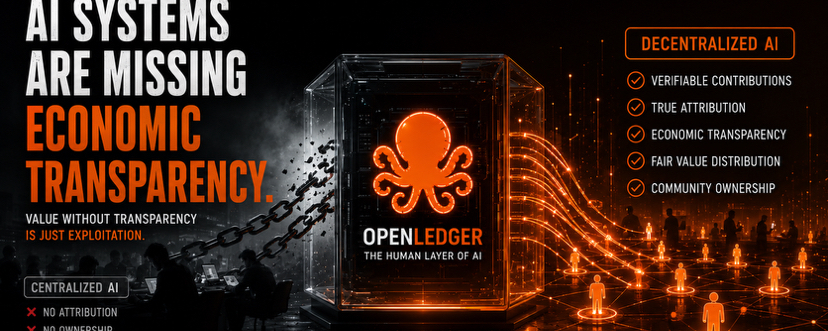
OpenLedger made me realize how little economic transparency actually exists inside most AI systems today.
And honestly, I didn’t think much about that before.
Like most people, I used to focus almost entirely on the visible side of AI:
the models,
the outputs,
the speed,
the capabilities.
That’s what everyone talks about anyway.
But after spending more time exploring ecosystems connected to decentralized AI infrastructure like @OpenLedger , I started paying attention to something else completely.
Who is actually creating the value behind these systems?
And more importantly…
who is capturing it?
The deeper I looked into AI, the stranger the imbalance started feeling.
Because behind almost every impressive AI system, there are thousands of invisible human contributions happening quietly in the background.
People:
• refining datasets
• labeling information
• improving workflows
• testing outputs
• creating niche knowledge
• training community tools
Yet most of those contributors remain economically disconnected from the systems they help improve.
That realization stayed in my head longer than I expected.
Especially because modern AI conversations rarely mention the economic layer at all.
Everything becomes about intelligence and automation.
Almost nothing about attribution.
Ownership.
Contribution history.
Value distribution.
And maybe that’s why so many AI ecosystems start feeling emotionally detached after a while.
The systems keep scaling…
but the human layer inside them becomes harder and harder to see.
That’s the part of OpenLedger that genuinely caught my attention.
Not because decentralization automatically solves every problem.
It obviously doesn’t.
But the ecosystem at least seems designed around the idea that contribution should remain visible instead of disappearing behind centralized infrastructure forever.
That changes the atmosphere more than I expected.
Things like:
• attribution systems
• verifiable contribution layers
• decentralized datasets
• community coordination
might sound technical at first.
But underneath all of it, there’s actually a very human question:
If people are continuously helping AI systems become more valuable…
shouldn’t the economic structure reflect that somehow?
I think that question is going to become much bigger later.
Because AI is scaling incredibly fast now, but economic transparency around AI still feels surprisingly primitive.
And the weird part is…
most people barely seem to notice it yet.
The more I think about it, the more I feel like future AI ecosystems won’t just compete on intelligence.
They’ll compete on trust.
On visibility.
On contribution.
On whether people actually feel connected to the value they help create.
That may end up mattering more than model size alone.
Curious if anyone else has started thinking more about this side of AI lately while exploring #openledger
