
The more I think about AI systems lately, the more I feel like the biggest shift isn’t technological anymore. It’s economic.
For years the internet trained people around a very specific incentive structure. You shared information publicly, gained visibility, built an audience, and visibility itself eventually turned into value. Whether through followers, advertising, reputation, clients, or opportunities, the relationship between contribution and reward was still visible enough for people to understand intuitively.
Then AI changed the direction of that flow almost silently.
Now knowledge moves differently. A niche research thread, a detailed technical explanation, years of accumulated pattern recognition from someone posting online, a specialized dataset built slowly over time… all of it can be absorbed into training systems without anyone really noticing when the transition happened. The contribution still creates value, but the value no longer returns visibly to the contributor.
That feels like a much bigger structural shift than most people are admitting openly.
And honestly, OpenLedger is one of the first projects that made me stop and think seriously about that problem.
Because the protocol doesn’t seem primarily obsessed with making AI models “smarter” in the way most AI narratives are. It feels more focused on rebuilding the economic relationship between contribution and output itself.
That’s where Proof of Attribution becomes more important than it initially sounds.
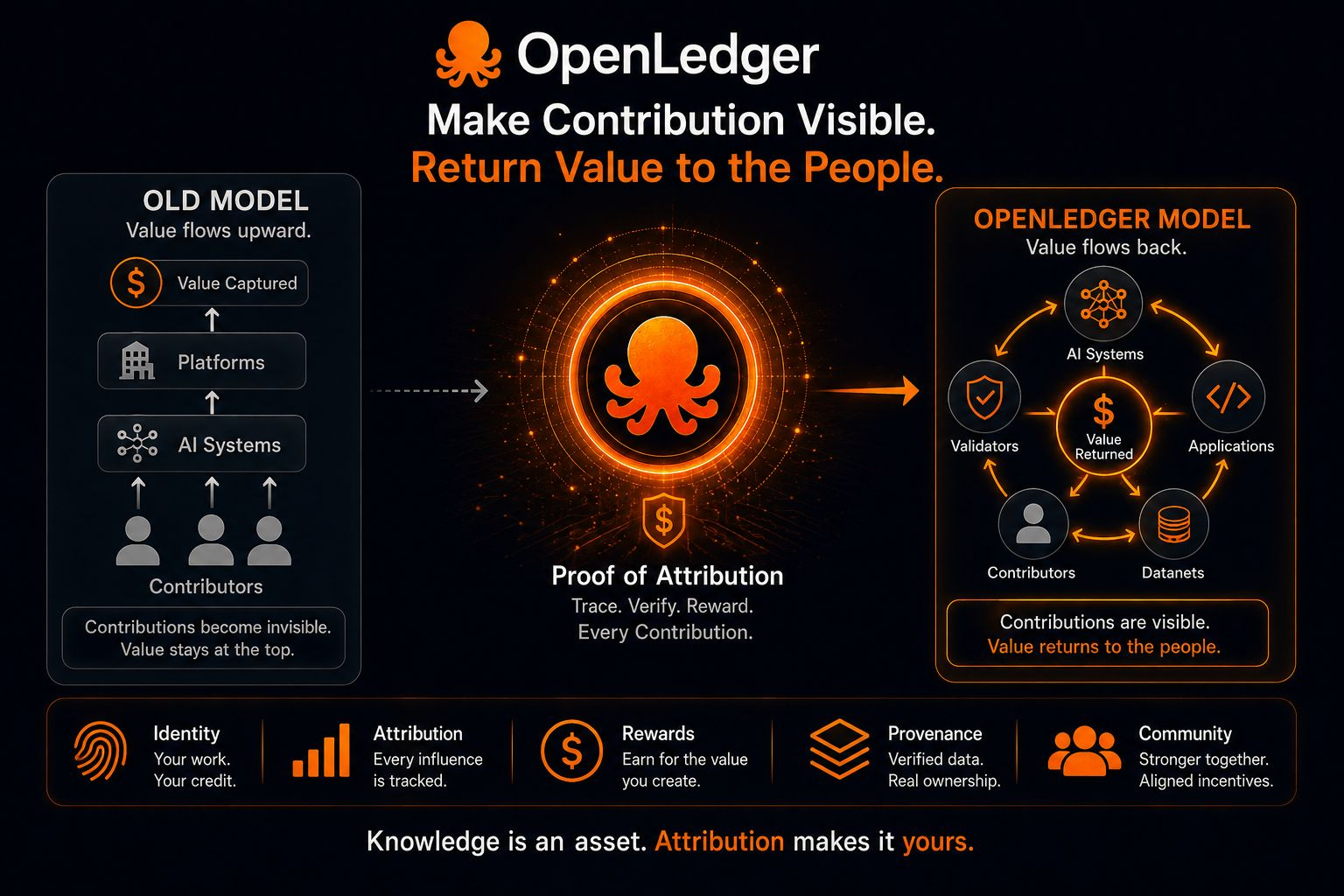
On the surface it’s a technical mechanism tracing how data influences model behavior. Smaller models use influence function approximations while larger systems rely on token matching approaches to connect outputs back toward source material. But underneath the technical layer, the implication is much more human.
OpenLedger is trying to make contribution economically visible again.
And I think that changes behavior in ways people underestimate.
Once attribution exists at the protocol level, information stops functioning like disposable internet exhaust. A trader refining market intelligence, researchers contributing specialized knowledge, communities building domain-specific Datanets, developers improving AI coordination layers… all of those activities begin carrying identity and economic weight simultaneously.
Participation changes psychologically once contribution becomes persistent instead of invisible.
The internet we’ve lived inside for years mostly rewards visibility. The loudest accounts capture attention, and attention captures monetization. But AI systems complicate that model because usefulness and visibility are no longer tightly connected. Someone with no audience at all can still contribute highly valuable information that shapes machine behavior at scale later.
That creates a strange new dynamic.
The most economically important people inside future AI systems might not be the most visible people online anymore. They might be the people quietly feeding networks with the most useful data underneath the surface.
And honestly, I think that possibility changes how online economies evolve long term.
Because if contribution becomes traceable, then knowledge itself starts behaving differently as an asset. People stop sharing carelessly once systems can measure influence economically. Communities begin organizing around contribution quality instead of pure engagement metrics. Specialized datasets accumulate value because provenance and expertise become part of the infrastructure itself rather than external context.
That’s probably why Datanets inside OpenLedger feel more important to me than another generic “AI + blockchain” feature list.
A medical Datanet curated by practitioners is different from anonymous scraped data. Same with legal, financial, cybersecurity, or research-focused datasets. The value isn’t only scale anymore. It becomes verified usefulness attached to real contributor history over time.
And once that happens, the economics around AI start shifting too.
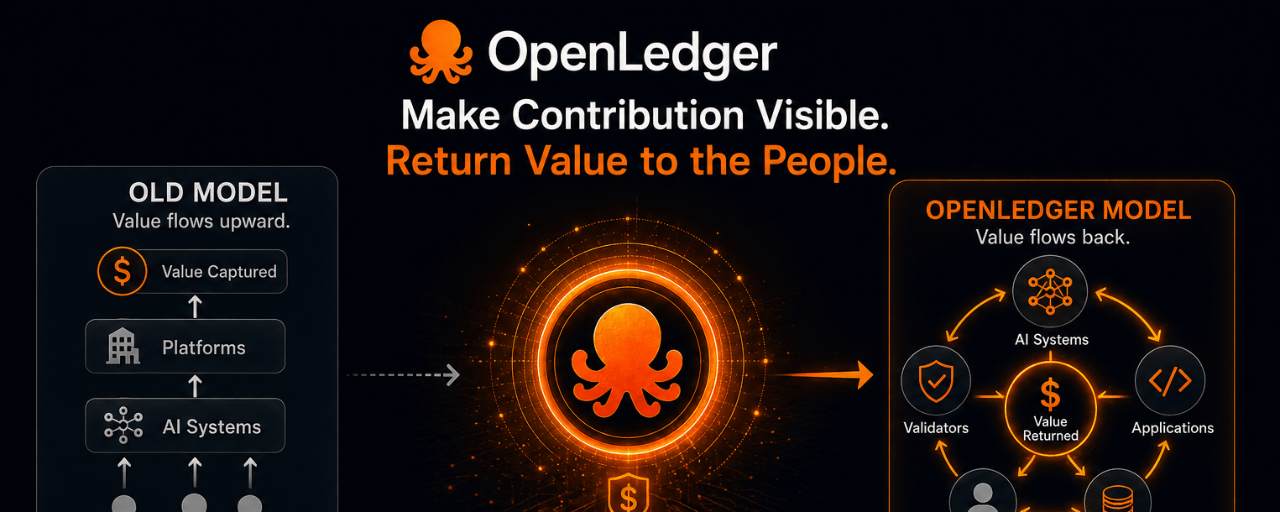
Instead of platforms capturing almost all downstream value while contributors disappear into model training pipelines anonymously, attribution systems create the possibility of value flowing back toward the people shaping the intelligence underneath.
I’m not saying OpenLedger automatically solves all of this. There are still huge scaling, adoption, and incentive challenges ahead. And the broader AI industry may resist attribution models precisely because existing systems benefit enormously from invisible contribution structures.
But I do think OpenLedger is pointing toward a deeper issue most AI narratives avoid talking about directly.
The future AI economy probably cannot expand forever while treating human knowledge like a free raw material with no persistent ownership layer attached to it.
At some point contribution itself becomes too economically important to remain invisible.
And protocols building attribution infrastructure early may end up shaping how that transition happens long before the rest of the market fully realizes why it matters.
@OpenLedger $OPEN #OpenLedger