
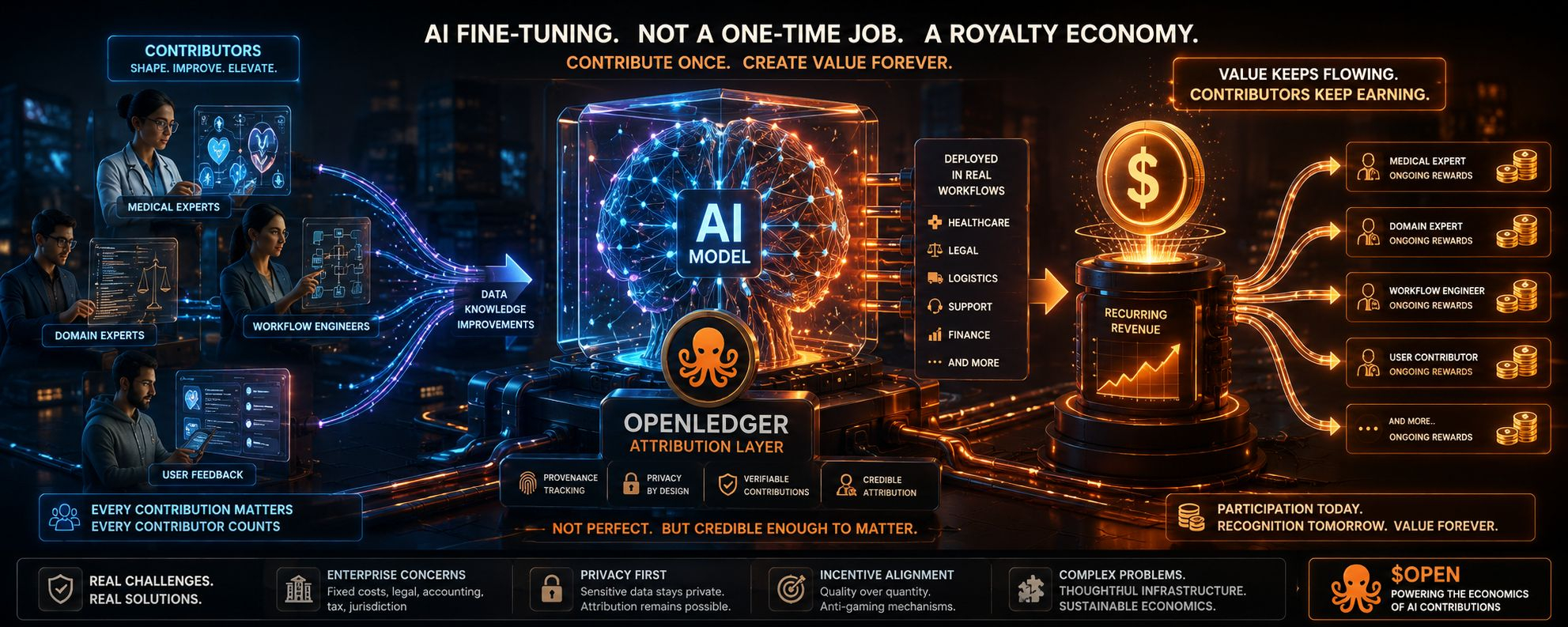

Most people still talk about AI fine-tuning like it is just a paid service. A company needs a custom model, hires experts, buys data, pays for the work, and that is the end of it. Clean. Simple. One and done.
But that way of thinking may be too narrow.
AI is starting to feel less like ordinary software and more like an evolving system that keeps creating value long after the original work is finished. And once that happens, the economics start to look different.
Right now, a lot of the conversation is still centered on compute. GPUs are easy to understand. Inference has a clear cost. Decentralized hardware stories make sense because they are tangible. But in many real businesses, the biggest source of value is not the base model itself.
It is everything that happens after the model is deployed.
That means domain-specific tuning, workflow feedback, human corrections, edge cases, and all the practical knowledge that turns a generic AI model into something actually useful. In areas like healthcare, law, logistics, customer support, and fraud detection, that adaptation layer is often where the real value lives.
And yet it is usually treated like a one-time job.
That feels increasingly outdated.
If someone helps improve a model that keeps generating revenue for years, why should the economic upside stop the moment the work is delivered? Other industries already understand the difference between upfront creation and ongoing value. Music has royalties. Software has licensing. Franchises have recurring fees. AI fine-tuning, for the most part, still behaves like freelance labor.
That is why OpenLedger is interesting.
The real opportunity may not be in another compute marketplace. Compute matters, but it can become commoditized. The scarcer asset may be something else: attribution.
Not just who supplied the data, but who actually helped shape the model in a way that mattered commercially.
That sounds abstract, but the economics are very real. Think about an enterprise AI system trained and refined by medical reviewers, domain experts, workflow engineers, and ongoing user feedback. If that system later produces serious recurring revenue, should all of that value go only to the company that deployed it?
@OpenLedger seems to be exploring a different model, one where contribution provenance can be tracked well enough to support ongoing recognition or payment. Not perfect attribution, because that is probably impossible in a complex AI system, but attribution that is credible enough to matter economically.
That distinction is important.
Markets do not need absolute philosophical certainty. They need systems people trust enough to build around.
If #OpenLedger can make AI contributions traceable and economically meaningful, then fine-tuning starts to look less like a one-time service and more like royalty-bearing participation in infrastructure. In that kind of setup, $OPEN is not just a token for access. It becomes part of the settlement logic around how value gets tracked and shared.
Of course, the obvious objections are real.
Enterprises do not like indefinite obligations. Finance teams want fixed costs. Legal teams do not enjoy vague claims on future revenue. Once you introduce ongoing participation rights, you also introduce accounting issues, tax complexity, contract disputes, and jurisdictional headaches.
Privacy is another major problem. A lot of the most valuable fine-tuning happens in sensitive environments like healthcare records, internal company systems, customer interactions, and compliance workflows. You cannot solve attribution by exposing confidential data. Any serious solution has to preserve privacy from the start.
And then there is the incentive problem.
Crypto systems have seen this movie before. The minute future rewards become visible, people start optimizing for payouts instead of quality. Spam shows up. Gaming starts. The system gets farmed.
So attribution infrastructure without proper filtering can quickly become extraction infrastructure.
That risk is very real.
Still, the bigger idea is worth paying attention to.
AI may be moving away from a simple ownership model and toward a participation model, especially in specialized markets where adaptation creates most of the value. Commodity AI will probably remain transactional. But vertical AI, the kind shaped by ongoing human input, may need a very different economic structure.
If that happens, the most important infrastructure may not be the network that makes intelligence cheaper.
It may be the one that decides whether contributors still matter economically after the model starts making money.
That is a much stranger market.
And possibly a much bigger one.