
Tonight I was sitting in a small coffee shop waiting for the rain to calm down, scrolling through a few AI discussions, and I suddenly realized how strange the current AI industry actually feels when you stop looking at the hype for a minute.
Everyone talks about what the models can do now.
Almost nobody talks about what the systems quietly forget.
A model becomes smarter, an app becomes more useful, a company becomes more valuable, but the people who helped shape that intelligence slowly disappear behind the interface. Data gets absorbed. Corrections get absorbed. Human feedback gets absorbed. Eventually the output is all anyone sees.
That’s probably why OpenLedger stayed in my head longer than I expected.
Not because it promises some futuristic AI revolution. Honestly I’ve seen too many projects throw “AI infrastructure” into their bio lately. Most of them feel interchangeable after five minutes.
What feels different here is the obsession with contribution itself.
The more I read about OpenLedger, the more it feels like the project started from a very specific frustration: modern AI systems are extremely good at extracting value, but surprisingly weak at remembering where that value came from.
And I think that changes user behavior more than people realize.
When people believe their work disappears into a black box forever, they naturally stop caring about long-term quality. Everything becomes short-term. Faster uploads. Faster farming. Faster extraction.
You can already see this behavior everywhere online.
But systems behave differently when contributors feel visible.
Not visible in a social media sense.
Visible economically.
Visible structurally.
That’s the part of OpenLedger I keep thinking about. The idea that datasets, models, agents, and contributors should remain connected instead of being separated once the output becomes profitable.
I’m not even sure the average market fully understands how difficult that problem actually is.
Because attribution sounds simple until real incentives appear.
The moment rewards exist, behavior changes immediately. People optimize. Spam increases. Low-quality contributions start flooding systems because quantity becomes easier than usefulness. Every open network eventually runs into this tension.
That’s why I’ve become more interested in restraint lately.
And strangely enough, OpenLedger feels more restrained than most AI narratives floating around crypto right now.
Some parts of the ecosystem move slower than people probably want. But slower infrastructure is not always weakness. Sometimes it means the team understands that once bad incentives become normalized, fixing them later becomes painful.
I’ve watched enough ecosystems over the years to notice that the strongest projects usually stop feeling exciting at some point. They become dependable instead.
That transition matters.
Early users join because they’re curious.
Later users stay because the system quietly became useful in their routine.
Those are completely different forms of adoption.
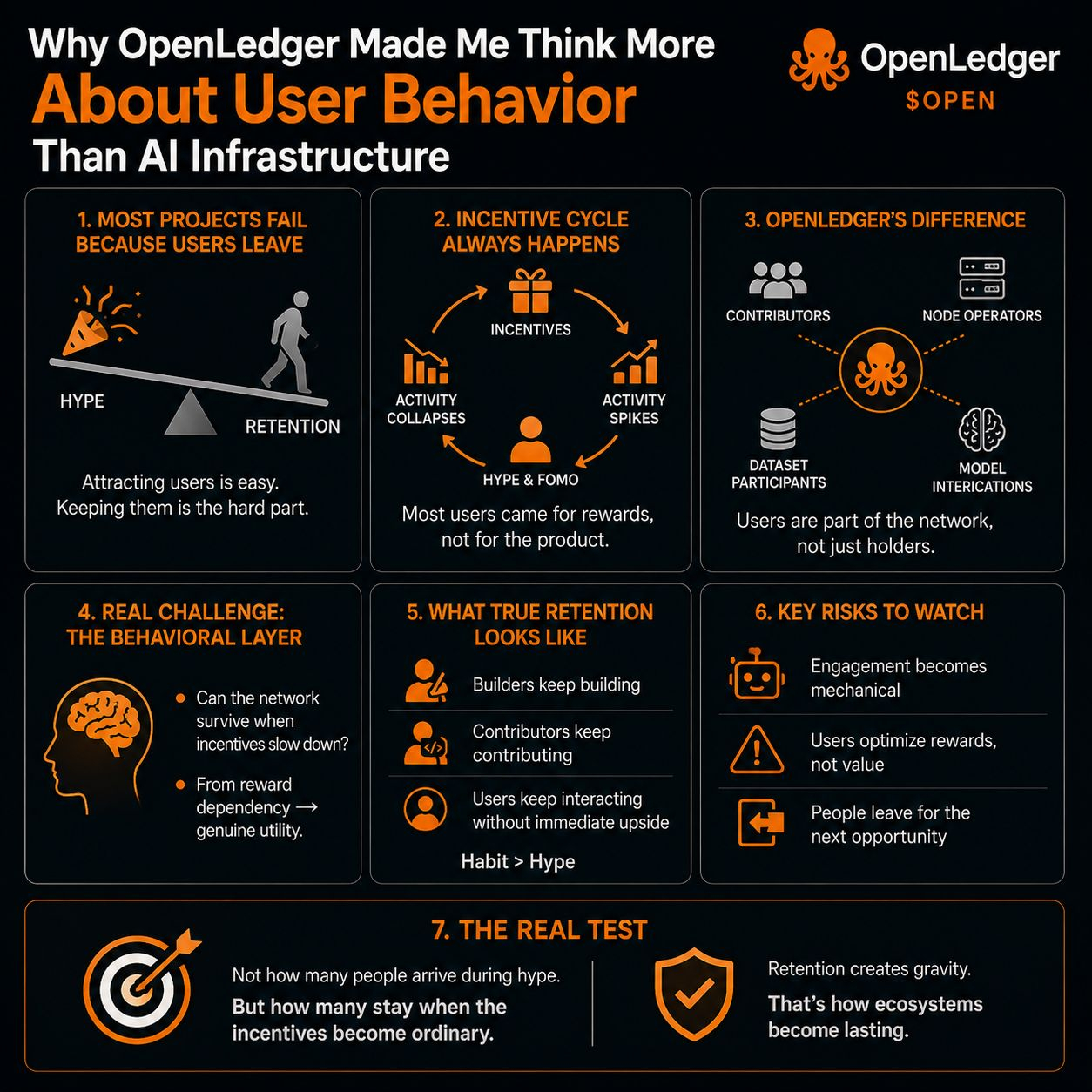
The thing I’m watching most with OPEN isn’t hype or short-term price movement. It’s whether the network eventually creates behavior that survives after incentives cool down.
Do contributors still care about quality later?
Do builders keep integrating tools into real workflows?
Do users return because the infrastructure actually helps them, not because campaigns temporarily pushed activity?
That’s usually where the truth hides.
I also think people underestimate how important trust will become once AI agents start interacting economically with each other at larger scale. If systems begin routing information, making decisions, handling transactions, or coordinating services autonomously, then provenance suddenly matters a lot more.
Who created the data?
Which model influenced the output?
Who becomes accountable when things fail?
Most AI systems still feel blurry around those questions.
OpenLedger at least seems to be trying to build around them directly instead of pretending they don’t exist yet.
Maybe that ends up becoming important later.
Maybe it doesn’t.
Still early.
But the more time I spend watching AI evolve, the more I feel the future winners won’t just be the systems producing intelligence.
They’ll probably be the systems capable of remembering where intelligence actually came from in the first place.