
I keep noticing how every cycle in crypto eventually turns into a conversation about extraction. Not in the dramatic sense people usually frame it but in the quieter structural sense. Somewhere along the way, every supposedly open system develops hidden toll booths. Liquidity fragments middlemen reappear under new names and the people creating actual value often end up furthest away from the economic upside. It happened with content on the internet long before crypto existed. Platforms absorbed creators. Algorithms absorbed audiences. Data got centralized almost by accident because coordination at scale is messy and expensive. Then AI arrived and somehow intensified the problem instead of solving it.
The strange thing about AI is that everyone talks about models while almost nobody talks about the invisible substrate underneath them. The market gravitates toward outputs because outputs are easier to price psychologically. People can understand a chatbot. They can compare image generators. They can benchmark reasoning scores. But the deeper infrastructure layer the actual production pipeline of data attribution labeling refinement feedback loops model tuning inference markets distribution rights remains blurry and underpriced. Maybe because it is harder to see. Maybe because the internet trained us to treat data as ambient and infinite even though it clearly is not.
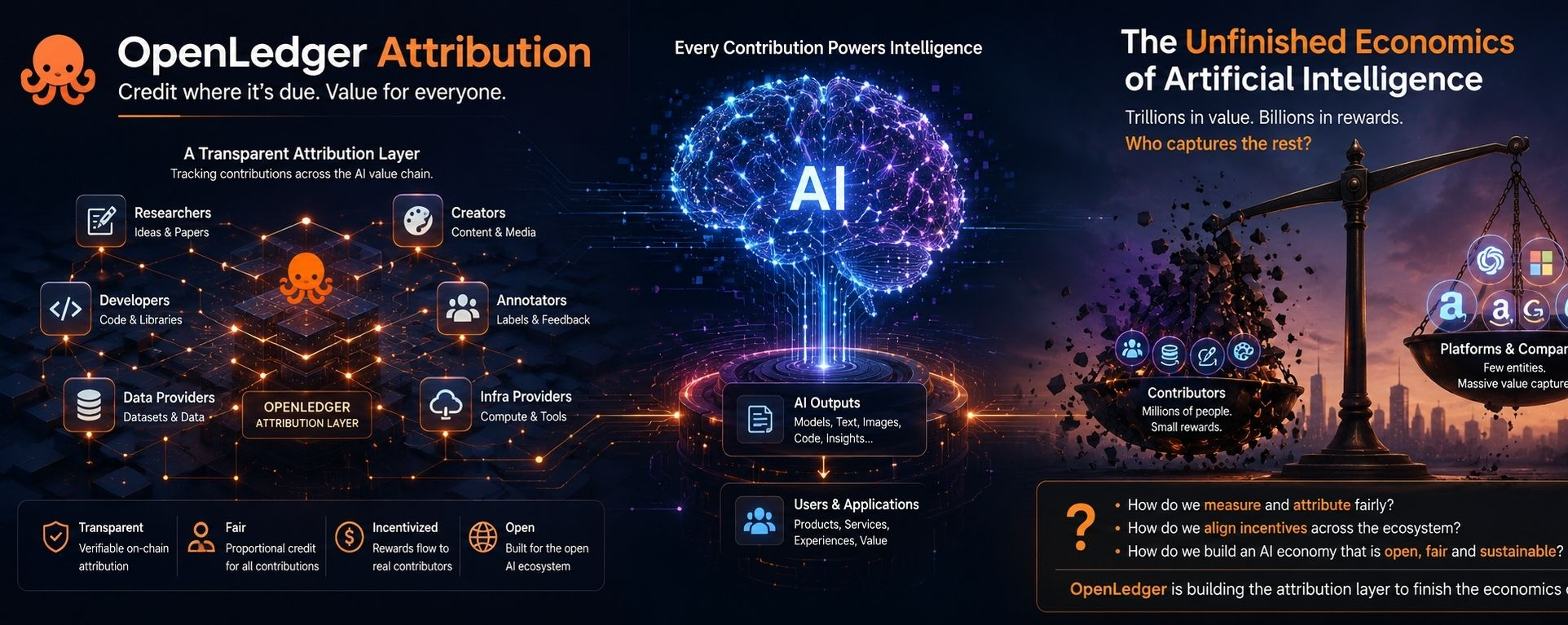
I find myself thinking about this more lately because the current AI economy feels oddly incomplete. Massive valuations are accumulating around model providers while the contributors feeding those systems remain economically invisible. The people generating data, curating datasets refining outputs creating domain-specific knowledge or even interacting with AI systems in ways that improve them rarely capture proportional value. It resembles an industrial supply chain where raw material providers never realize their commodity became essential until the monopoly forms downstream.
Crypto has always claimed it could solve coordination problems like this, although historically it mostly solved financial coordination before anything else. Tokens are surprisingly effective at mobilizing behavior, but behavior itself is complicated. Speculation is easy to incentivize because price becomes the universal feedback mechanism. Useful long-term contribution is harder because it requires measuring quality authenticity persistence and reputation across time. Most token systems eventually drift toward short-term extractive loops because markets naturally reward liquidity over patience.
That tension is partly why I became interested in OpenLedger, not because I think it has already solved anything but because it seems to be orbiting a more foundational question than most AI-crypto projects. The project appears less focused on creating another consumer-facing AI application and more focused on the economic rails beneath AI itself. The phrase unlocking liquidity for data models and agents initially sounded abstract to me in the way crypto language often does but the more I sat with it the more it started sounding like an attempt to formalize ownership around AI production.
And ownership in AI is still incredibly undefined.
Right now if someone contributes useful data to improve a system, what exactly do they own? If an autonomous AI agent produces economic value using models trained on millions of distributed contributions who captures the upside? If specialized datasets become the most defensible asset in AI over the next decade, how are those datasets priced, exchanged, verified or attributed? Traditional markets struggle with this because data behaves strangely as an asset. It is infinitely reproducible yet unevenly valuable. Its usefulness depends on context freshness and integration. Attribution becomes blurry the moment contributions are aggregated.
I think this is where blockchain starts becoming conceptually interesting again, not as a speculative casino layer but as a persistent accounting system for invisible coordination. Not necessarily because blockchains are efficient they usually are not but because they create auditable histories around participation. That matters more in AI than people realize.
The deeper implication behind OpenLedger, at least as I interpret it, is that AI may eventually require an entirely new market structure beneath it. Not just model marketplaces or decentralized GPUs, but attribution infrastructure. Systems capable of tracking where intelligence originates, how it evolves and who contributed to its usefulness. That sounds almost philosophical until you realize modern AI already runs into attribution crises constantly. Artists argue their work trained models without consent. Publishers complain their archives became fuel for systems that may eventually replace them. Users unknowingly generate reinforcement data simply by interacting with applications. Everyone contributes. Very few participate economically.
There is something oddly asymmetrical about that.
The internet normalized free contribution because distribution itself used to feel valuable enough. People uploaded content because visibility was rewarding. But AI changes the equation because the outputs increasingly compete with the contributors themselves. Once generated intelligence becomes economically productive the absence of attribution starts looking less like a technical oversight and more like a structural imbalance.
What OpenLedger seems to imply is that attribution itself could become a liquid economic primitive. Not just ownership in the legal sense but programmable ownership attached to data flows models agents, and interactions. If that sounds overly ambitious it probably is. But I also think ambitious infrastructure ideas often sound unrealistic right before markets realize they were missing the layer entirely.
Still I cannot shake the feeling that there are difficult contradictions embedded inside this vision.
The first problem is measurement. Everyone says contributors should be rewarded but contribution quality is notoriously hard to quantify. One tiny piece of specialized data might improve a model more than millions of generic interactions. How do systems determine proportional value without recreating centralized gatekeepers? Reputation systems help, but reputation itself becomes gameable once financial incentives emerge. Crypto history is full of mechanisms that worked beautifully in theory before human behavior distorted them.
Then there is the issue of financialization. Turning data and AI contributions into liquid markets sounds empowering but markets also have a tendency to absorb meaning into price. If every contribution becomes tokenized and tradable, does participation become more open or more extractive? Liquidity can democratize access but it can also incentivize spam manipulation and short-term optimization. The moment data becomes yield-bearing, people will inevitably start manufacturing synthetic engagement purely to capture value flows.
I suspect this is the hidden danger beneath many decentralized AI narratives. Coordination systems do not just reward good actors. They reshape behavior itself. Sometimes in subtle ways that only become obvious years later.
Another tension I keep returning to is whether decentralization is actually compatible with the direction AI infrastructure is heading. Frontier models increasingly benefit from scale compute concentration proprietary optimization and vertically integrated ecosystems. That naturally pushes power toward large entities. Open systems theoretically counterbalance that concentration but only if they achieve enough coordination efficiency to matter economically. Otherwise decentralization risks becoming symbolic while real leverage accumulates elsewhere.
Maybe OpenLedger’s real challenge is not technological at all. Maybe it is sociological. Creating a system where contributors believe attribution is fair enough to participate consistently. Markets are ultimately trust systems, even decentralized ones. People contribute when they believe the accounting layer recognizes them meaningfully. Without that belief infrastructure becomes hollow.
I also wonder whether the long-term value in AI ends up residing less in models themselves and more in the networks surrounding them. The persistent human feedback loops. The specialized domain knowledge. The agent ecosystems. The data provenance trails. If models become increasingly commoditized over time then the infrastructure coordinating intelligence may become more important than intelligence generation itself.
That possibility feels underexplored.
Crypto, at its best was never just about moving money. It was about designing incentive environments for strangers coordinating online. AI meanwhile is rapidly becoming a system for compressing human cognition into scalable infrastructure. Somewhere between those two ideas sits a strange emerging economy where contribution ownership and intelligence blur together.
I do not know if OpenLedger becomes a meaningful part of that future. Most infrastructure projects fail quietly because the market only notices infrastructure once it becomes indispensable. And there are still too many unanswered questions around verification governance sybil resistance market quality and incentive alignment for anyone to speak confidently.
But I keep coming back to the intuition that attribution may eventually become one of the defining economic questions of the AI era. Not attribution as a moral argument alone but as an infrastructure problem. A coordination problem. A market design problem.
And historically coordination problems are where crypto either becomes genuinely useful or collapses into noise.
Right now it still feels unresolved. Maybe necessarily unresolved. But that uncertainty is probably what makes projects like OpenLedger interesting to think about in the first place. Not because they offer certainty but because they force a different question about where value in AI actually comes from and whether the people contributing to that value will remain invisible forever.
