
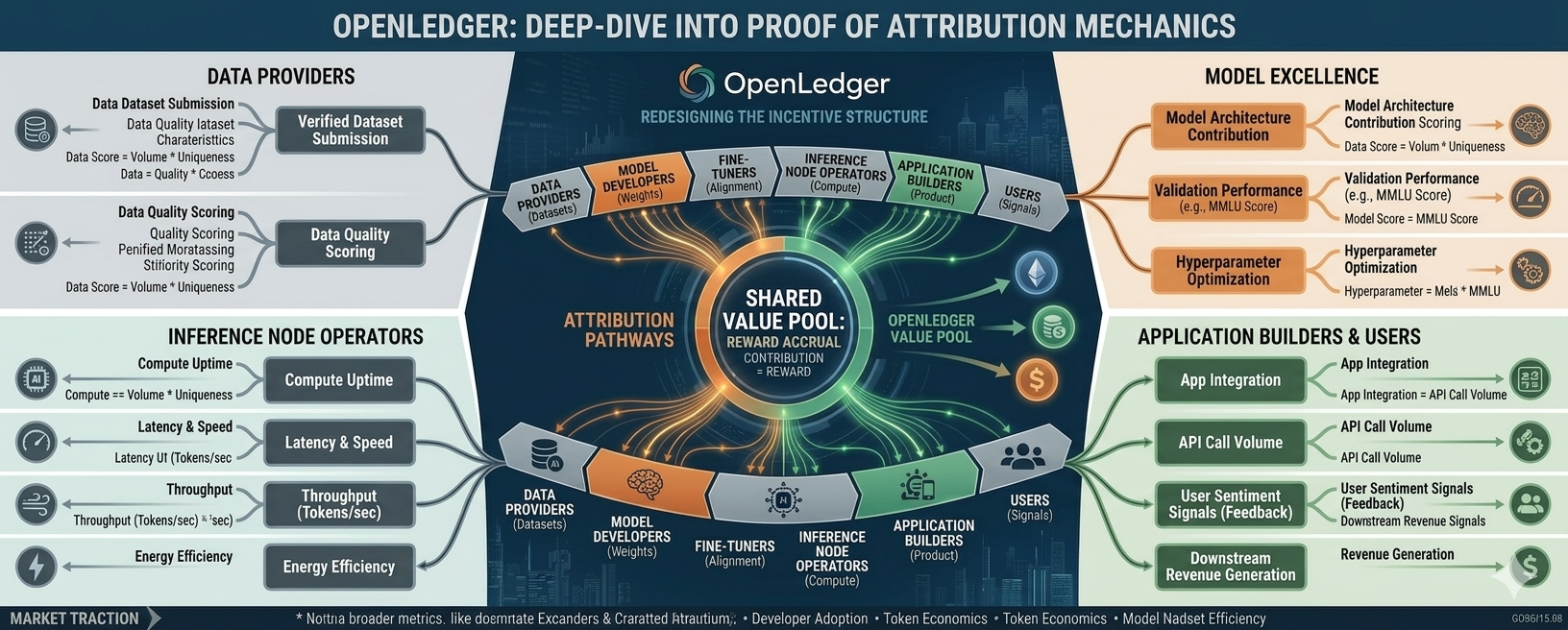
My thesis around OpenLedger is compelling because it focuses on something most AI-crypto narratives still avoid: the economics of intelligence ownership.
A lot of AI infrastructure projects talk about speed, models, or compute. Very few talk about who captures the value once intelligence becomes a production layer of the internet. That is the deeper debate now emerging across both AI and crypto markets.
What makes OpenLedger interesting is not simply that it combines blockchain and AI. It is that it tries to redesign the incentive structure behind AI itself.
Right now the dominant AI economy is vertically integrated:
Large firms own the compute
Large firms own the model weights
Large firms aggregate the datasets
Large firms monetize downstream usage
Contributors — whether they provide data, inference demand, model tuning, or behavioral feedback — rarely participate in long-term value creation.
That imbalance is becoming increasingly visible as AI transitions from a speculative technology cycle into a real economic layer.
The strongest part of your argument is the framing around “Proof of Attribution.” That concept matters because attribution may become the defining economic primitive of decentralized AI.
Instead of simply asking:
> “Who trained the model?”
OpenLedger is asking:
> “Who contributed intelligence value across the entire lifecycle?”
That includes:
Data providers
Model developers
Fine-tuners
Inference node operators
Application builders
Potentially even users generating reinforcement signals
If decentralized AI succeeds long term, attribution systems could become as important as consensus systems were for early blockchains.
There is also an important market shift happening beneath this narrative.
In 2023 and early 2024, capital largely flowed into “AI exposure.” Projects only needed AI branding to attract attention. By 2025 and now into 2026, the market is becoming more selective.
Investors increasingly care about:
Real infrastructure
Distribution
Developer adoption
Sustainable token economics
Actual usage metrics
Cost efficiency
That transition favors projects trying to solve structural problems instead of purely speculative narratives.
OpenLedger fits into that second category.
Its positioning around decentralized inference and modular AI infrastructure is important because the AI industry is approaching a compute bottleneck. Training frontier models is expensive, but inference demand may become even larger over time. If decentralized networks can reduce inference costs while maintaining acceptable quality, they could occupy a meaningful layer in the AI stack.
The launch of products like DGrid AI and the EVM Bridge matters because it shows movement beyond whitepaper-stage ambition. In crypto markets, execution matters more than vision once speculative momentum fades.
At the same time, the concerns you raised are legitimate and probably underappreciated.
The biggest issue is not technology. It is economic sustainability.
The token structure introduces a classic decentralized infrastructure dilemma:
Networks need incentives to bootstrap participation
Incentives create emissions
Emissions create supply pressure
Supply pressure weakens price stability
Weak token performance hurts ecosystem confidence
Your mention of the locked supply is especially important. If roughly 70% of supply remains locked with scheduled unlocks ahead, markets will continuously price future dilution into present valuations.
That creates a difficult environment even if the underlying technology improves.
The bearish momentum indicators you referenced also reflect a broader reality in AI-crypto markets: fundamentals and price often disconnect in the short term.
A project can improve infrastructure while the token declines because:
Early investors rotate out
Unlock schedules increase circulating supply
Liquidity remains thin
Narratives cool temporarily
Market participants shift toward revenue-producing assets
This is especially true for infrastructure projects that are still early in monetization.
Another critical issue is adoption friction.
Decentralized AI sounds philosophically attractive, but developers ultimately optimize around:
Reliability
Latency
Cost
Tooling
Simplicity
Legal clarity
If attribution systems become too complex or ownership rights around fine-tuned models remain ambiguous, enterprises may hesitate to build on the network regardless of ideology.
That may become one of OpenLedger’s most important tests: Can it make decentralized AI infrastructure feel operationally easier rather than ideologically better?
Because ideology alone rarely sustains adoption cycles.
There is also a broader geopolitical and economic angle emerging here.
The concentration of AI capabilities inside a handful of companies is starting to resemble earlier internet monopolization cycles, except with far greater implications. AI systems increasingly shape:
Information access
Labor productivity
Creativity
Financial systems
Decision making
That means ownership of intelligence infrastructure could become one of the defining economic questions of the decade.
Projects like OpenLedger are effectively making a bet that markets will eventually prefer:
Open contribution systems
Shared value accrual
Permissionless intelligence infrastructure
Transparent attribution layers
rather than fully centralized AI monopolies.
That is a very large thesis.
The challenge is timing.
Historically, infrastructure markets often move slower than narratives. Superior architectures do not automatically win. Distribution, capital access, developer ecosystems, and user experience matter just as much.
So the next phase for OpenLedger is probably less about vision and more about measurable traction:
Active developers
Inference demand
Revenue generation
Model ecosystem growth
Enterprise integrations
Sustainable token utility
If those metrics begin compounding, the market may start valuing OpenLedger less as a speculative AI token and more as foundational infrastructure.
If not, it risks becoming another intellectually interesting project that never escapes the experimental phase.
That tension is exactly why OpenLedger remains one of the more fascinating AI-crypto projects right now: it sits at the intersection of two enormous questions:
1. Who owns intelligence?
2. How should intelligence economies distribute value?
Most projects are still chasing attention.
OpenLedger is trying to redesign the economic architecture underneath AI itself.
