I didn’t take it seriously at first…
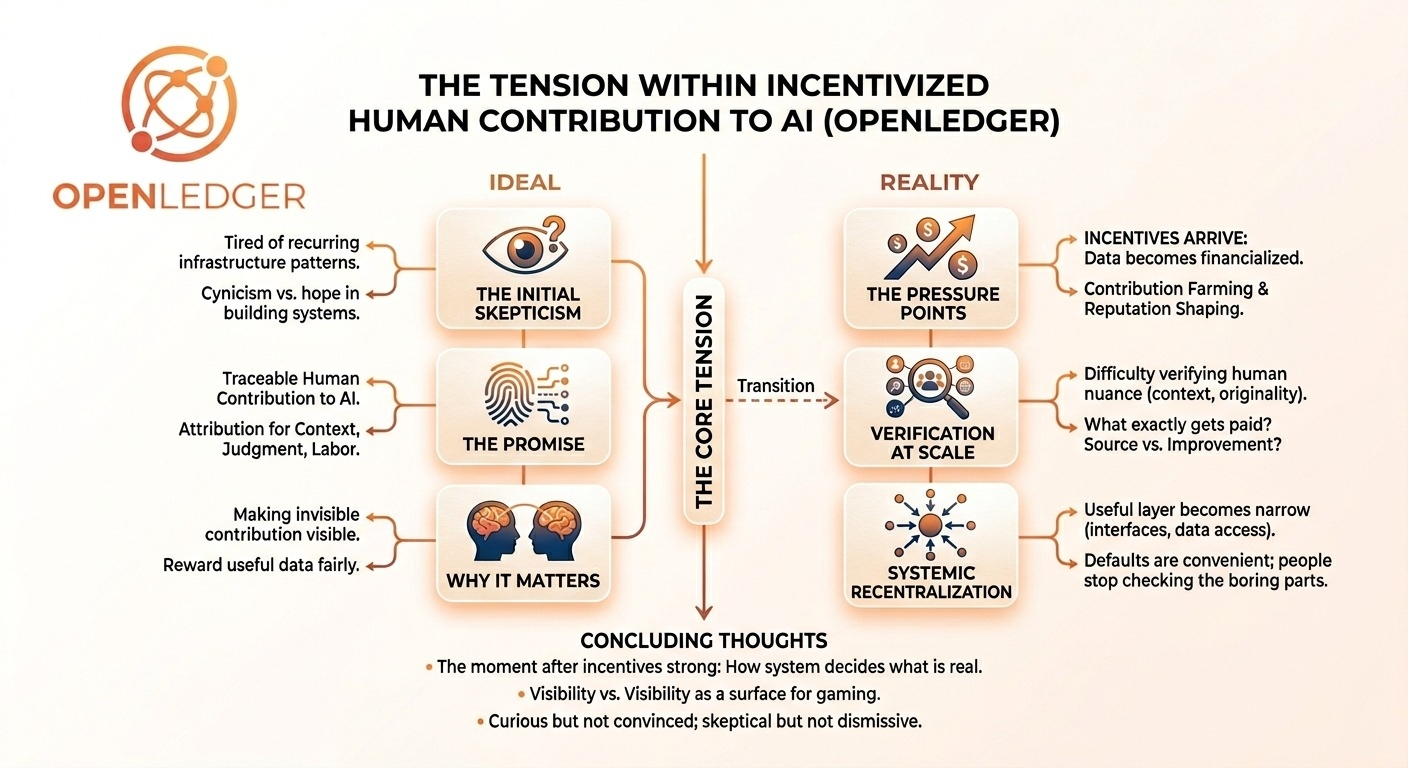
not because OpenLedger seemed unserious. more because I’ve become tired of the shape these conversations take. every cycle finds a new word for infrastructure, a new place to locate trust, a new mechanism that is supposed to make coordination less fragile than it was last time.
and then the same pressures return.
sometimes slower. sometimes dressed better. but they return.
Maybe that’s too harsh. I know there are people building these systems with real care, and I don’t want to flatten everything into cynicism. still, after watching enough networks begin with wide-open ideals and end up orbiting around a few hidden choke points, it becomes hard to listen without flinching a little.
that’s why OpenLedger bothers me in a way I didn’t expect.
not as a token, not as a clean protocol category, not even as another AI-data thing. those labels are too easy. what’s harder to sit with is the idea underneath: that human contribution to machine intelligence should be traceable, verifiable, maybe even economically remembered.
I can understand why that feels necessary.
AI has made a habit of swallowing context and returning outputs that look ownerless. datasets appear as if they came from nowhere. judgment gets compressed into model behavior. labor disappears behind performance benchmarks. people contribute corrections, labels, examples, preferences, patterns, taste, and then the system improves in ways nobody can fully attribute.
so yes, attribution matters.
I keep coming back to that.
but attribution is one of those ideas that feels morally clean before it meets pressure. trace who contributed what. reward useful data. coordinate models transparently. make the invisible visible. it works in theory. most things do.
then incentives arrive.
and once data becomes financialized, the texture changes. people no longer just contribute. they optimize. they study what gets counted. they create inputs that look valuable to the measuring system. eventually there are tools for contribution farming, reputation shaping, synthetic participation, maybe whole markets built around appearing useful to whatever verifier sits in the middle.
That’s where things start to feel uncomfortable.
because verifying human contribution at scale is not like verifying a transaction. a transaction is crude, but at least it has edges. human input doesn’t. usefulness can be delayed. context can be invisible. originality is often collective. one person’s small correction might matter more than another person’s entire dataset, but only after the model has absorbed both and moved on.
so what exactly gets paid?
the source? the signal? the improvement? the effort? the measurable part?
The problem isn’t really the technology… or maybe the technology is only the surface of the problem. the deeper issue is that systems like this have to coordinate humans, models, and incentives without letting any one of them quietly corrupt the others. that is a very hard thing to do. maybe harder than people want to admit.
crypto infrastructure has this pattern. the open layer stays open, but the useful layer becomes narrow. interfaces centralize. data access centralizes. scoring rules centralize. maintenance centralizes. not always maliciously. often because people are tired, and defaults are convenient, and someone has to keep the thing running.
most “open” systems don’t recentralize because someone announces it.
they recentralize because everyone slowly stops checking the boring parts.
That part keeps bothering me more than it should.
OpenLedger is interesting because it points directly at one of the more uncomfortable AI questions: if intelligence systems are trained through dispersed human contribution, what does ownership even mean after enough abstraction? and if ownership becomes measurable, who controls the measurement?
I don’t think ignoring that question is an option. centralized AI has already shown what happens when contribution is treated like raw material and attribution is treated like an inconvenience. but I also don’t trust markets to handle memory gently. markets turn memory into claims, claims into strategies, strategies into extraction.
so I’m left somewhere awkward.
curious, but not convinced. skeptical, but not dismissive. tired, but still watching.
maybe OpenLedger makes some of this more visible. maybe that alone matters. or maybe visibility becomes another thing people learn to game, another surface where power hides itself behind process and dashboards and words like open.
I don’t know.
I just keep thinking about the moment after the incentives get strong enough, when the system has to decide what is real, who counts, and who quietly disappears into the model anyway.