I’ve reached a point where I almost automatically distrust projects that combine AI and blockchain in the same sentence. Maybe that sounds cynical, but after spending years watching infrastructure narratives repeat themselves, it becomes difficult not to react that way. Every few months another system appears claiming it will connect intelligence, automation, decentralization, coordination, ownership, and scalability all at once. Then you look deeper and realize most of the moving parts still rely on disconnected tooling, centralized execution, or layers of trust nobody really explains properly.
That hesitation was honestly my first reaction when I started reading about OpenLedger.
At first glance it sounded familiar. Another AI-focused blockchain project talking about infrastructure and interoperability. I expected the same pattern I’ve seen too many times already ambitious language at the top and fragmented systems underneath. But after spending more time looking into how the architecture actually operates, I started noticing something different about the way OpenLedger approaches AI participation itself.
The system doesn’t seem designed as a blockchain trying to attach AI afterward. It feels more like the infrastructure was built around AI activity from the beginning.
That distinction matters more than people think.
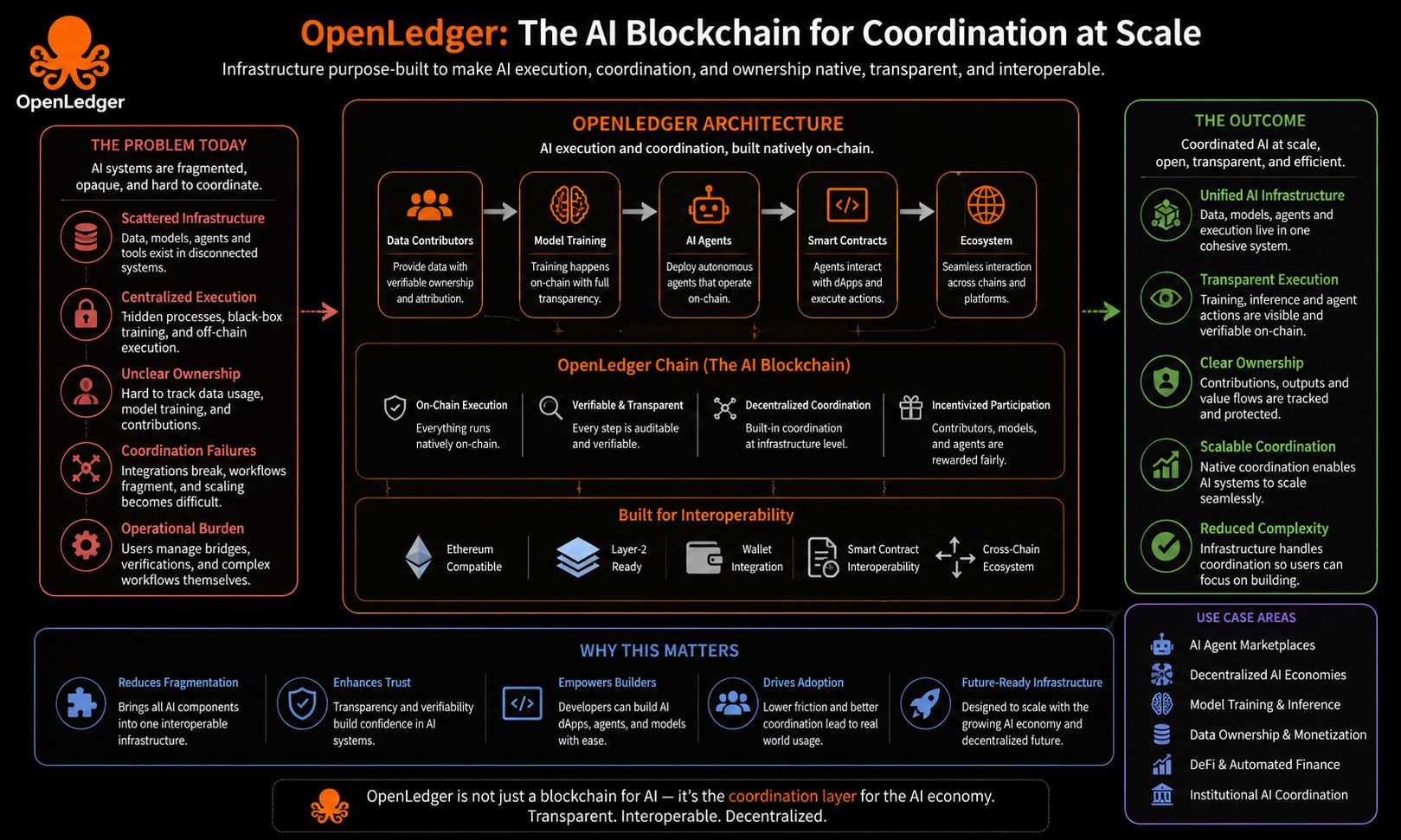
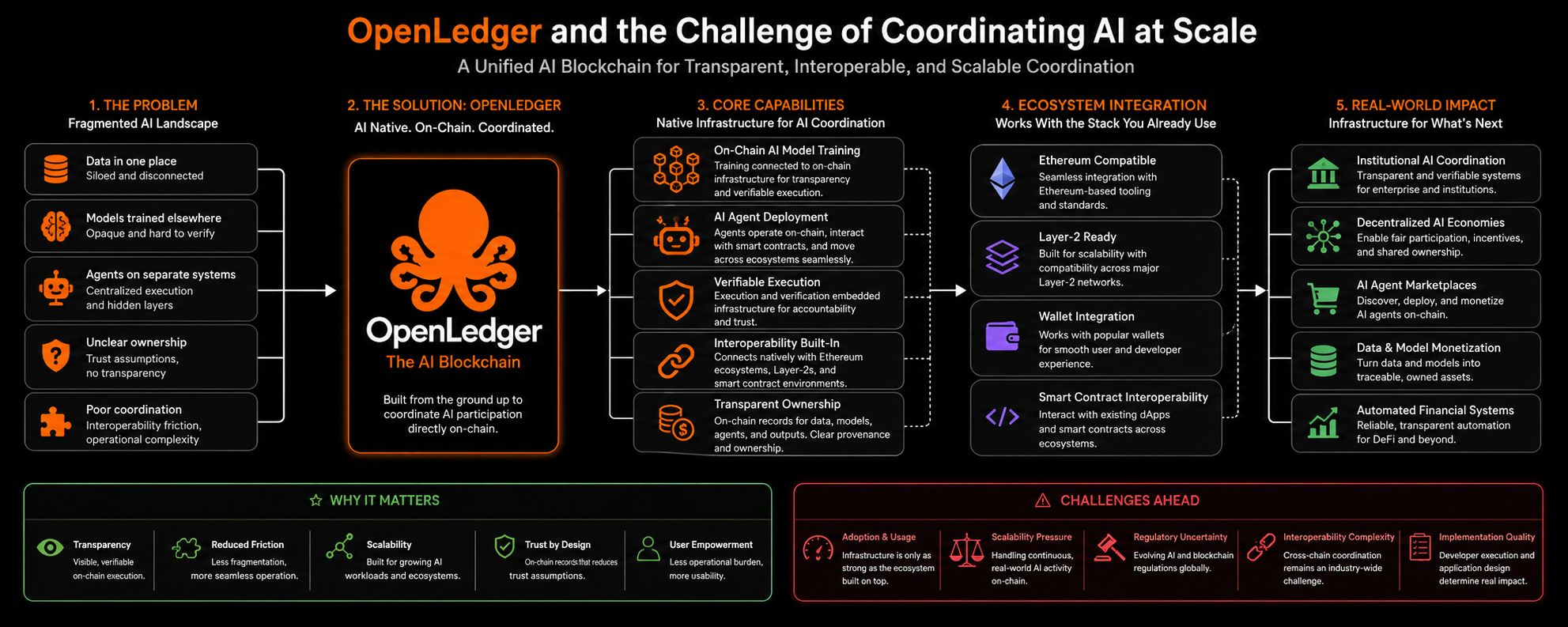
One of the biggest problems in the current AI economy is that everything feels scattered. Data exists in one place. Models are trained somewhere else. Agents operate through separate APIs. Ownership becomes blurry the second systems start interacting across platforms. Even basic coordination often depends on centralized infrastructure quietly sitting in the middle while projects continue calling themselves decentralized.
You can feel that friction almost immediately when trying to move from experimentation into real operational use.
What caught my attention with OpenLedger was the attempt to reduce that fragmentation directly inside the infrastructure layer itself. The project positions itself as “The AI Blockchain,” but I think the more important idea is how it tries to make AI execution native to the chain rather than external to it.
The more I looked into it, the more obvious the coordination focus became.
AI model training is connected directly to on-chain infrastructure instead of existing as a separate hidden process somewhere outside the system. That changes the transparency dynamic quite a bit. In most environments today, users are expected to trust how models are trained, how outputs are generated, and how data flows through the system without having much visibility into the actual process itself.
OpenLedger seems to approach this differently by embedding execution and verification directly into the infrastructure.
I’m careful not to exaggerate what that means because infrastructure alone doesn’t magically solve trust. But operational transparency matters more than most people admit, especially once automated systems start making decisions across financial or decentralized environments.
The same thing applies to AI agents.
A lot of projects talk about autonomous agents right now, but when you examine the mechanics closely, many of those systems still depend heavily on centralized execution layers or disconnected coordination frameworks. The “autonomy” mostly exists in presentation rather than infrastructure.
What made OpenLedger more interesting to me was the fact that AI agent deployment appears integrated directly into the blockchain environment itself. Agents can operate on chain, interact with smart contracts, and participate across ecosystems without relying on so many disconnected layers sitting in between.
Again, I’m not saying that suddenly removes every problem. But reducing operational fragmentation matters.
Especially at scale.
Because the larger AI systems become, the more coordination failures start appearing. Ownership becomes difficult to track. Execution pathways become harder to verify. Integrations become messy. Even simple interoperability across ecosystems starts creating friction that slows everything down.
That’s probably the part most AI conversations still underestimate.
Everyone talks about intelligence. Very few talk seriously about coordination.
And honestly, coordination is usually where systems either become usable or quietly fall apart.
Another thing I found practical about OpenLedger was its compatibility with Ethereum-based infrastructure. That may not sound exciting on paper, but compatibility matters a lot in real usage environments. Projects that force users into isolated ecosystems often create more friction than value. Developers already work across wallets, Layer 2 environments, smart contracts, and existing tooling stacks. If integration becomes painful, adoption slows almost immediately.
OpenLedger seems aware of that.
Instead of trying to replace everything around it, the infrastructure appears designed to connect into existing blockchain environments more naturally. Wallet integration, Layer 2 compatibility, and smart contract interoperability sound like small implementation details until you actually try moving automated AI workflows across fragmented systems yourself. Then suddenly those details become the difference between operational usability and constant technical friction.
That practicality is honestly what kept my attention.
Not marketing language.
Not AI narratives.
Execution design.
There’s also something psychologically different about systems where activity happens transparently on chain. Even when imperfect, visible execution creates a different trust environment than hidden backend processes users are simply expected to believe in. I think that becomes increasingly important as AI systems handle larger economic activity and autonomous decision making.
Most blockchain projects still quietly shift coordination problems back onto the user. They claim decentralization while depending on users to manually verify trust assumptions, bridge disconnected tooling, or manage fragmented workflows themselves.
OpenLedger became more interesting to me because it seems to recognize that infrastructure should reduce operational burden rather than simply advertise decentralization philosophically.
That doesn’t mean the system is flawless.
Far from it.
There are still very real limitations surrounding adoption, scalability, and implementation quality. Building infrastructure for AI coordination is difficult enough in centralized systems, let alone decentralized ones. Regulation around AI continues changing quickly. Cross-chain interoperability remains messy across the broader industry. Scalability pressure becomes serious once autonomous systems begin operating continuously on-chain.
And honestly, infrastructure quality alone cannot force meaningful adoption.
If developers build poor applications on top of strong infrastructure, users still leave.
If coordination becomes expensive or slow, efficiency suffers.
If ecosystems become overly complicated, most people simply stop engaging.
Those realities still apply here.
I also think many AI projects underestimate how difficult real world autonomous coordination actually is. Running demos is easy. Sustaining reliable AI participation across decentralized economic environments is much harder. There’s a difference between showing capability and maintaining operational consistency under real conditions.
That’s why I’ve become less interested in narratives and more interested in behavior.
I pay attention to how systems perform under actual usage pressure now.
That’s probably where infrastructure like OpenLedger makes the most sense to me environments where transparency, interoperability, and verifiable execution matter more than hype cycles. Institutional coordination layers, decentralized AI economies, automated financial systems, agent marketplaces, large-scale model participation, data monetization environments those are the kinds of areas where embedded coordination infrastructure starts becoming valuable.
Not because it sounds futuristic.
Because fragmented systems eventually become operational liabilities.
The practical side still matters most though.
I’m watching how integrations behave in practice. I want to see whether AI workflows actually run smoothly on chain or whether complexity eventually leaks back onto the user. I pay attention to deployment friction, interoperability quality, execution consistency, and how naturally the infrastructure connects with existing ecosystems.
That tells me far more than branding ever will.
Experience changes perspective over time.
A few years ago I probably would’ve focused mostly on narratives around decentralized AI. Now I care much more about operational reality. Systems become valuable quietly. Usually through reducing friction people are already tired of dealing with.
That’s partly why OpenLedger stayed on my radar longer than most AI blockchain projects do.
Not because it promised impossible outcomes.
But because the infrastructure appears designed around coordination itself, which honestly feels like the real problem most systems are still struggling to solve.
And in my experience, the projects that last usually aren’t the loudest ones.
They’re the ones that make complicated things feel easier to operate without constantly reminding users how complicated everything is underneath.