
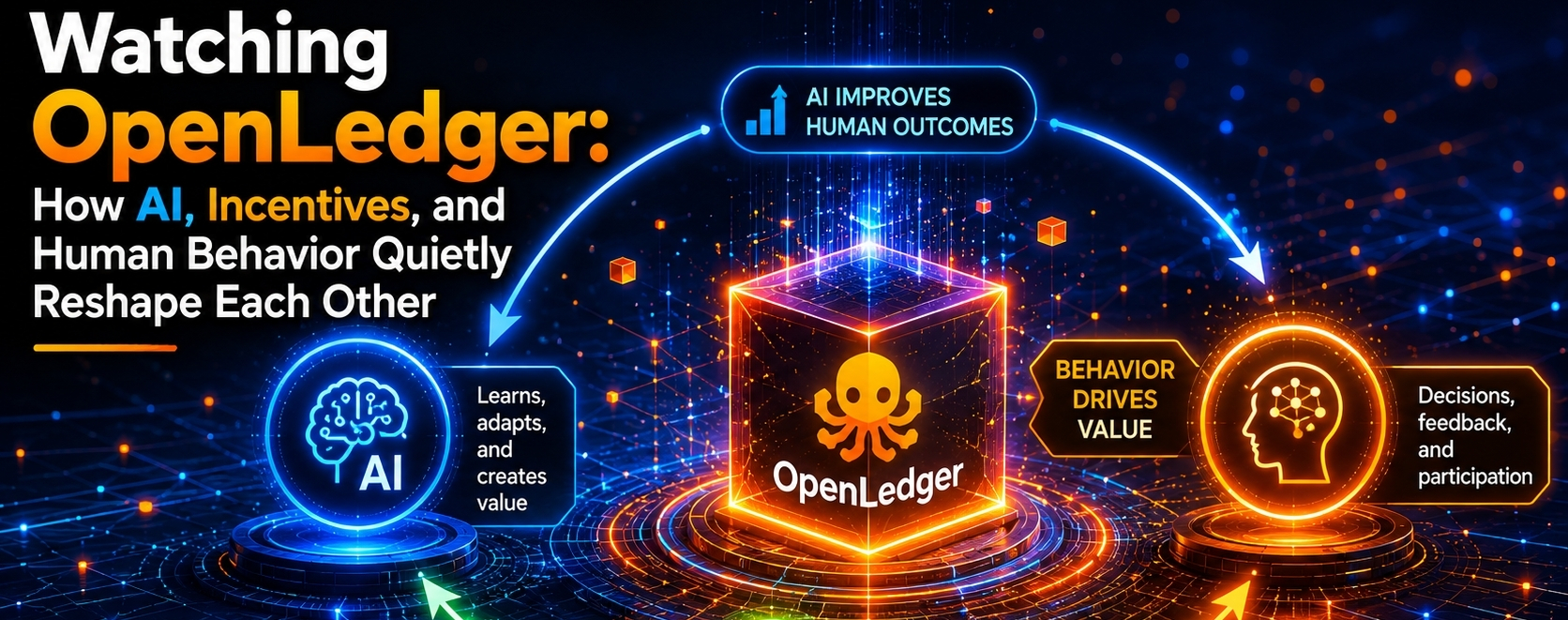

I’ve been quietly watching projects like OpenLedger for a while now, and I think what stays with me most isn’t the technology itself. It’s the people around it. In the beginning, there’s usually this genuine sense of curiosity. People come in wanting to explore, contribute, maybe even feel like they’re early to something meaningful. The conversations feel open and relaxed. Nobody seems too focused on winning yet.
But that atmosphere never stays untouched for long. I keep noticing how slowly, almost invisibly, things become more calculated. People start paying closer attention to rewards, rankings, recognition, and timing. What began as exploration turns into strategy. Even the way people talk changes. You can feel when someone stops asking questions because they’re curious and starts asking because they’re trying to figure out the system.
With OpenLedger, I find myself thinking about this idea of turning data, AI models, and agents into something liquid, something that can carry measurable value. Part of me understands the appeal. For years, people have contributed data and attention to platforms without really owning any piece of what they helped build. So when a project says contributors should finally benefit, it naturally pulls people in. It sounds fair in a way that many older systems never did.
Still, I’ve learned to sit with these ideas a little longer before fully trusting them. Because once rewards enter a system, behavior changes. It always does. People begin adapting themselves around whatever gets noticed or valued most. And after enough time, it becomes difficult to tell whether participation is still genuine or simply optimized. I don’t even mean that as criticism. I think humans naturally move toward incentives, especially when uncertainty is involved.
What I find most interesting is how subtle these shifts are. Nobody wakes up one day and decides to become transactional. It happens gradually. Communities that once felt thoughtful become competitive without realizing it. People who once shared openly become more careful, more protective, more aware of visibility. I’ve seen it happen in almost every digital ecosystem that introduces status or rewards, even when the original intentions were good.
I also keep wondering who truly benefits in systems like this over time. On the surface, everything looks open and decentralized. But somehow there are always certain people who understand the structure earlier than others. They know how to position themselves before everyone else catches on. And sometimes I think the real advantage in these spaces isn’t talent or contribution alone. Sometimes it’s simply understanding the hidden rhythm of the system before the crowd does.
The part that feels hardest to answer is the question of fairness. If an AI model learns from thousands of invisible contributions, who really deserves the value created from it? Can a system genuinely track that fairly? Or does it eventually reward the people who are best at navigating the structure rather than the people who quietly shaped it underneath? I honestly don’t know. The older I get, the less confident I become in simple answers.
And maybe that’s why I keep observing projects like OpenLedger with a mixture of interest and distance. I don’t think these ideas are meaningless. I actually think they reflect something real about where the internet is moving. But I also think human behavior has a way of reshaping every idealistic system into something more familiar over time. So now I mostly watch patiently, paying attention to patterns instead of promises, and wondering whether any platform can truly stay aligned with the spirit it began with.


