
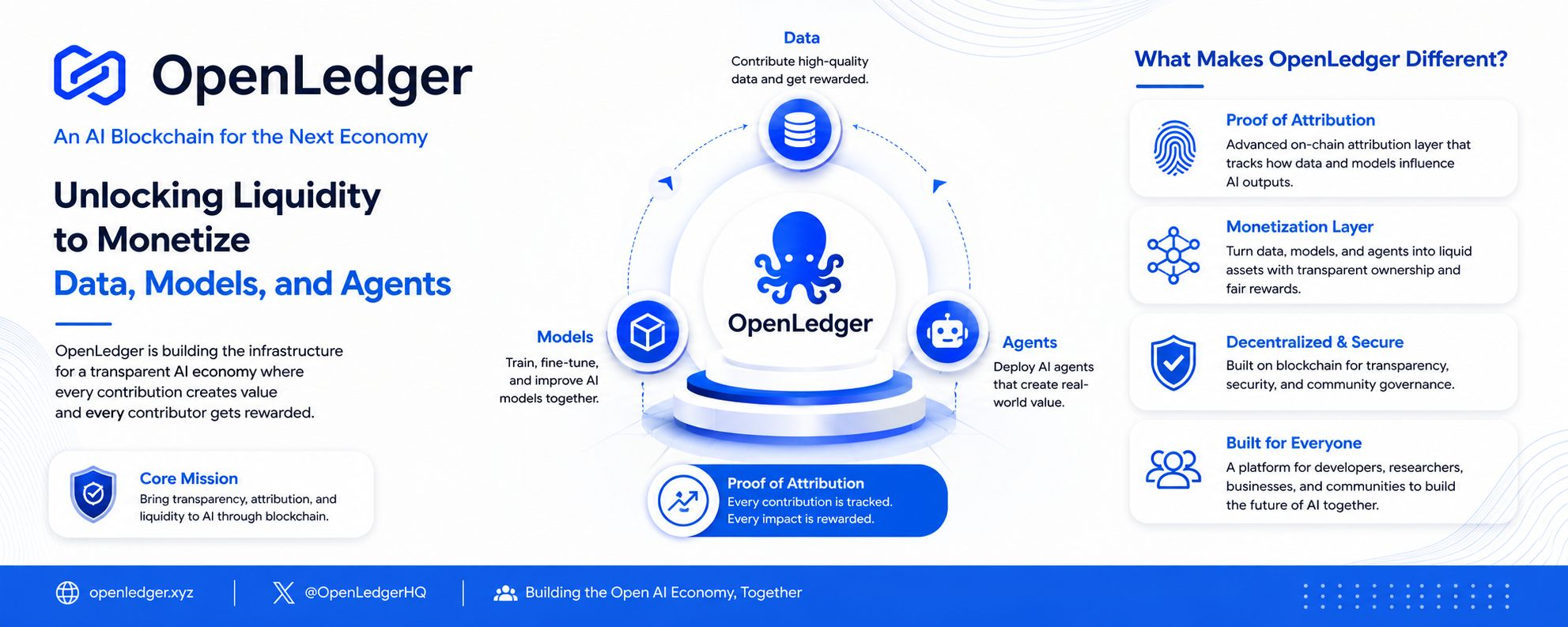

When I first came across OpenLedger, my reaction was fairly predictable. Crypto has a habit of turning every new trend into the same story. A project appears with a compelling narrative, attracts attention, launches incentives, creates a rush of participation, distributes rewards, and then slowly fades once the easy gains disappear. AI has only accelerated that cycle, producing countless projects that sound revolutionary until you look beyond the marketing.
That was my expectation here as well.
But the more I looked into OpenLedger, the more it felt like the team might be aiming at a deeper problem rather than simply wrapping another token around the AI narrative. The project is built around a question that most people rarely think about: if data is becoming one of the most valuable resources in AI, why are the people providing that data usually the least rewarded participants in the system?
OpenLedger’s answer is to build infrastructure where data, models, and AI agents can all become economic assets with transparent ownership and measurable contribution. In theory, users contribute valuable data, help improve models, and receive rewards based on the impact of those contributions. The goal is not just to incentivize activity, but to create a system where contributors continue participating because their work remains connected to future value creation.
What caught my attention was not the rewards themselves. Crypto has never struggled to invent reward mechanisms. The more interesting part is the attempt to solve attribution. OpenLedger wants to track where value actually comes from inside AI systems and then route rewards back to the people responsible for creating that value. If that works at scale, it would address a genuine weakness in today's AI economy, where data providers often disappear into the background while platforms capture most of the upside.
That idea sounds simple until you realize how difficult it is. Measuring contribution inside complex AI models is not a trivial challenge. Many projects talk about rewarding contributors, but very few can clearly explain how those contributions are identified, measured, and verified. OpenLedger appears to be making attribution a core part of its architecture rather than an afterthought. Whether that can be executed effectively remains one of the biggest unanswered questions.
The token design also feels slightly different from the typical speculative model. Instead of positioning the token purely as an object of financial speculation, the ecosystem appears designed to encourage continued participation, staking, contribution, and network activity. That doesn't automatically guarantee sustainability, but it does suggest the team understands that long-term networks cannot survive on speculation alone.
The real test will be user behavior. Every incentive system eventually reveals what it truly rewards. If participants are encouraged to create meaningful contributions that improve models and generate lasting value, the ecosystem becomes stronger over time. If the easiest path is simply farming rewards with low-quality activity, the system risks becoming another short-lived incentive machine. Many projects begin with noble intentions and end up optimizing for metrics rather than usefulness.
This is where I remain cautious. The theory behind OpenLedger is compelling, but theories rarely fail on paper. They fail when they meet real users, real markets, and real incentives. Building a sustainable economy around data attribution requires more than technical innovation. It requires people to consistently create valuable contributions, developers to build on top of the infrastructure, and businesses to find enough utility in the system to generate demand beyond speculation.
Still, there is something refreshing about a project that is trying to connect AI value creation directly to the people who contribute to it. Most AI crypto projects focus on attention. OpenLedger appears to be focusing on ownership. That distinction may end up being more important than any reward campaign or token launch.
Whether it succeeds remains uncertain. There are plenty of ways this experiment could fail, from attribution challenges to weak adoption to the simple reality that users often follow incentives differently than designers expect. But unlike many projects that feel like recycled narratives with new branding, OpenLedger at least seems to be asking an interesting question.
For now, that is enough to keep it on my watchlist. Not because the outcome is guaranteed, but because the experiment itself feels worth paying attention to. Success will ultimately depend on execution, product adoption, and whether real users find value in the system once the initial excitement fades. Until then, cautious optimism feels like the most reasonable position.