

I’ve spent enough years in crypto to know when a narrative feels forced.
Usually you can tell within five minutes. New buzzword, recycled roadmap, token attached to a problem nobody actually has. People pretend to care until liquidity disappears and the timeline moves on to the next shiny thing.
That’s honestly why I ignored most AI projects at first.
The market turned “AI” into a trade before it became a real infrastructure shift. Everyone suddenly had an AI roadmap. Every protocol became “intelligent.” Half the space sounded like broken pitch decks trying to front-run retail attention.
But somewhere underneath the noise, something real started happening.
Trading itself changed.
A few years ago edge mostly came from being early. Early wallets. Early rotations. Early Discord groups. You could survive just by staying online longer than everyone else.
Now it feels different.
The market moves too fast for manual thinking alone. Information spreads instantly. Narratives form in hours instead of weeks. Most traders are quietly building systems around themselves now. Custom dashboards. AI-assisted research. Automated monitoring. Signal filtering.
Not because it sounds futuristic. Because attention has become expensive.
That’s the part people underestimate when they talk about AI infrastructure.
The real value isn’t “robots replacing humans.” It’s reducing friction between information and execution.
And that’s where OpenLedger started making sense to me.
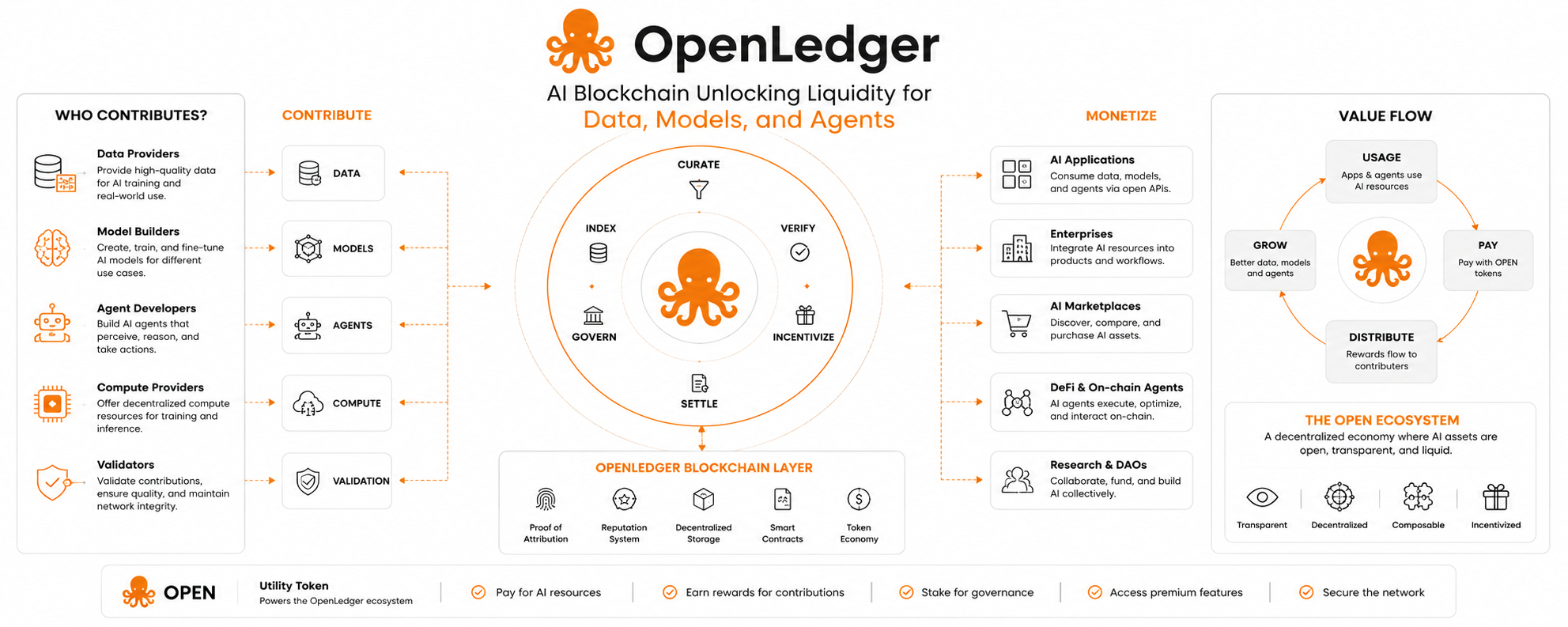
What caught my attention wasn’t the branding or the AI angle. It was the idea that data, models, and agents could become liquid economic assets instead of closed products controlled by a few companies.
That changes the structure completely.
Right now the AI world feels strangely centralized for something that’s supposed to define the future of the internet. A small group of firms own the compute, own the models, own the distribution, and eventually own the economics flowing through the system.
Crypto traders have seen this movie before.
We watched entire ecosystems become dependent on gatekeepers during previous cycles. Liquidity gets trapped upstream. Builders lose leverage. Smaller participants create value while platforms absorb most of it.
OpenLedger is trying to approach AI differently by turning contribution itself into something monetizable.
Data providers can earn.
Model builders can earn.
Agents interacting with networks can potentially generate value autonomously.
That sounds simple on paper, but if infrastructure like this matures properly, it changes who gets paid in the AI economy.
A small independent team with niche financial data could theoretically compete with much larger players if distribution and monetization become open enough. That’s a very crypto-native idea when you think about it.
And honestly, this feels like a natural evolution of where markets were already heading.
The first crypto cycle was mostly about money.
The second was about applications.
Then came scalability and modular infrastructure.
Now we’re entering a phase where intelligence itself becomes part of the stack.
Not metaphorically. Economically.
AI agents making decisions.
Models consuming live data.
Systems interacting with each other faster than humans can process manually.
In that environment, open coordination layers matter.
But I’m still cautious.
Crypto has a habit of correctly identifying future trends while massively mispricing timelines. We tend to overestimate adoption speed and underestimate operational difficulty.
AI infrastructure is brutally hard.
Most users ultimately choose convenience over decentralization. Developers choose speed. Enterprises choose reliability. If decentralized systems can’t compete on actual performance, the philosophy alone won’t save them.
That’s the challenge OpenLedger still has ahead.
Because the real question isn’t whether decentralized AI sounds important. It’s whether people will genuinely build on it when scale, latency, and economics start becoming painful.
And then there’s the token question, which nobody likes discussing honestly.
Does value truly flow back to OPEN itself?
Or does the network become useful while the token simply becomes narrative fuel?
Crypto still struggles with this problem everywhere.
Some of the best products in this industry never rewarded token holders meaningfully. Meanwhile completely useless assets reached absurd valuations because speculation moved faster than fundamentals.
I don’t think the market has figured out how to value AI networks yet.
Maybe nobody can yet.
Still, I find projects like OpenLedger more interesting than most of the noise because they’re at least trying to solve an infrastructure problem instead of manufacturing temporary attention.
That matters to me more these days.
After enough cycles, you stop looking for perfection. You start looking for systems that make structural sense if the industry keeps evolving.
And whether people realize it or not, data is becoming one of the most important assets in modern markets.
Not just owning it.
Controlling its flow.
Monetizing its usage.
Building coordination around it.
Crypto was originally about removing middlemen from money.
Maybe the next phase is removing middlemen from intelligence itself.
I’m still not sure how investable that becomes long term.
But I do think the direction is real.
