@OpenLedger The first time I looked at OpenLedger, I had a familiar reaction. Not excitement exactly. More like a long pause.
After enough years in crypto, you stop reacting to project descriptions the way you did in earlier cycles. Every few months there's another network claiming to solve the thing that supposedly everyone else missed. Faster. Smarter. More scalable. More decentralized. More aligned. Whatever the market happens to be interested in at that moment.
Right now, of course, that word is AI.
So when I saw OpenLedger positioning itself around AI, data, models, agents, and the idea of unlocking liquidity around those assets, my instinct wasn't to immediately believe it. It was to ask a simpler question.
What problem does this actually notice that other chains aren't paying attention to?
That's where things became a little more interesting.
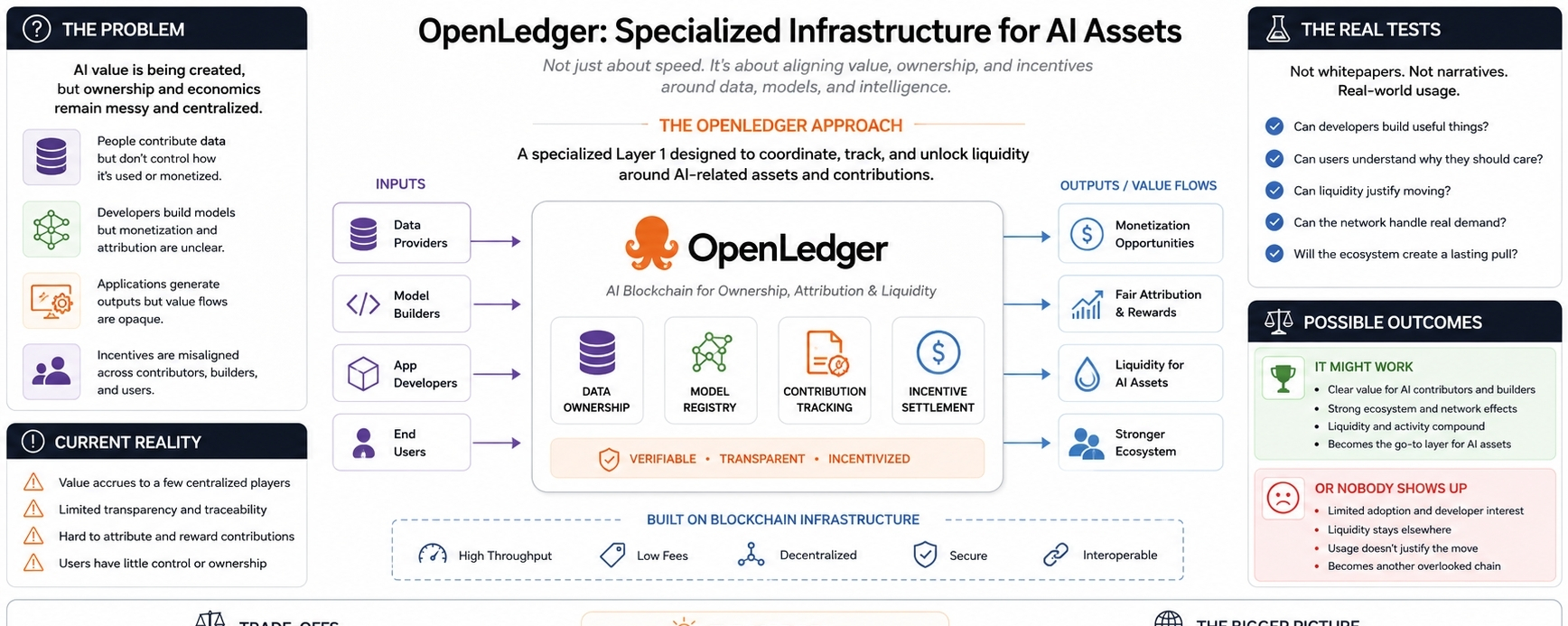
Because beneath the AI terminology, OpenLedger seems to be focused on something that has become increasingly obvious over the last few years. A huge amount of value is being generated by data, models, and machine intelligence, yet the ownership structure around that value remains messy. People contribute data. Developers build models. Applications generate outputs. But the economic relationship between those participants often feels unclear or centralized.
OpenLedger appears to be looking directly at that gap.
Whether it can solve it is another question entirely.
And honestly, that's the question that matters.
We've seen this movie before with Layer 1 blockchains. The story usually starts the same way. New architecture. New consensus model. New incentives. New vision for how everything should work.
Then reality arrives.
Reality doesn't care about whitepapers.
The thing that breaks blockchains is rarely the thing people argue about on social media. It isn't usually theoretical design flaws or philosophical disagreements. It's usage. Actual traffic. Actual users doing unpredictable things at scale.
That's the point where systems reveal what they really are.
A network can look incredibly efficient when activity is controlled and predictable. Then thousands of users arrive at the same moment and suddenly assumptions start colliding with reality.
Even Solana is a useful example here.
I actually think Solana deserves credit for what it has accomplished. When everything is working well, the experience feels remarkably smooth. Transactions happen quickly. Costs remain low. Applications feel responsive.
But we've also seen moments where intense demand exposed stress points. That's not an attack on Solana. If anything, it's evidence that real adoption creates challenges that simulations can't fully predict.
Every Layer 1 eventually faces that test.
OpenLedger will too.
The interesting thing is that OpenLedger doesn't seem to be trying to compete purely on transaction speed or raw throughput, which has become an increasingly crowded conversation anyway. Instead, it appears to be asking whether specialized infrastructure for AI-related assets deserves its own environment.
That idea sounds reasonable on paper.
The question is whether separate environments actually create better outcomes or simply fragment attention further.
Crypto has spent years debating whether one chain eventually wins everything or whether the future consists of many ecosystems sharing activity between them.
I honestly don't know.
Some days the multi-chain future feels inevitable. Different systems optimized for different purposes. Different communities. Different priorities.
Other days it feels like we're creating complexity faster than we're creating users.
Liquidity doesn't naturally spread itself around. People don't wake up wanting to bridge assets across five different networks. Most users gravitate toward whatever already has activity, applications, and familiar interfaces.
That's one of the hardest problems any new Layer 1 faces.
Not technology.
Gravity.
Existing ecosystems develop their own pull.
Developers stay where developers already are. Liquidity stays where liquidity already exists. Communities reinforce themselves.
Moving that is difficult.
OpenLedger seems aware of this, at least indirectly. The focus on monetizing data and AI-related contributions suggests an attempt to create a reason for participation beyond simple speculation.
I think that's important.
Because eventually every network reaches a point where token narratives stop carrying the conversation. People need a practical reason to remain there.
At the same time, there are trade-offs visible in the approach.
OpenLedger appears willing to narrow its focus instead of trying to become a universal settlement layer for every possible use case. That's probably intentional. Specialization can create clarity.
The downside is equally obvious.
The narrower the focus, the more dependent the project becomes on the success of that specific sector.
And AI remains full of unanswered questions.
There's genuine innovation happening. There is also an enormous amount of noise. Sometimes it's difficult to tell where one ends and the other begins.
That's probably why my view on OpenLedger remains somewhere in the middle.
I don't dismiss it.
I also don't assume that connecting AI and blockchain automatically creates value.
What I do find interesting is that the project seems to recognize an economic coordination problem that many networks only address indirectly. Data ownership, model ownership, contribution tracking, incentive distribution—these are not imaginary problems.
They're real.
Whether blockchain is the best solution remains open for debate, but at least the problem itself feels tangible.
The outcome will probably depend less on architecture diagrams and more on execution. Can developers build useful things? Can users understand why they should care? Can liquidity justify moving? Can the network handle activity if people actually show up?
Those questions sound boring compared to futuristic AI narratives.
They're also the questions that decide whether projects survive.
For now, OpenLedger feels less like a guaranteed breakthrough and more like an experiment worth watching from a reasonable distance. Not because it promises a new world, but because it seems to be looking at a corner of the market that still feels unresolved.
That doesn't mean success is coming.
It just means the idea isn't completely absurd.
And these days, in crypto, that's sometimes enough to keep paying attention.
It might work. Or nobody shows up.