
A few years ago, most blockchain projects were focused on moving money faster, creating decentralized finance, or building digital collectibles. Today, the conversation is changing. Artificial intelligence has become the center of attention, and suddenly a new question has emerged: if AI models are becoming more valuable every day, who should own the data, models, and intelligence that power them?
The first time I came across OpenLedger, it felt like one of those ideas that sounds obvious once someone explains it. AI systems are built on data. They learn from information generated by people, businesses, researchers, and entire communities. Yet the value created by that data often ends up concentrated in a handful of companies. OpenLedger proposes a different future one where data contributors, model builders, and AI developers can all participate in the value they help create.
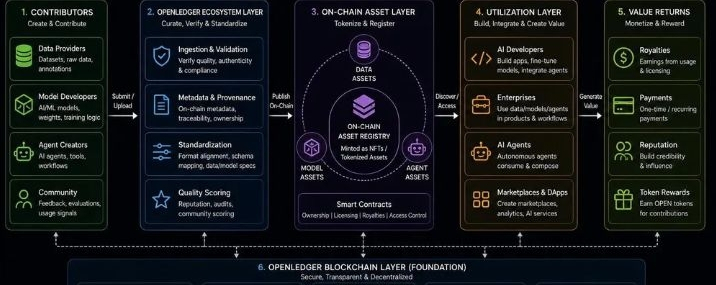
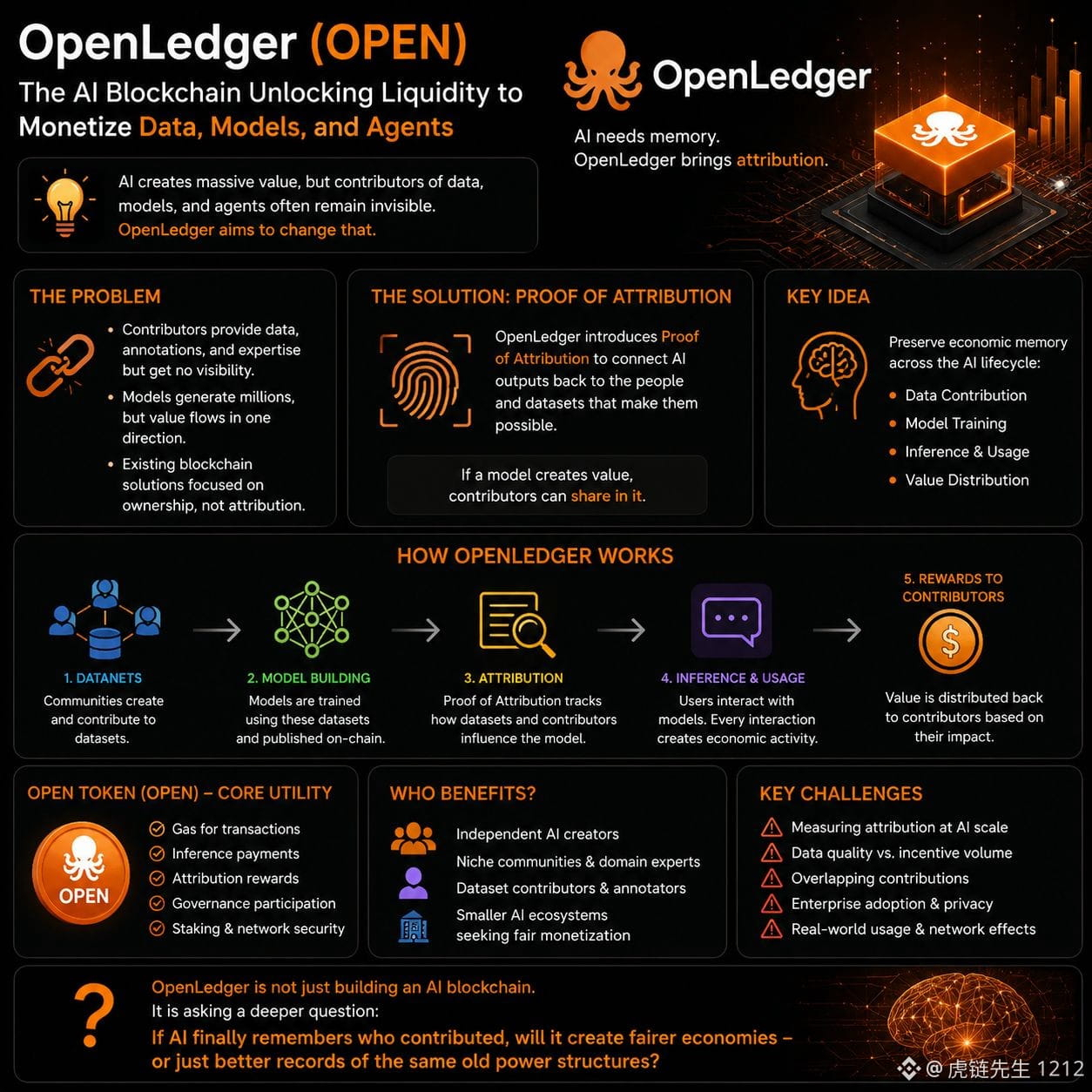
At its core, OpenLedger describes itself as an AI blockchain designed to unlock liquidity for data, models, and agents. That might sound technical, but the underlying concept is surprisingly simple. Imagine a world where your data is not just something you give away for free. Instead, it becomes an asset that can generate value whenever it contributes to an AI application or service. OpenLedger aims to create the infrastructure that makes this possible.
The blockchain serves as a transparent settlement layer where contributions can be recorded, verified, and rewarded. Instead of treating AI as a black box controlled by a few organizations, OpenLedger attempts to build a system where value flows back to participants across the ecosystem.
To understand why this matters, imagine a small healthcare research group that gathers valuable medical data. Traditionally, that data might be sold once, stored in a private database, and eventually become inaccessible to those who generated it. Under OpenLedger's vision, that same dataset could continuously generate value whenever it helps train AI models used in diagnostics, research, or healthcare applications. The contributors would remain connected to the economic activity their data creates.
This approach extends beyond data. AI models themselves can become assets within the network. Developers who build useful models could potentially monetize them more efficiently, while businesses could access specialized intelligence without having to create everything from scratch. The result is an ecosystem where data providers, model creators, and application builders interact in a shared economic framework.
Of course, this is where the story becomes more complicated.
The idea sounds powerful, but turning vision into reality is never easy. One of the biggest challenges facing OpenLedger is the same challenge facing nearly every blockchain project connected to AI: adoption. Technology alone does not guarantee success. A network only becomes valuable when people actively use it.
The blockchain industry has witnessed countless projects with ambitious visions that struggled to attract users. OpenLedger must convince businesses, developers, and data providers that its ecosystem offers advantages strong enough to justify participation. Without meaningful activity, even the most innovative infrastructure risks becoming an impressive solution searching for a problem.
Another challenge lies in data quality. AI systems are only as good as the information they learn from. If a network rewards data contributions, mechanisms must exist to ensure that valuable and accurate information is prioritized over low-quality submissions. Creating incentives that encourage quality rather than quantity is easier said than done.
There is also intense competition. Large technology companies are investing billions into AI infrastructure. At the same time, dozens of blockchain projects are racing to position themselves at the intersection of AI and decentralization. OpenLedger is entering a crowded field where differentiation matters enormously.
Yet despite these realities, I find the broader vision compelling.
The reason is simple. AI is becoming an economic engine. Every day, more businesses rely on machine intelligence to automate tasks, generate content, analyze information, and improve decision-making. As this trend accelerates, questions about ownership and value distribution become increasingly important.
Imagine a future where thousands of specialized AI agents perform work on behalf of users. Some analyze financial markets. Others assist with research, customer service, healthcare, or education. Behind every one of those agents lies data, training, and intellectual effort. OpenLedger is betting that these resources should function as economic assets rather than hidden components controlled by centralized platforms.
Whether that vision succeeds remains uncertain. The crypto market is notoriously unpredictable, and technological trends can change rapidly. Investors and users should approach every emerging project with realistic expectations and healthy skepticism. Promising ideas do not automatically translate into sustainable ecosystems.
Still, innovation often begins with ambitious questions. OpenLedger is asking one that feels increasingly relevant: if AI becomes one of the most valuable industries in the world, who gets rewarded for creating the intelligence that powers it?
The answer could shape the next chapter of both blockchain and artificial intelligence. OpenLedger may not have all the answers yet, but it is attempting to build infrastructure for a future where data, models, and AI agents are treated as productive digital assets rather than invisible resources. In a world increasingly driven by machine intelligence, that possibility alone makes the project worth watching.
Perhaps the most interesting aspect of OpenLedger is not the blockchain itself, but the economic model it represents. It challenges long-standing assumptions about who owns value in the digital age. If the network can successfully connect contributors, developers, and businesses into a functioning marketplace for intelligence, it could become part of a larger shift toward a more open AI economy.
For now, OpenLedger remains a developing story. But sometimes the projects that matter most are not the ones chasing today's trends they are the ones preparing for tomorrow's realities. And in the rapidly converging worlds of AI and blockchain, OpenLedger is clearly positioning itself as one of those future focused experiment.