I'll be honest, I didn't expect OpenLedger to hold my attention for very long.
I've spent enough time around crypto and AI to become skeptical whenever a project presents itself as the solution to a fundamental problem. The industry has a tendency to wrap difficult questions inside elegant narratives. Sometimes the technology is impressive, but the assumptions underneath it remain largely untouched. Over time, I've found that the most interesting projects are not necessarily the ones with the boldest claims. They're the ones that force you to rethink an underlying problem you thought you already understood.
That was my experience with OpenLedger.
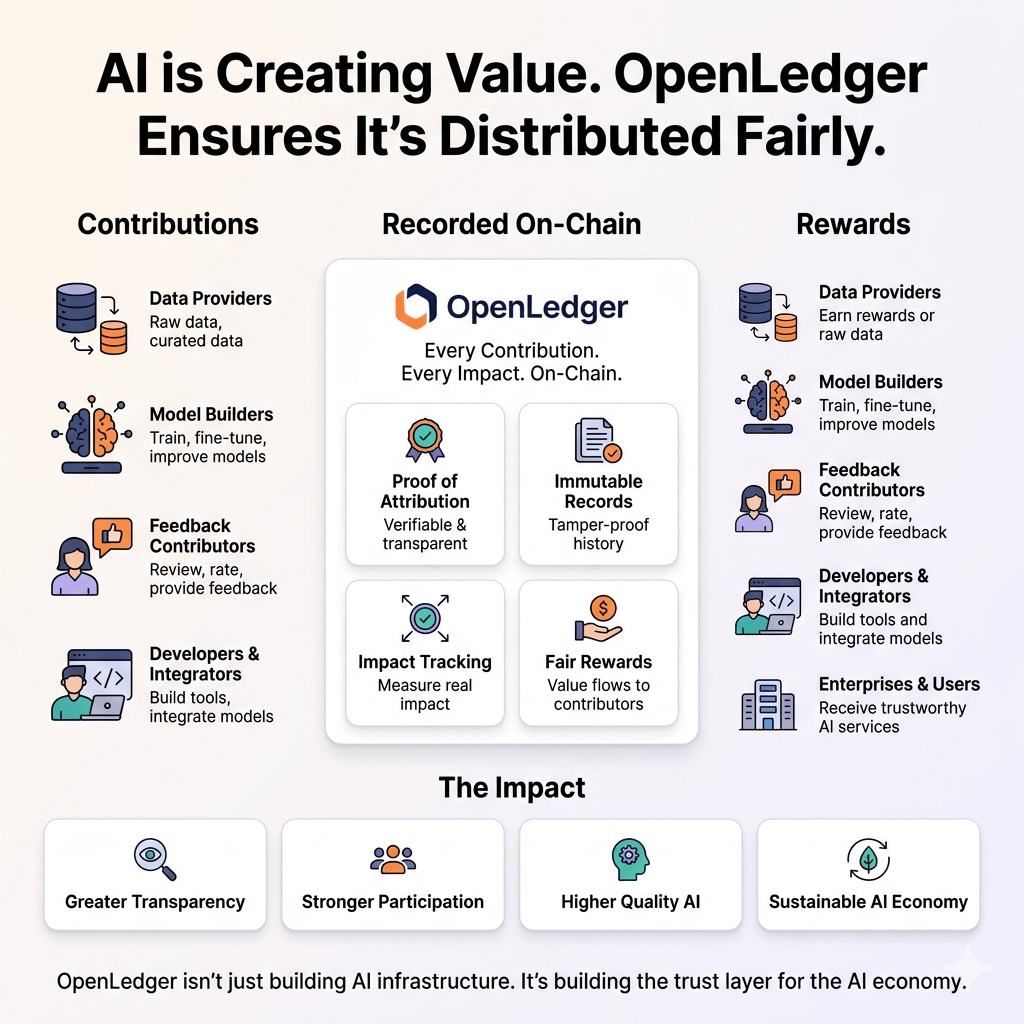
At first glance, it looks like another attempt to position itself at the intersection of blockchain and artificial intelligence. There are already countless projects occupying that space. Most focus on making AI more accessible, more decentralized, or more efficient. OpenLedger seems to be asking a different question entirely. It is less concerned with how intelligence is created and more concerned with how value should be distributed once intelligence exists.
The longer I sat with that idea, the more interesting it became.
One of the strange realities of the current AI economy is that nearly everyone contributes to it, but very few people participate in the value it creates. Every dataset originates somewhere. Every model learns from information generated by countless individuals, communities, researchers, and creators. Yet once those contributions enter a training pipeline, ownership becomes increasingly difficult to trace. Intelligence emerges from the system, but attribution often disappears along the way.
For years, the internet has operated on a similar dynamic. People generate value while platforms capture most of the economic benefits. AI simply amplifies this pattern. The scale becomes larger, the process becomes more opaque, and the distance between contribution and reward grows even wider.
What caught my attention about OpenLedger is that it appears to recognize attribution as an infrastructure problem rather than a policy problem.
That distinction matters.
Most discussions about fairness in AI eventually become debates about regulation, ethics, or corporate responsibility. OpenLedger seems to start from a different assumption. Instead of asking institutions to distribute value more fairly, it attempts to build systems where contributions can be measured, recorded, and rewarded directly through the network itself.
Whether that works in practice is another question entirely.
But the ambition behind it is difficult to ignore.
The challenge, of course, is that attribution sounds much easier than it actually is. In theory, everyone agrees that contributors should receive recognition for the value they create. In reality, determining who contributed what is one of the hardest problems in economics.
Imagine thousands of participants providing data, building models, validating outputs, and creating specialized AI agents. Some contributions are obvious. Others are indirect. Some become valuable immediately, while others only reveal their importance months later when combined with entirely different resources. Value rarely emerges from a single source. It emerges from interaction.
This is where OpenLedger becomes more than a blockchain project. It starts looking like an attempt to map economic causality itself.
That may sound abstract, but I think it's the real heart of the protocol.
Most digital systems are surprisingly bad at understanding where value originates. They are good at measuring transactions. They are good at recording ownership. They are good at tracking movement. They are much less effective at identifying the countless invisible contributions that make those transactions possible in the first place.
OpenLedger appears to be exploring whether attribution can become a native property of the network rather than an afterthought layered on top of it.
What fascinates me is that this isn't only a technical challenge. It's a social one.
The moment attribution becomes tied to economic rewards, people begin competing over definitions. What counts as meaningful contribution? How should value be measured? Who decides which data matters more than other data? These questions cannot be solved through code alone because they ultimately reflect human judgment.
This is why I often think the hardest part of decentralized systems isn't decentralization itself. It's coordination.
Technology can distribute infrastructure. It can distribute validation. It can distribute ownership records. Distributing agreement is much harder.
Every protocol eventually discovers this.
At some point, participants disagree. Incentives diverge. Different groups begin optimizing for different outcomes. Governance becomes less about technology and more about collective decision-making under uncertainty.
OpenLedger will likely face those same challenges.
In some ways, that is exactly why I find it interesting.
Perfect systems are usually built around simplified assumptions about human behavior. Imperfect systems often reveal a deeper understanding of reality because they acknowledge how difficult coordination actually is.
When I look at OpenLedger, I don't see a finished answer. I see an attempt to build infrastructure around a question that is becoming increasingly difficult to avoid.
As AI grows more capable, ownership becomes more ambiguous.
Who owns a model's intelligence?
The company that trained it?
The individuals whose data shaped it?
The developers who improved it?
The participants who continue refining it?
The answer is probably some combination of all of them, which is precisely why the problem becomes so complicated.
Historically, institutions have managed these ambiguities through centralized authority. A company owns the platform, controls the assets, and determines how value flows. OpenLedger seems to be exploring whether attribution itself can become decentralized, allowing ownership to emerge from transparent participation rather than centralized control.
That idea sits somewhere between idealism and practicality.
The idealist in me understands the appeal. A world where contributors receive proportional recognition for the value they create feels more aligned with how intelligence is actually produced. Knowledge has always been collaborative. Innovation has always been cumulative. Most breakthroughs are built on foundations created by countless people who rarely receive direct compensation.
The realist in me understands how difficult it will be.
Human systems are messy. Incentives evolve. Participants adapt. Every economic network eventually encounters behaviors its designers never predicted. Attribution can reduce ambiguity, but it cannot eliminate conflict. Transparency can improve trust, but it cannot replace it entirely.
And yet I think there is something important happening here.
Not because OpenLedger has solved the problem, but because it is attempting to engage with the problem at the infrastructure level.
For a long time, discussions about AI have focused on intelligence itself. Better models. Faster computation. More capable agents. Those developments are important, but they may not be the most consequential part of the story.
The deeper question is how societies organize around intelligence once it becomes abundant.
When intelligence can be generated, distributed, and monetized at global scale, ownership becomes one of the defining challenges of the digital economy. Attribution becomes economic infrastructure. Coordination becomes economic infrastructure. Trust becomes economic infrastructure.
That future may still be taking shape, but the direction feels increasingly clear.
OpenLedger matters to me not because it offers certainty, but because it reflects a growing realization that the next generation of AI systems will not simply be technical systems. They will also be ownership systems. They will determine who captures value, who receives recognition, and who remains invisible.
Whether OpenLedger ultimately succeeds is impossible to know.
What interests me more is the fact that projects like this are beginning to ask the right questions.
Because beneath every discussion about artificial intelligence lies an older and far more human question: when value is created collectively, how do we decide who deserves credit for it?
Technology can help us answer that question.
But it cannot answer it for us.
And perhaps that is the most important thing OpenLedger reminds us of.