I've become a little wary whenever I hear the word "coordination" in crypto or AI discussions.
Maybe that's because I've seen it used so many times that it almost starts losing its meaning. Every project seems to promise better coordination, smoother collaboration, or more efficient systems. But when you actually spend time using the products, what often ends up happening is that you're still the one connecting all the pieces yourself. The tools may be different, the interfaces may look cleaner, but the responsibility still falls on the user.
That was one of the reasons OpenLedger caught my attention.
At first, I assumed it was another project trying to combine AI and blockchain under a broad infrastructure narrative. There are plenty of those already. But the more time I spent looking into how the system is designed, the more I realized that OpenLedger seems to think about coordination differently. Instead of treating it as a feature that sits on top of the system, it appears to treat coordination as part of the infrastructure itself.
The longer I looked at the current AI landscape, the easier it became to understand why that matters.
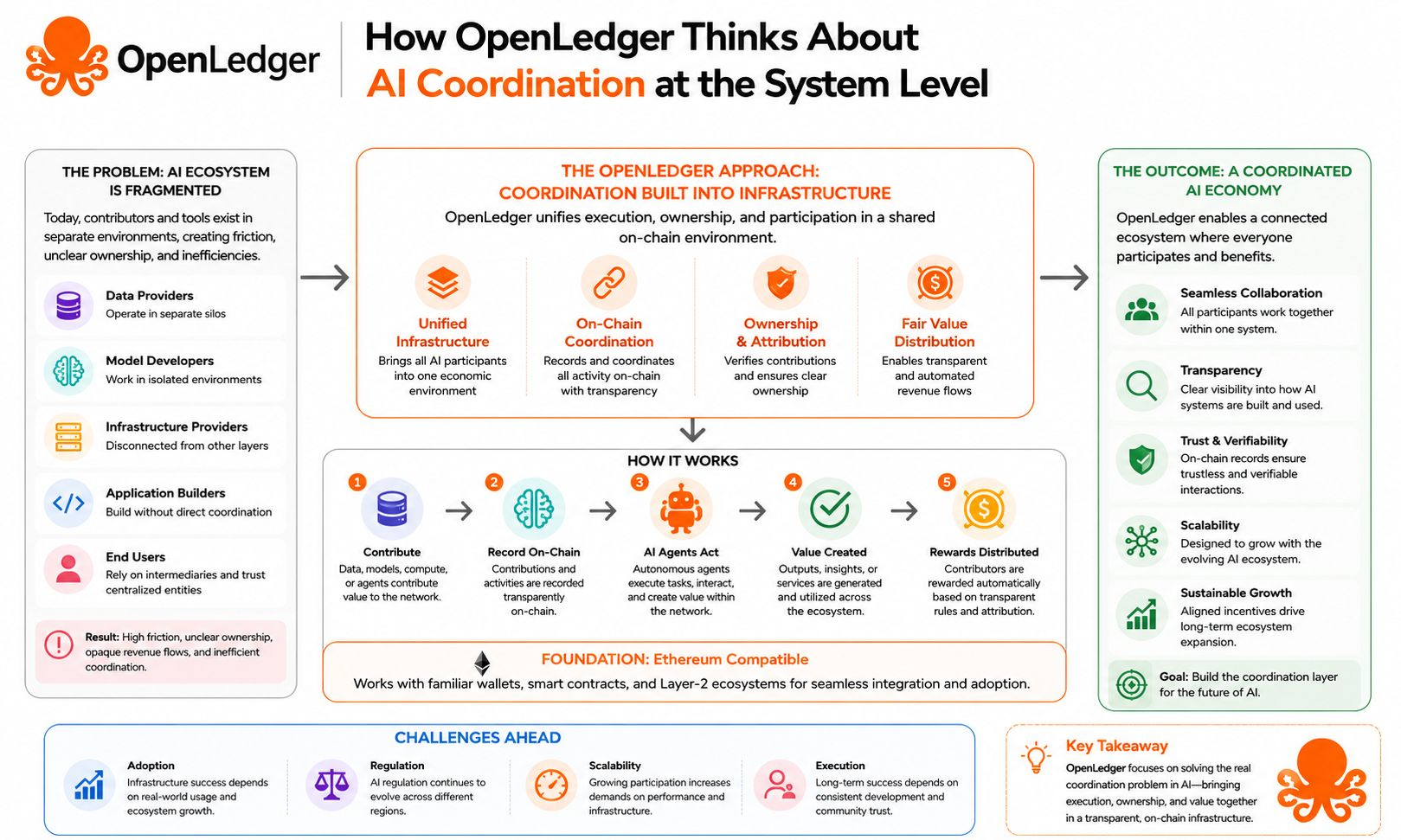
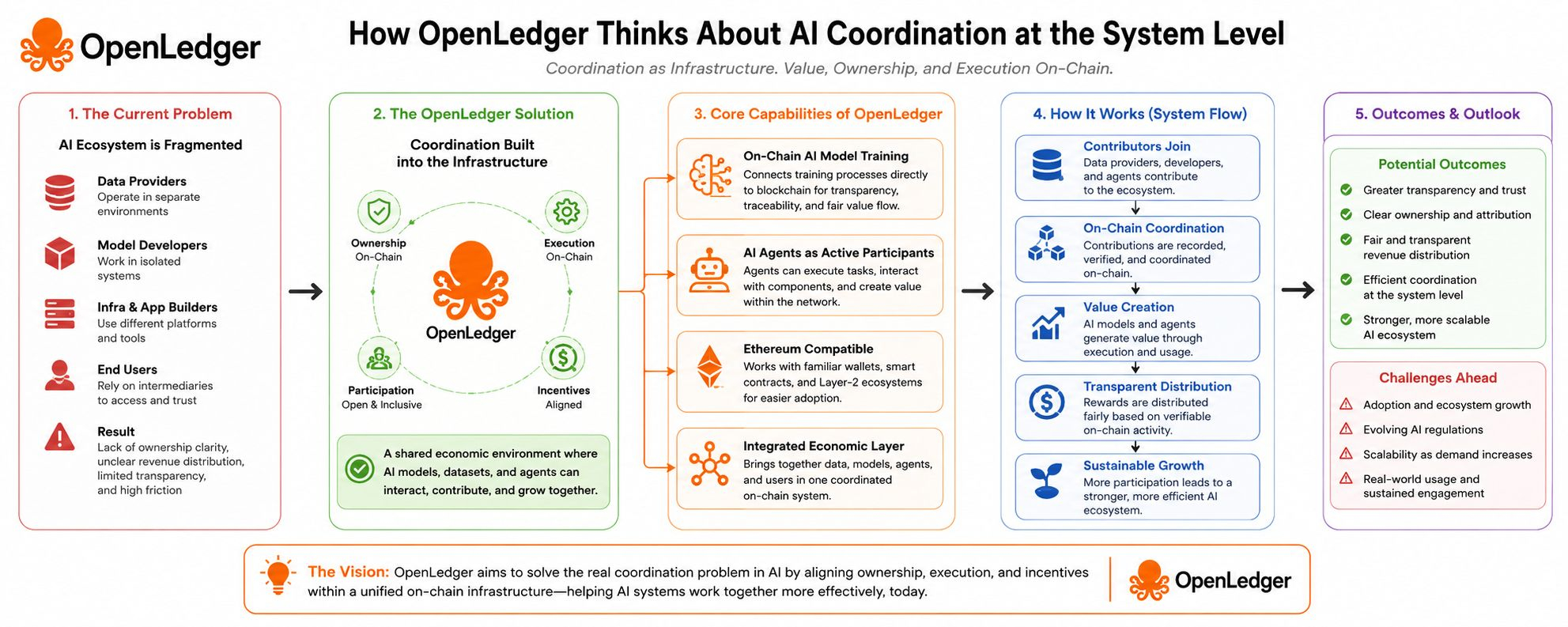
Today, most AI ecosystems feel fragmented. Data providers operate in one environment. Model developers work in another. Infrastructure providers, application builders, and end users often exist in completely different systems. Even when everyone contributes to the same outcome, they're frequently separated by multiple platforms, intermediaries, and layers of trust.
That separation creates a surprising amount of friction.
Ownership can become difficult to verify. Revenue distribution is often unclear. Contributors may not know exactly how their work is being used, and users frequently have to trust centralized entities to keep everything running smoothly. Blockchain technology was supposed to solve some of these issues, but in many cases it simply added another layer without fully addressing the coordination problem underneath.
What interested me about OpenLedger is that it seems to start with that problem rather than treating it as an afterthought.
The platform is built around the idea that AI models, datasets, and autonomous agents should be able to participate within the same economic environment. Instead of relying on a collection of disconnected services, OpenLedger attempts to bring execution, ownership, and participation into a shared infrastructure where activity can be recorded and coordinated on-chain.
The practical value becomes easier to see when looking at AI model training.
In most environments, model development happens largely outside the systems where value is eventually created. OpenLedger takes a different approach by connecting training processes directly to blockchain infrastructure. The goal appears to be creating greater visibility into how AI systems are built, how contributions are made, and how value flows through the ecosystem.
I also found the role of AI agents particularly interesting.
A lot of projects talk about AI agents as if they're standalone products waiting to become more intelligent. OpenLedger seems more focused on how agents actually operate inside an economic system. Rather than existing as isolated software tools, they can function as active participants capable of executing tasks, interacting with other components, and contributing value within the network itself.
Another detail that stood out to me was the platform's Ethereum compatibility.
That might not sound exciting compared to discussions about advanced AI systems, but I've learned that adoption often depends on familiarity. Infrastructure becomes much easier to use when it works with wallets, smart contracts, and Layer 2 ecosystems that people already understand. Building entirely separate environments can sometimes create more problems than it solves. OpenLedger appears to recognize that reality and leans toward integration rather than isolation.
What ultimately keeps my attention is that the project focuses on operational challenges instead of abstract promises.
I've seen plenty of teams assume that coordination will somehow emerge once enough users arrive. In reality, coordination usually requires deliberate design. Systems don't become connected simply because they're decentralized. Someone still has to solve the practical problems of ownership, execution, incentives, and trust.
OpenLedger seems to be trying to address those problems directly through infrastructure.
Of course, none of that guarantees success.
Adoption remains one of the biggest challenges for any infrastructure project. AI regulation continues to evolve across different regions. Scalability demands could increase dramatically if participation grows. And even well designed systems can struggle if real world usage doesn't materialize.
Those are legitimate concerns, and I don't think they should be ignored.
Still, after spending time studying the project, I find myself looking at OpenLedger less as another AI narrative and more as an attempt to solve a coordination problem that already exists today. Whether the solution ultimately works will depend on execution, ecosystem growth, and real-world adoption.
But the underlying issue feels genuine.
And in a space where many projects focus on what AI might become someday, there's something refreshing about seeing one focus on the practical challenge of helping AI systems work together more effectively right now.