
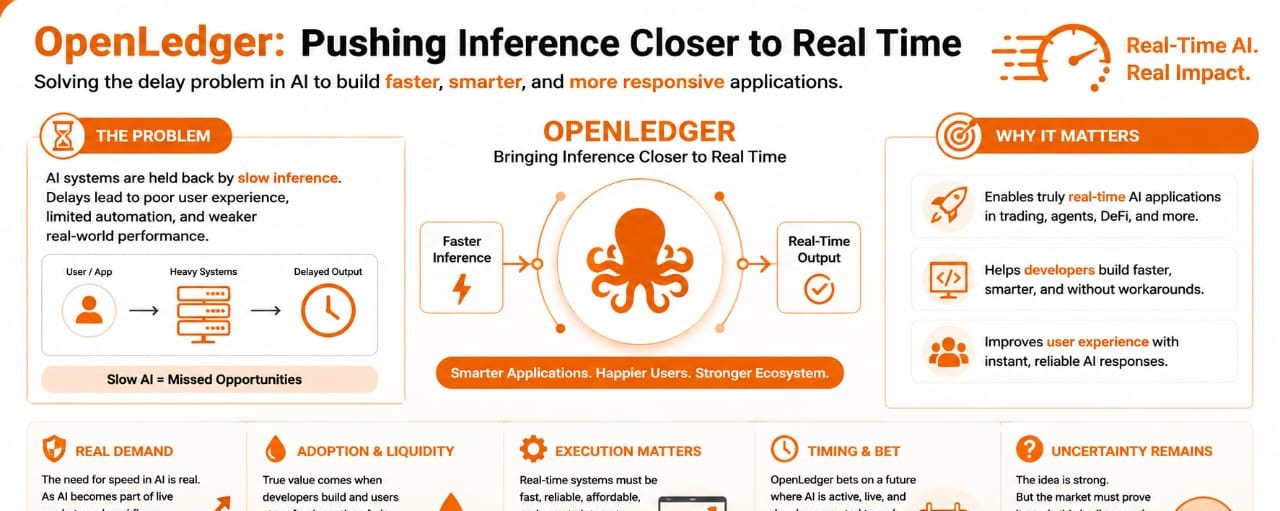
I’m watching OpenLedger a little differently from the way I watch most new crypto projects, because this one is touching a problem that feels simple but important.
Crypto people love big words, big narratives, and complicated explanations, but sometimes the real issue is very plain. If AI takes too long to respond, people stop trusting it in moments where speed matters. That is why OpenLedger pushing inference closer to real time caught my attention. Not because it sounds flashy, but because delay is one of those small problems that can quietly ruin the whole user experience.
I think this matters more when you stop looking at AI as just a chatbot. A slow answer is annoying in a normal conversation, but inside an agent, a trading tool, a data workflow, or an on-chain application, delay becomes a real weakness. If the system needs too much time before producing output, users feel it. Builders feel it too. They have to work around the lag, simplify the product, or accept that the experience will never feel truly live.
That is where OpenLedger becomes interesting to me. The project is not only trying to join the AI crypto trend. It is focusing on the part underneath the experience, where speed, response time, and usability actually decide whether something feels useful. Real-time inference is not the kind of thing that gets everyone excited immediately, but it can become important if AI systems start acting more often inside live markets and applications.
Honestly, I like that OpenLedger is dealing with something practical. A lot of AI crypto projects talk about intelligence in a very broad way. They talk about agents, ownership, data, models, and future economies. Some of that matters, but users usually judge technology in a much simpler way. Does it work? Is it fast? Can I depend on it? Does it make the product better? If OpenLedger can make AI output feel closer to the moment, then it is solving a problem people can actually notice.
Still, I’m not fully convinced yet. That is not a criticism. It is just how I look at crypto now. Every cycle has projects that sound early, important, and inevitable. Some of them really are. Others become good stories without becoming real dependencies. OpenLedger still has to prove that faster inference creates real demand, not just better marketing language. Developers have to use it because it helps them build better products. Users have to stay because the experience is stronger. Liquidity has to connect to real usage instead of only chasing another AI narrative.
Part of me thinks OpenLedger is aiming at the right layer. The best infrastructure is often not loud. It sits behind the product and makes everything feel smoother. People may not talk about inference speed every day, but they will notice when an AI tool feels slow, late, or disconnected from what is happening in real time. If OpenLedger reduces that gap, then its value becomes easier to understand.
Another part of me stays cautious because crypto has a habit of turning real technical ideas into oversized expectations. A project can be solving a real problem and still struggle with adoption. Timing matters. Execution matters. Distribution matters. If the market is not ready, even good infrastructure can sit unused. If centralized AI platforms solve the same issue well enough, OpenLedger will need to show why its approach is not only different, but necessary.
That is what makes OpenLedger interesting. It is making a bet that AI will not stay slow, passive, and separate from real economic activity. It is betting that AI will become more live, more responsive, and more connected to actions happening across apps, markets, and networks. If that future becomes real, then inference speed stops being a small technical detail and starts becoming part of the foundation.
The real test for OpenLedger will not be whether people talk about it during the AI cycle. The real test will be whether builders keep coming back after the excitement cools down. Are they using OpenLedger because it improves their product, or because incentives are available? Are users feeling a better experience, or just hearing a better story? Does the project become something applications depend on, or does it remain another name inside the AI crypto rotation?
I think OpenLedger has a cleaner argument than many projects in this space because the problem is easy to understand. Slow AI feels bad. Real-time AI feels more useful. The hard part is turning that simple truth into a working network with real adoption, real demand, and real value capture. That part cannot be solved by a narrative alone.
So I’m watching OpenLedger with interest, but not blind belief. The project is focused on something that could matter if AI keeps moving toward agents, live data, and on-chain activity. But the market still has to prove it needs this badly enough. Maybe OpenLedger becomes one of those quiet infrastructure layers people only appreciate once they depend on it. Maybe it becomes another smart idea that arrived before demand was ready. I think the question is still open, and that uncertainty is exactly what makes it worth watching.