

Most people look at AI data markets and think the opportunity is simple:
More datasets.
More supply.
More things for builders to buy.
But I think that's looking at the wrong layer.
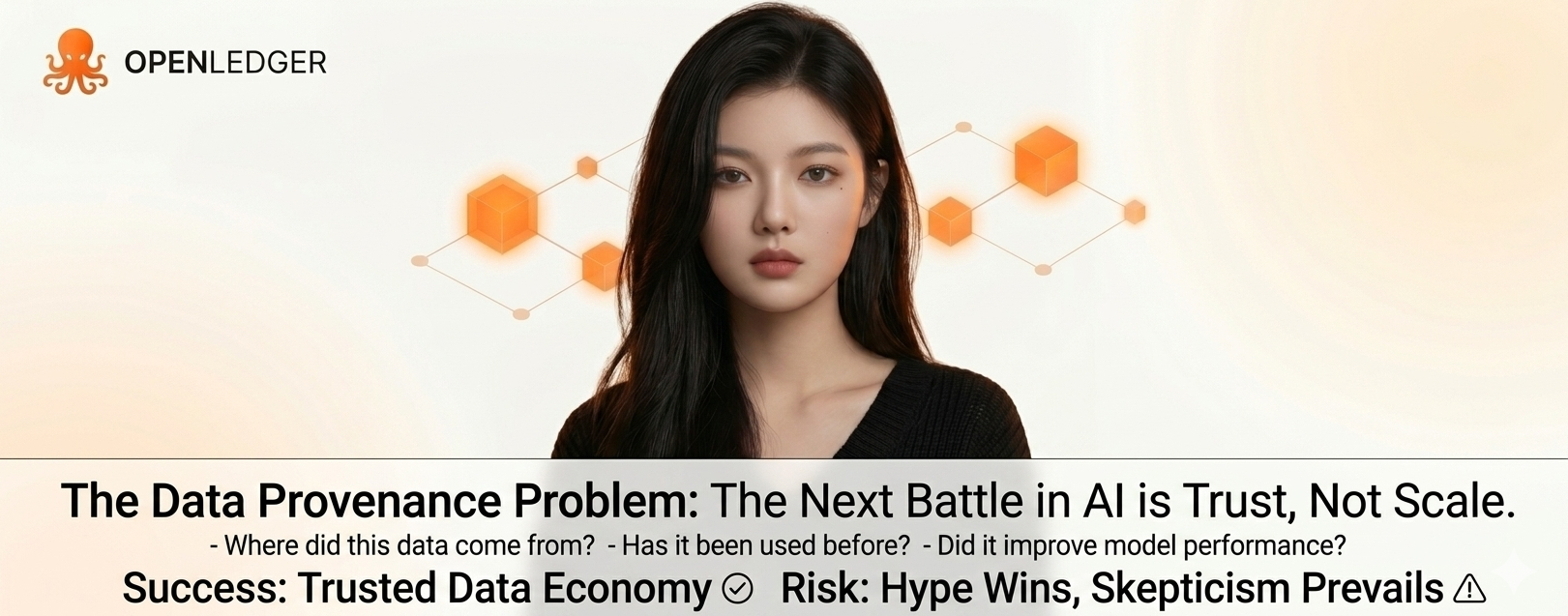
The next battle in AI probably won't be won by whoever has the biggest dataset.
It might be won by whoever can prove why their dataset deserves to be trusted.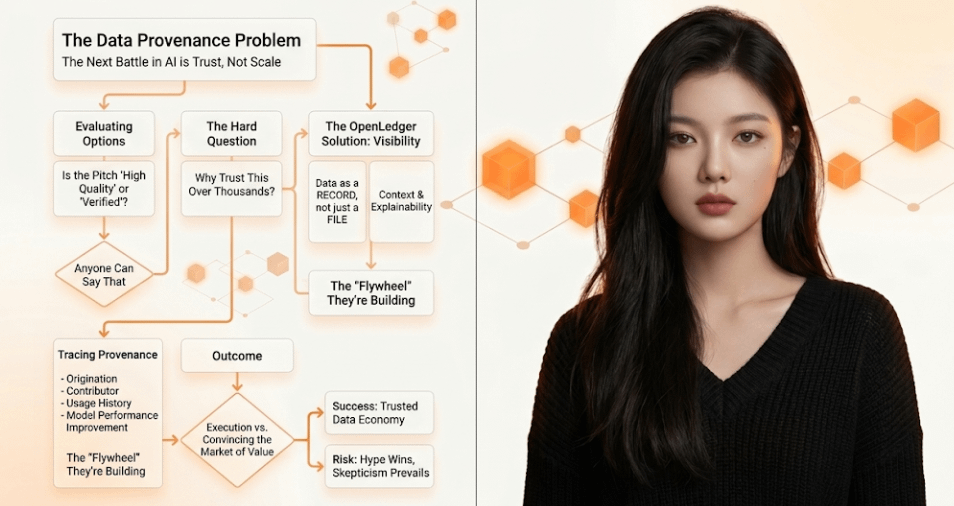
And that's where @OpenLedger starts to get interesting.
Not because it's another AI token.
Not because it has blockchain attached to the story.
But because it's trying to answer a question that keeps getting bigger as AI grows:
How do you know which data is actually worth using?
The Problem Nobody Talks About
Right now, almost every dataset comes with the same sales pitch.
High quality.
Verified.
Clean.
Premium.
Trusted.
The problem is that anyone can say those things.
If you're building an AI product you're not just buying data.
You're making a bet on that data.
A bad dataset can waste time, distort outputs, introduce bias or simply fail to improve the model.
So the real question isn't:
"Can I get data?"
It's:
Why should I trust this data instead of the thousands of other options available?
That's a much harder problem.
And honestly, it's probably the more important one.
Where OpenLedger Looks Different
What caught my attention is that OpenLedger doesn't seem to be focused only on making data available.
It appears to be focused on making data explainable.
That's a subtle difference, but a meaningful one.
A large dataset isn't automatically a valuable dataset.
Bigger doesn't always mean better.
Some datasets are outdated.
Some contain duplicates.
Some are noisy.
Some look impressive until you actually try to build with them.
What builders really need is context.
Questions like:
- Where did this data come from?
- Who contributed it?
- Has it been used before?
- Did it improve model performance?
- Has anyone validated it?
Those details matter.
Because trust rarely comes from the asset itself.
Trust usually comes from understanding the story behind the asset.
The Importance of Provenance
One word that keeps showing up in discussions around AI infrastructure is provenance.
Despite sounding technical, the idea is pretty simple.
It's the history of the data.
The trail behind it.
Where it originated.
Who touched it.
How it moved through the system.
Whether it created value.
That history may become far more important than people expect.
Because when two datasets look similar on the surface, provenance could be what separates them.
The future data economy may not reward the largest collection of information.
It may reward the most transparent one.
Why the Ledger Actually Matters
A lot of people hear "ledger" and immediately think about storing things on-chain.
I think the bigger idea is visibility.
Instead of seeing a dataset as a file, you start seeing it as a record.
A living history.
You can potentially see:
- Where it came from
- How it has been used
- Whether it produced results
- Who contributed to it
- Who deserves credit
At that point, the marketplace becomes something more than a place where data is bought and sold.
It starts looking like a reputation system.
And that changes the conversation completely.
Because AI builders don't just need more inputs.
They need better signals.
The Token Makes More Sense Through This Lens
A lot of AI projects struggle because the token feels disconnected from the actual product.
With OpenLedger, the connection becomes easier to understand.
At least in theory.
If useful contributions can be identified and tracked, then contributors can potentially be rewarded when their data creates value.
Builders gain access to data.
Validators help maintain quality.
Governance helps shape standards.
The entire system starts revolving around usefulness rather than noise.
Of course, none of that is guaranteed.
Execution still matters.
Adoption still matters.
But the incentive structure is easier to follow than many AI token models I've seen.
The Real Test Starts Now
The project isn't operating in theory anymore.
Now it has to perform in public.
And that's where things get difficult.
Because markets eventually stop caring about narratives.
They start caring about behavior.
People will ask:
Are builders actually using it?
Are contributors actually earning from it?
Are buyers making better decisions because of the system?
Is attribution becoming a real part of the workflow?
Or is it just another attractive concept?
Those questions matter far more than marketing.
The Flywheel They're Trying to Build
What makes OpenLedger interesting to me is that it doesn't appear to be targeting a single piece of the AI stack.
It seems to be aiming for a complete loop.
Data enters the network.
Its history becomes visible.
Quality gets validated.
Contributors receive attribution.
Better incentives attract better data.
Better data improves AI systems.
More usage generates more proof of value.
Then the cycle repeats.
If that loop works, the network becomes stronger over time.
If it doesn't, the entire model struggles.
It's a simple idea on paper.
Actually making it work is the hard part.
And That's Also the Biggest Risk
The entire thesis depends on one assumption:
That the market truly values explainability.
I'm not completely convinced we're there yet.
Developers say they want trusted data.
But when budgets shrink and deadlines get tighter, convenience often wins.
Users say they care about transparency.
But many only care after something breaks.
That's the challenge.
The demand for trust is obvious.
The willingness to pay for trust is less obvious.
And that's a gap every project in this category has to overcome.
OpenLedger also faces the usual pressures:
- Adoption risk
- Token economics risk
- Governance concentration risk
- Regulatory uncertainty
- Competition
- The possibility that hype grows faster than actual usage
None of those should be ignored.
Final Thought
The question isn't whether OpenLedger becomes another AI token.
There are already plenty of those.
The more interesting question is whether it can help turn data into something that's easier to evaluate, verify and trust.
Can it connect provenance, validation, attribution, governance and AI usage into one system that makes data quality more visible?
That's the real challenge.
Because if OpenLedger succeeds, it won't just be helping people trade data.
It will be helping people understand why certain data deserves trust in the first place.
And as AI becomes increasingly dependent on high quality information that may end up being one of the most valuable layers of all.
#OpenLedger $OPEN $STG $PORTAL


