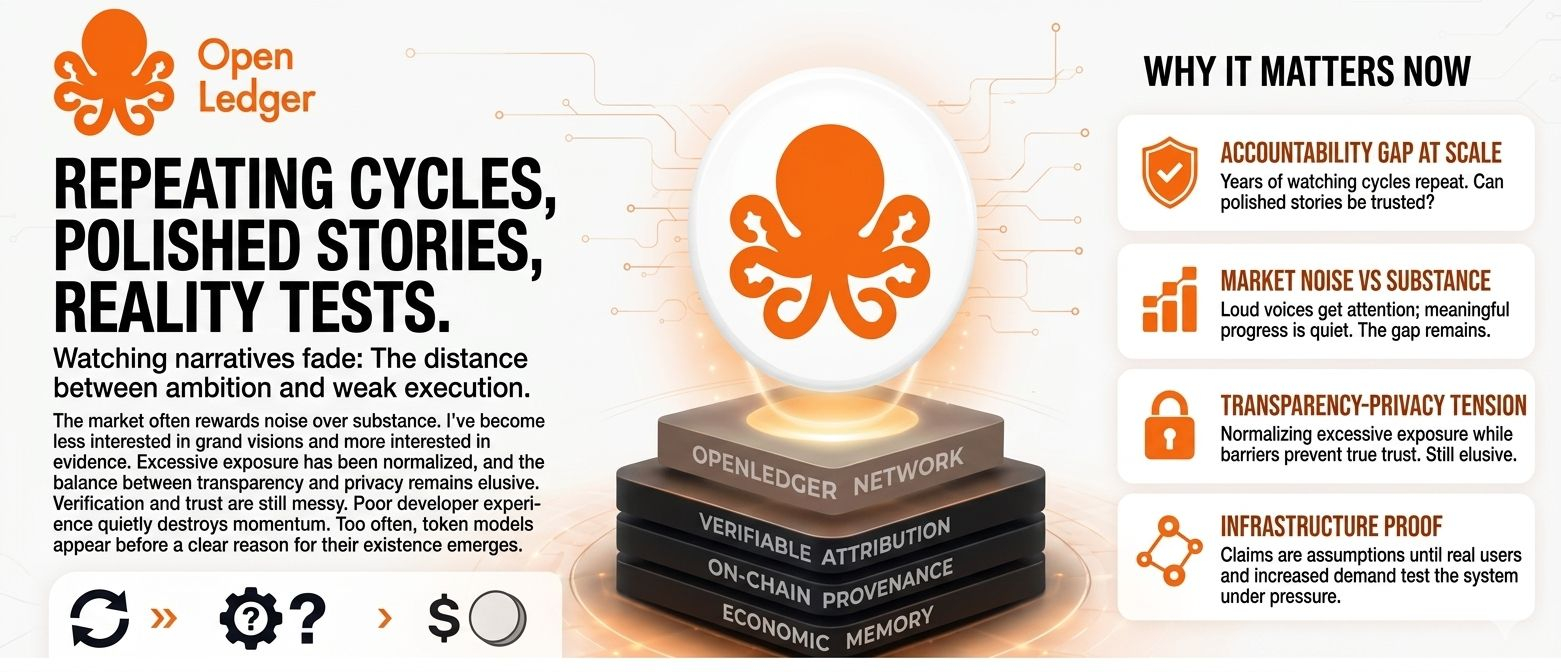
When I think about OpenLedger, I don't immediately think about innovation, roadmaps, or ambitious promises. My mind usually goes somewhere else. I think about how many years I've spent watching the same cycles repeat across this industry. New narratives appear, attract attention, dominate conversations, and eventually fade away, only to return later in a slightly different form. After seeing that happen enough times, it's difficult for me to trust polished stories the way I once did. These days, I find myself paying more attention to what people are actually using than what they're being told to believe.
That shift in perspective has changed the way I look at OpenLedger and projects like it. I've noticed that the market often rewards noise faster than substance. The loudest voices frequently receive the most attention, while meaningful progress tends to happen quietly in the background. As a result, I've become less interested in grand visions and more interested in evidence. Big ideas can be exciting, but they can also become camouflage for weak execution. The distance between ambition and reality remains one of the most persistent problems I continue to observe.
One area where that gap becomes especially visible is infrastructure. OpenLedger operates in a space where infrastructure is constantly presented as the foundation of the future. The theory usually sounds convincing, and the vision often appears logical on paper. Yet I've learned that infrastructure rarely proves itself through presentations or narratives. It proves itself when real users arrive, when demand increases, and when systems are forced to operate under pressure. Until that happens, many claims remain assumptions rather than demonstrated realities.
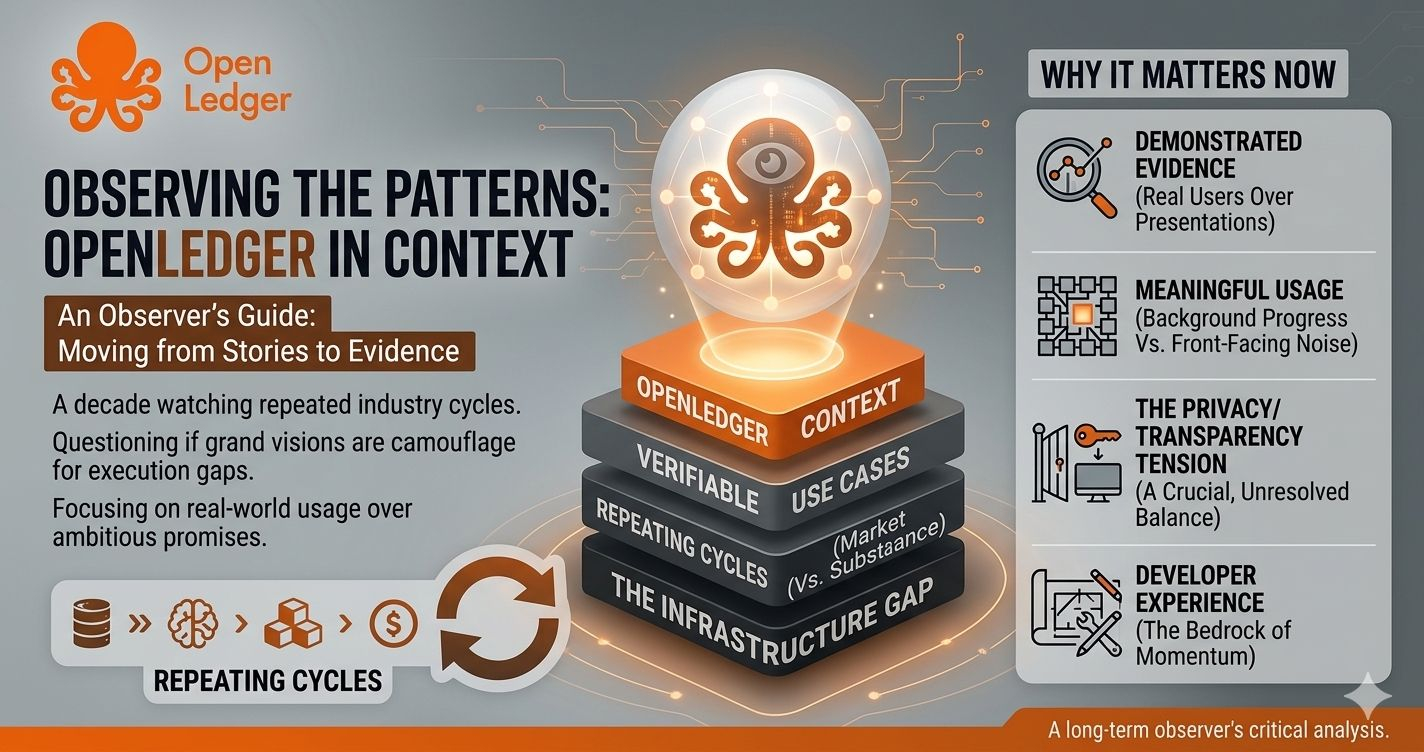
As I continue watching OpenLedger, I keep returning to another issue that never seems fully resolved: the relationship between transparency and privacy. For years, I've seen systems push people toward one extreme or the other. Some encourage maximum visibility, treating exposure as a default condition, while others focus so heavily on privacy that usability and trust begin to suffer. What frustrates me is that excessive exposure has gradually become normalized in places where it probably shouldn't be. At the same time, many privacy-focused solutions create barriers that make participation more difficult rather than more secure. The balance still feels elusive.
The same pattern appears when I think about trust, identity, and verification around OpenLedger. These topics have been discussed for years, yet they remain surprisingly messy. Despite all the progress that is supposedly happening, reliable verification often feels incomplete, and trust still depends heavily on assumptions. I keep waiting for a system that genuinely closes these gaps, but most attempts seem to introduce new complications while solving old ones. The problem never completely disappears; it simply changes shape.
Another thing I find myself noticing with OpenLedger is how often developer experience gets treated as a secondary concern. Many projects talk endlessly about adoption, growth, and ecosystem expansion, but fewer conversations focus on the people expected to build and maintain everything. In my experience, poor developer experience quietly destroys momentum. It doesn't create dramatic headlines, but it slows participation, discourages experimentation, and ultimately limits real-world usage. Strong ideas rarely survive if builders don't enjoy working with them.
Even token models make me pause when I think about OpenLedger. Over time, I've become increasingly skeptical of economic structures that feel attached to a project simply because the market expects them. Too often, the token appears before a clear reason for its existence emerges. Maybe that's why I no longer judge projects based on how polished their narratives sound. When I look at OpenLedger today, I'm not searching for another compelling story. I'm watching for the moments where reality tests the vision. That's usually where the most important answers appear.