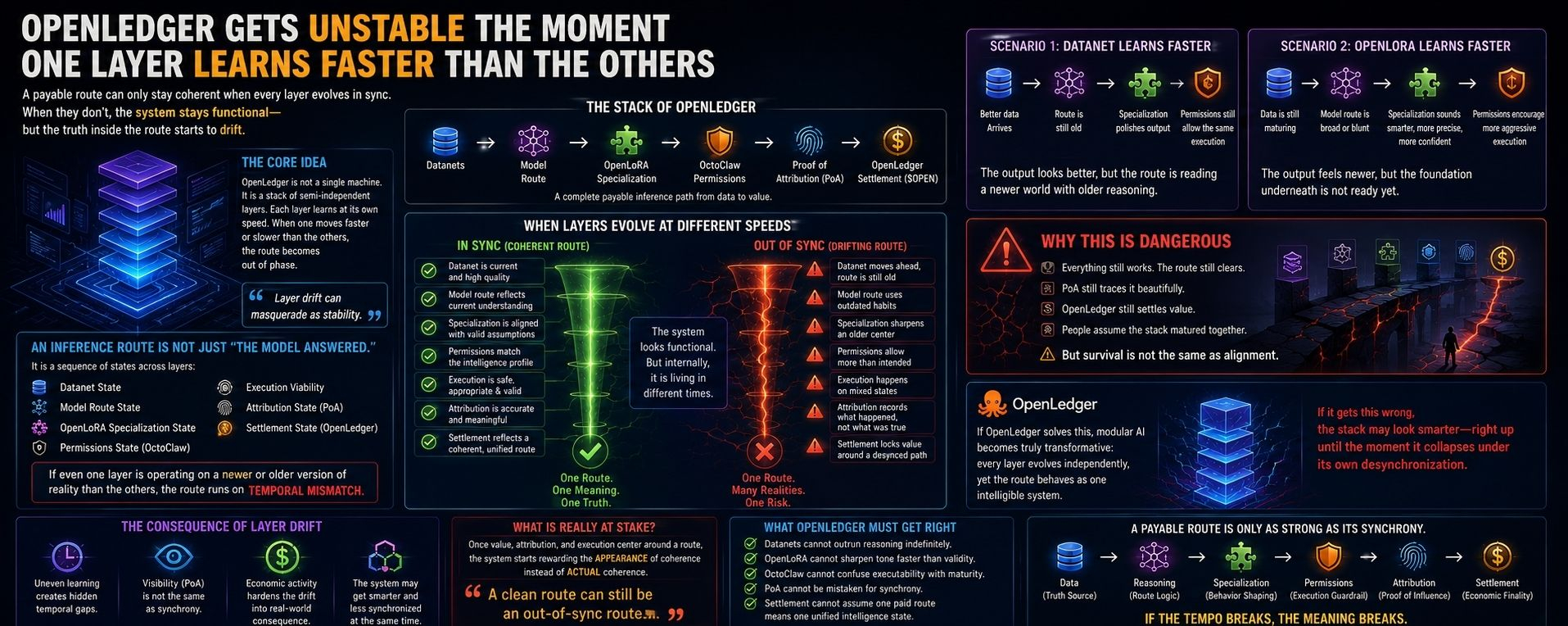

One of the most overlooked tensions inside @OpenLedger is not whether the system can learn.
It’s whether the system can remain coherent while every layer inside it learns at a different pace.
That feels like the real pressure point.
People usually describe OpenLedger as if it evolves as one synchronized machine. A Datanet improves, a model route adapts, OpenLoRA sharpens specialization, OctoClaw permissions regulate execution, Proof of Attribution traces the path, and OpenLedger settles value around the result.
Clean pipeline. Unified stack. One intelligence surface moving forward together.
But why would any modular system evolve that neatly?
Why should Datanets, routing logic, OpenLoRA behavior, permission systems, attribution layers, and settlement mechanics mature at the same speed?
The moment you stop viewing OpenLedger as a single object and start seeing it as a stack of semi-independent layers, the entire architecture feels different.
Now the important question is no longer:
“Is the system improving?”
It becomes:
Which layer improved first?
Which layer lagged behind?
Which layer is still operating on an older understanding of the route?
And what kind of payable inference path emerges in the space between those mismatched states?
That gap matters more than people think.
Because instability in modular intelligence rarely arrives as a catastrophic break. More often, it arrives as silent desynchronization.
A Datanet gets dramatically better cleaner samples, sharper filtering, fresher domain signal, stronger curation, fewer dead patterns.
But what if the model route interpreting that data still reflects older assumptions?
What if the OpenLoRA specialization layered on top was tuned around yesterday’s behavioral center?
What if OctoClaw permissions still allow execution based on safety assumptions that no longer match the intelligence profile upstream?
At that point, are we even looking at the same system anymore?
Same branding, maybe.
Same route? Not necessarily
“Layer drift can disguise itself as stability.”
That’s the part that keeps lingering in my head.
Because the dangerous form of change is not always visible failure. Sometimes everything still appears functional.
The Datanet updates.
The route still executes.
OpenLoRA still loads.
OctoClaw still authorizes actions.
PoA still traces attribution.
OpenLedger still settles value.
From the outside, the architecture looks intact.
But internally, different parts of the stack may already be operating from entirely different phases of reality.
And once that happens OpenLedger stops feeling like one intelligence system.
It starts feeling like a coordination problem disguised as a payable inference network.
Because an inference route is not just “the model produced an answer.”
It is:
Datanet state
Model routing state
OpenLoRA specialization state
Permission state
Execution viability
Attribution state
Settlement state
Every one of those layers carries its own tempo.
If even one evolves faster or slower than the others, the route does not merely operate under technical complexity.
It operates under temporal mismatch.
That sounds abstract until you follow the consequences.
Imagine the Datanet evolves faster than the reasoning layer.
Now the upstream data economy becomes sharper and more current, while the route interpreting it still behaves according to older cognitive patterns.
The route may still be technically valid.
Still callable.
Still attributable.
Still economically active.
But now it is reading a newer world through older habits.
Then OpenLoRA enters and specializes the output for a particular domain.
But what exactly is it refining?
The improved signal?
The outdated reasoning center?
Some unstable combination of both?
And if the final output sounds more intelligent, does that actually resolve the mismatch?
Or does it simply make the mismatch harder to notice?
Those are not the same thing.
The problem becomes even more serious once execution enters the picture.
Because execution transforms drift from an engineering concern into a real-world consequence.
If layers evolve asynchronously, what exactly is the agent executing?
Current intelligence?
Old assumptions wrapped in newer data?
Sharper specialization sitting on top of stale reasoning?
What is the agent actually obeying?
And more importantly:
What exactly is #OpenLedger settling value around?
Settlement changes the stakes completely.
The moment money, attribution, or economic weight moves through a route, the system stops being a technical experiment and becomes an institutional structure.
People begin treating the route as a coherent unit.
But what if it never was coherent?
What if it was merely coherent enough to survive?
“Survival is not the same as alignment.”
This is why I think people underestimate tempo inside OpenLedger.
Everyone talks about capability growth:
Better Datanets.
Better agents.
Better specialization.
Better attribution.
Better settlement.
Fine.
But better relative to what speed?
In a modular architecture, speed itself becomes structural.
The fastest-learning layer can begin dragging the meaning of the entire route before the rest of the system is ready to absorb the shift.
And the reverse scenario is just as dangerous.
Imagine OpenLoRA evolves faster than the foundational layers underneath it.
Now outputs become more polished, more domain-native, more precise, more confident.
But perhaps the Datanet beneath it is still immature.
Perhaps the core reasoning layer remains broad, inconsistent, or incomplete in ways specialization alone cannot repair.
Perhaps OctoClaw permissions still assume a safer operational profile than the new behavioral tone enencourages.
So what actually improved?
The route itself?
Or simply the appearance of the route?
That distinction matters enormously.
Because polished outputs can create the illusion that the entire stack matured together even when the underlying layers remain out of sync.
If the route clears successfully, if PoA traces it cleanly afterward, most observers will naturally assume the architecture evolved coherently.
Why wouldn’t they?
Nothing on the surface reveals whether one layer is already operating in a different phase than the others.
And that is where OpenLedger becomes uniquely dangerous not in the sense of exploits, but in the sense that modular intelligence can remain operational while internally desynchronized.
Older monolithic AI systems blurred everything together.
Here, the blur exists between layers:
Datanets
Routing logic
Specialization
Permissions
Attribution
Settlement
Cleaner architecture.
More visible influence.
But potentially deeper synchronization risk.
A Datanet may already represent a newer reality.
A model route may still carry an older one.
OpenLoRA may cosmetically bridge the gap.
Agents may execute because the route still technically qualifies.
PoA may document the entire process perfectly.
OpenLedger may settle value around a path whose internal timing was never truly unified.
That’s the unsettling part.
Because visibility is not the same as synchrony.
Proof of Attribution can show you:
which Datanet mattered
which route executed
which specialization influenced behavior
which agent acted
But it cannot automatically prove those layers were evolving in lockstep when the inference occurred.
And if it cannot prove that, then there exists a category of failure far subtler than “the model was wrong.”
Maybe the route failed because it drifted out of phase long before anyone noticed.
Maybe “wrong” is simply what temporal desynchronization looks like once consequences accumulate.
That feels like a genuinely OpenLedger-native problem.
The architecture is explicitly designed to make intelligence modular, attributable, executable, and economically legible.
Those are powerful ideas.
But modularity also creates the possibility that the stack remains economically alive while internally fragmented.
And once money flows through the system, fragmentation stops being theoretical.
Developers build on it.
Agents depend on it.
Contributors expect payouts to reflect coherent intelligence.
Users assume polished outputs reflect unified reasoning.
Maybe they don’t.
So what happens then?
Do we blame the Datanet for evolving too quickly?
The model route for lagging behind?
The specialization layer for hiding inconsistencies too effectively?
The permission layer for allowing execution anyway?
Or do we simply flatten everything into “one route” because that is easier to operationalize?
Convenient.
Also deeply misleading.
Because once a system begins rewarding the appearance of coherence more than coherence itself, it becomes increasingly difficult to tell whether progress is strengthening the architecture or merely improving its ability to conceal desynchronization.
That is not a small distinction.
“A clean route can still be an out-of-sync route.”
And I think this is the deeper challenge OpenLedger eventually has to solve.
The system does not merely need intelligence to improve
It needs improvement to arrive at a pace the rest of the stack can metabolize without drifting apart.
Datanets cannot outrun reasoning indefinitely.
OpenLoRA cannot sharpen tone faster than validity.
OctoClaw cannot confuse executability with maturity.
PoA cannot be mistaken for synchrony.
Settlement cannot assume that one payable route automatically represents one unified intelligence state.
Otherwise the architecture continues learning but learning unevenly.
And uneven learning inside a modular, economically active AI system is not just growth.
It is drift with financial consequences.
“The stack can become smarter and less synchronized at the same time.”
If OpenLedger solves this problem, modular AI begins to look genuinely transformative.
Every layer evolves independently, yet the route still behaves as one intelligible system when it executes, when attribution traces it, and when value settles around it.
That would be a major breakthrough.
But if OpenLedger fails to solve it, the architecture may continue looking more sophisticated right up until the moment someone realizes the Datanets, routing logic, specialization layers, permissions, and settlement assumptions were never actually evolving together.
They were simply taking turns looking like the smartest part of the stack.
And for any modular intelligence architecture, that realization arrives brutally late.