
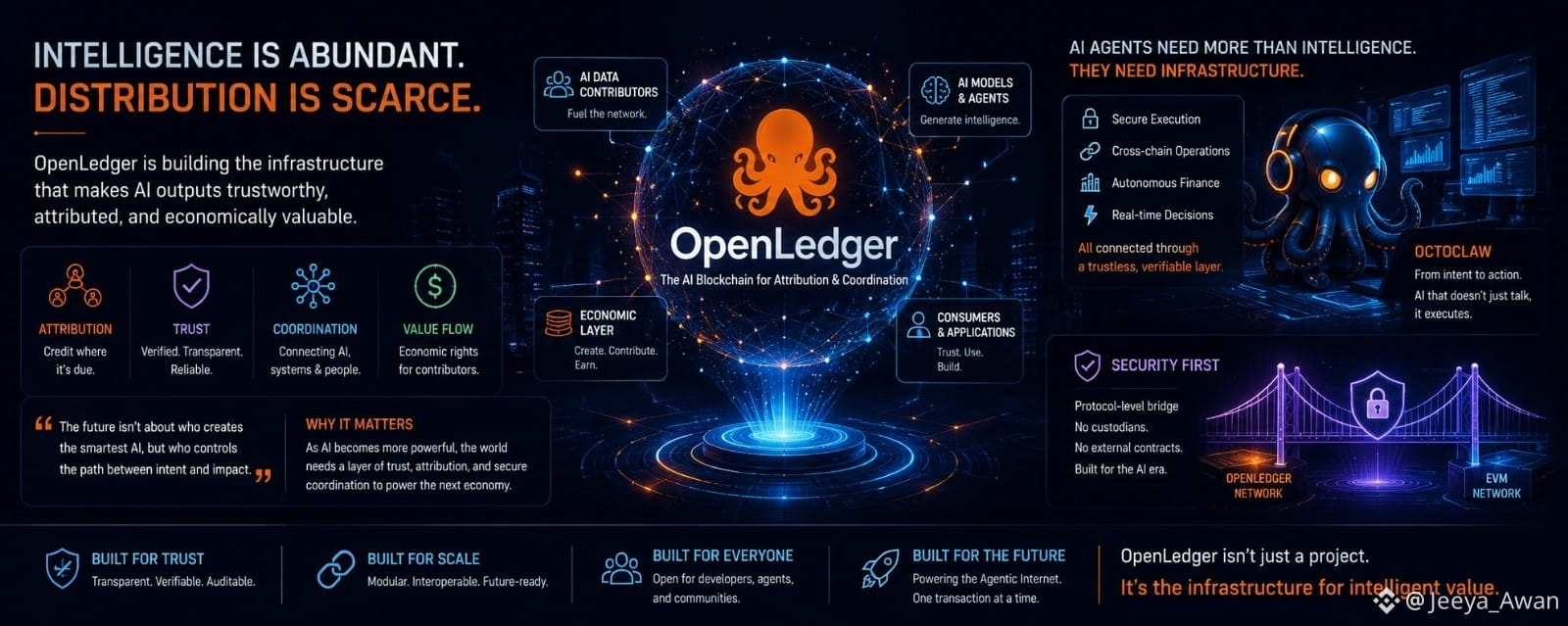
For a long time, I thought the future of AI would be decided by who could build the smartest model. Bigger datasets, stronger compute, and more advanced reasoning seemed like the obvious ingredients for success. But the more I explored #OpenLedger , the more I started questioning that assumption.
What if intelligence itself is no longer the scarce resource?
Every day, new AI models appear. Some are open-source, some are commercial, and many can already perform tasks that seemed impossible just a few years ago. As AI becomes more accessible, the challenge shifts from creating intelligence to managing it, verifying it, and making it useful in real-world systems.
This is where @OpenLedger feels different to me.
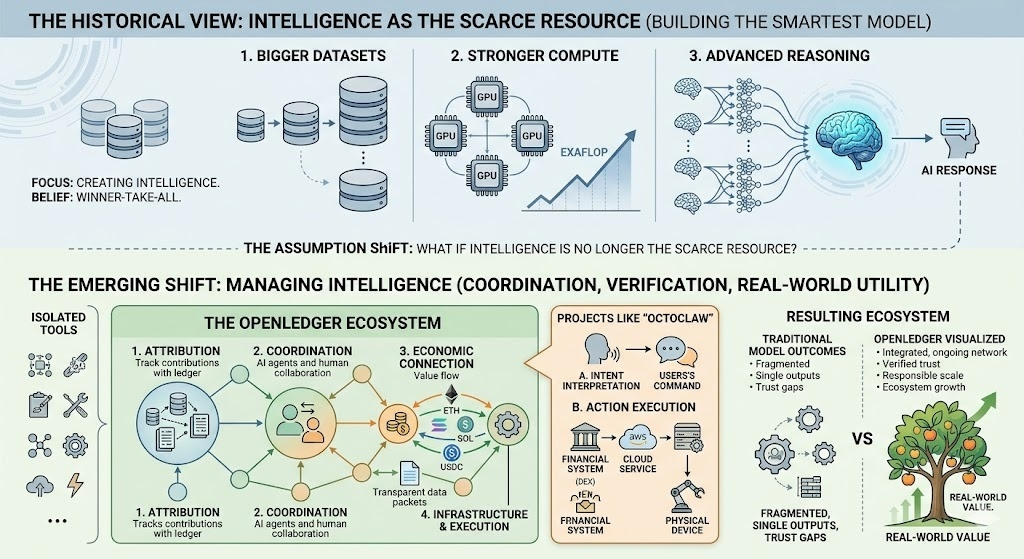
Rather than focusing only on generating AI outputs, OpenLedger appears to be building an ecosystem where intelligence can be attributed, coordinated, and economically connected. The project seems interested in what happens after an AI response is created. How can contributions be tracked? How can trust be established? How can value flow between participants in a transparent way?
The more I looked into it, the more it felt like OpenLedger was approaching AI as an ongoing network rather than a collection of isolated tools.
Another aspect that caught my attention is the broader infrastructure being developed around the ecosystem. As AI agents become capable of interacting with financial systems, executing actions, and operating across multiple environments, reliability and security become increasingly important. Intelligence without trustworthy coordination can quickly create risks instead of opportunities.
Projects like OctoClaw highlight this shift. Instead of limiting AI to conversations, the vision seems to involve systems that can interpret intent and translate it into action. That idea is exciting, but it also raises important questions about accountability, control, and trust.
What makes OpenLedger interesting is that it appears to recognize these challenges early. The focus is not simply on making AI more capable, but on building the underlying structures that allow intelligent systems to operate responsibly and at scale.
I don't see OpenLedger as just another AI project. To me, it looks more like an attempt to create the connective tissue between intelligence, economics, and execution. Whether that vision succeeds remains to be seen, but the direction itself feels important.
As AI continues evolving, the projects that matter most may not be the ones producing the loudest outputs. They may be the ones quietly building the infrastructure that allows intelligence to move, coordinate, and create value across entire ecosystems.
That possibility is what keeps OpenLedger on my radar.
