
While following the rise of AI Agents, I’ve come to realize that the real competition may not be about building smarter intelligence at all. The bigger challenge seems to be figuring out how humans coordinate and interact with that intelligence effectively.
That’s why I find the comparison between OpenLedger and Spectral far more interesting than the usual conversations around models, performance, or token economics. Both projects appear to be addressing AI infrastructure, but from very different angles.
Looking back at previous technology cycles, people often focus on the most visible layer. The internet was once viewed as a collection of websites, blockchain as a network of tokens, and AI today is often reduced to chatbots. Yet the most transformative changes usually happen beneath the surface, within the infrastructure that users rarely notice.
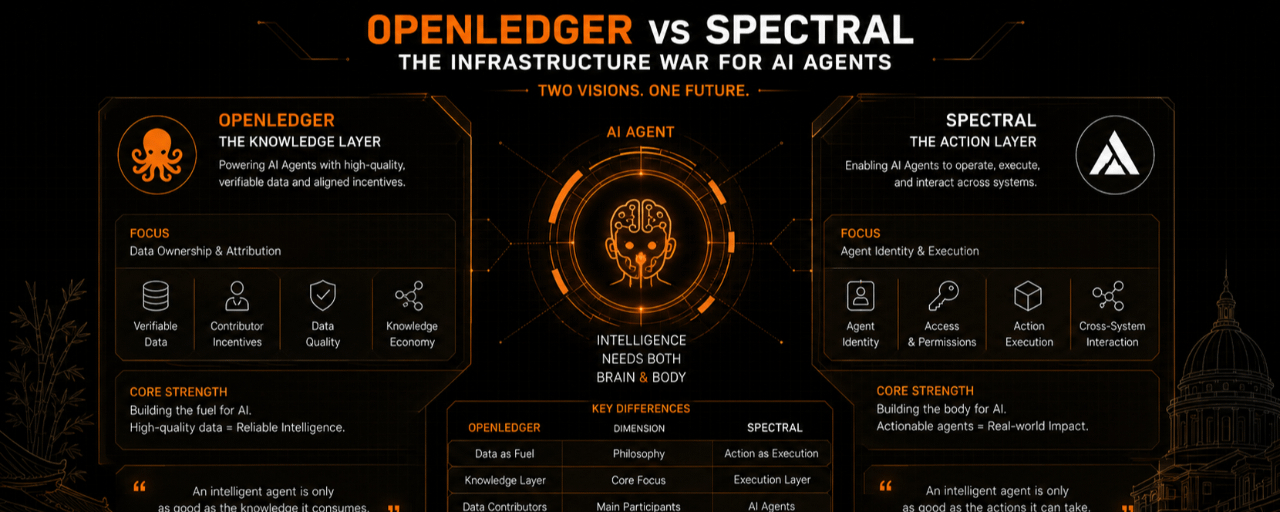
OpenLedger appears to begin with the idea that AI’s biggest limitation is not a shortage of models, but a shortage of high-quality, specialized data. From that perspective, the challenge for AI Agents is less about reasoning and more about the quality and origin of knowledge.
Even the most advanced agent can produce poor outcomes if it relies on noisy, unreliable, or poorly incentivized data. Intelligence alone cannot compensate for weak inputs.
What stands out about OpenLedger is its focus on creating economic incentives around data contribution and ownership. In many ways, it seems to be addressing the fuel layer of AI.
Spectral, on the other hand, appears to focus on a different problem entirely: execution.
As AI Agents evolve, they are expected to perform actions on behalf of users. To achieve that, they need identity, permissions, behavioral context, and the ability to interact across different systems and environments.
If OpenLedger views AI as a brain that requires knowledge, Spectral seems to view AI as a digital entity that requires the tools and autonomy to operate.
Although these approaches may appear similar on the surface, they reflect two fundamentally different visions of the future. One prioritizes cognitive quality, while the other prioritizes execution capability.
This highlights a familiar paradox in technology. We often assume that good decisions naturally lead to good outcomes, yet many systems fail because of the gap between knowing what should be done and actually doing it.
An AI Agent may understand the correct course of action but struggle to execute it. Conversely, an agent may possess extensive operational capabilities while lacking sufficient understanding to make the right decisions.
Perhaps this is the core tension emerging within the AI Agent landscape.
The race may not be about creating the smartest agent. Instead, it may be about building the infrastructure that makes intelligence genuinely useful in real-world environments.
What fascinates me is that both OpenLedger and Spectral are working on layers that most users rarely notice. Historically, those hidden layers are often where the most significant technological shifts begin.
Not at the interface.
Not in the features.
But deep within the foundational systems that quietly shape how people think, decide, and act.
Will the future favor platforms that solve data ownership and knowledge attribution, or those that empower agents to execute actions more effectively?
For now, the answer remains uncertain.
Because AI Agents may need more than just a brain.
They may also need a body.
And the market is still trying to determine which of those is the greater bottleneck.