The first time I came across OpenLedger, I reacted the same way I react to most projects trying to combine AI and blockchain. I assumed there would be a lot of ambitious language about autonomous systems, decentralized intelligence, and next-generation infrastructure, but very little explanation of how any of it would actually work in practice.
That skepticism has become almost automatic for me. Over the last few years, I've watched countless projects promise coordination between AI systems, data networks, and blockchain ecosystems. Most looked impressive on paper. Many struggled once real execution entered the picture.
That was why OpenLedger caught my attention slowly rather than immediately.
What interested me wasn't the branding around being "The AI Blockchain." It was the fact that the project appeared to focus on a problem that feels increasingly important as AI grows: most AI systems still operate in isolation. Models are trained in one place, data comes from somewhere else, agents execute through another service, and ownership often sits inside centralized platforms that users don't control.
The more I looked into OpenLedger, the more I realized the team wasn't simply talking about AI models. They seemed focused on building infrastructure where data contributors, model creators, and AI agents could participate within the same environment.
That distinction matters.
A lot of the friction in today's AI economy comes from fragmentation. Data providers struggle to prove the value of their contributions. Developers train models but often lose visibility into how those models are used. Users interact with AI systems while having little understanding of where outputs originate or how decisions are made.
The infrastructure underneath remains disconnected.
OpenLedger appears to approach this problem by bringing AI activity directly onto blockchain infrastructure. Instead of treating blockchain as a secondary settlement layer, the network is designed around AI participation itself.
That means model training can be connected directly to on chain systems. It means AI agents can operate within an environment where actions, ownership, and execution become visible and verifiable. It also means contributors potentially have clearer paths toward monetizing data and AI resources without relying entirely on centralized intermediaries.
What I found particularly interesting was how the project approaches coordination.
Coordination sounds like a boring word compared to all the excitement surrounding artificial intelligence, but coordination is often where systems fail. Most AI workflows involve multiple actors, multiple tools, and multiple sources of information. Every additional layer introduces complexity.
OpenLedger seems to recognize that challenge.
Rather than assuming external systems will solve coordination problems, the infrastructure attempts to embed coordination directly into the network itself. AI models, datasets, and agents can interact within a shared environment rather than constantly moving between disconnected services.
From a practical perspective, that could reduce a lot of operational friction.
Another detail that stood out to me was the emphasis on autonomous AI agent deployment. Many projects discuss agents as theoretical concepts, but OpenLedger appears focused on providing infrastructure where agents can actually operate, execute tasks, and interact with blockchain environments directly.
Again, that sounds technical until you think about the real world implications.
An AI agent that manages workflows, executes transactions, analyzes information, or coordinates activities becomes much more useful when its actions can be tracked and verified. Transparency isn't just a philosophical blockchain principle. It becomes an operational requirement when autonomous systems start making decisions on behalf of users or organizations.
The network's compatibility with Ethereum infrastructure also feels important.
One of the biggest mistakes infrastructure projects make is assuming users will abandon existing ecosystems. Most won't. Wallets, smart contracts, and Layer 2 environments already contain enormous amounts of activity and liquidity.
OpenLedger seems designed with that reality in mind. Integration with familiar blockchain tools reduces the burden on developers and users. Instead of rebuilding everything from scratch, the infrastructure can connect with systems people already use.
That practical approach is probably one reason the project held my attention longer than many AI related blockchain initiatives.
At the same time, I don't think infrastructure alone guarantees success.
Building the rails is one challenge. Getting people to use them consistently is another. Adoption remains difficult across both AI and Web3. Regulatory frameworks continue to evolve. Scalability pressures grow as systems become more complex. Coordinating real-world AI activity across decentralized networks introduces challenges that no infrastructure provider can fully eliminate.
Those realities shouldn't be ignored.
Still, I find projects like OpenLedger interesting because they focus on underlying mechanics rather than narratives. Instead of asking how impressive AI models can become, the project seems to ask how those models, datasets, and agents can actually work together in a transparent environment.
That's a more practical question.
As I continue watching the AI and blockchain sectors evolve, I increasingly pay attention to infrastructure that reduces friction. Real adoption rarely arrives through headlines. It usually arrives through systems that quietly make complex processes easier.
Whether OpenLedger ultimately succeeds will depend on execution, ecosystem participation, and long term usability. Those factors matter far more than branding.
But after spending time studying the project, my perspective shifted. I stopped viewing it as another AI story and started viewing it as an attempt to solve coordination problems that many existing systems still struggle with.
And honestly, that's where some of the most meaningful progress tends to happen.

Bài viết
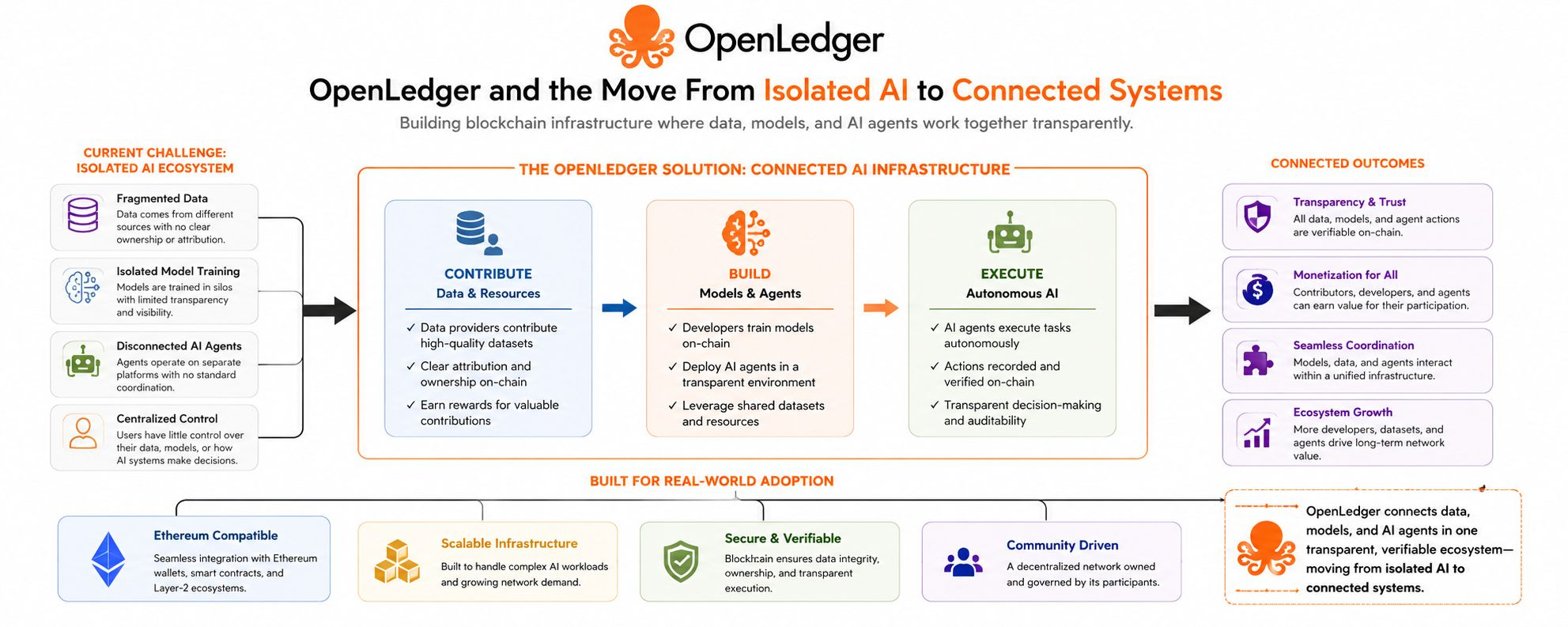
OpenLedger and the Move From Isolated AI to Connected Systems
--
Tuyên bố miễn trừ trách nhiệm: Bao gồm ý kiến của bên thứ ba. Không phải lời khuyên. Binance AI có thể được sử dụng mà không có đảm bảo. Xem Điều khoản & Điều kiện.